

Analysis
Sri Lanka’s Billion-Dollar Gamble for Energy Security Reshaping Global Energy Trade - By Jithendra Antonio
Apr 10, 202508:37 AM

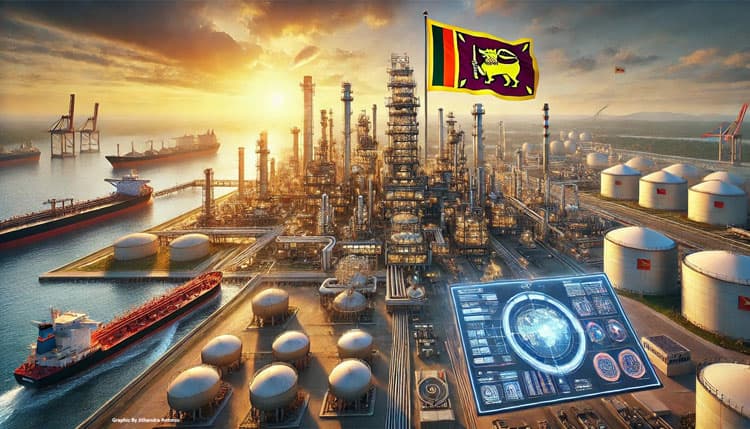
The Hambantota Sinopec Oil Refinery - A Strategic Bet on the Future In the evolving landscape of global energy trade, few moves are as audacious as Sri Lanka’s decision to greenlight a multi-billion-dollar oil refinery in Hambantota. More than an infrastructure project, this refinery signals Sri Lanka’s ambition to reposition itself at the centre of global oil supply chains, leveraging its strategic location along one of the busiest maritime routes. The almost US $ 4 billion investment by China’s Sinopec is not just a boost to Sri Lanka’s industrial ambitions—it is a calculated entry into the high-stakes geopolitical tug-of-war that is redefining global trade and energy security. For decades, Sri Lanka has been a mere consumer in the global energy matrix, vulnerable to oil price fluctuations and geopolitical disruptions. Now, with Hambantota’s refinery poised to handle 200,000 barrels per day, the island nation stands to emerge as a critical processing and transshipment hub. But as the world watches, the question remains: will Sri Lanka successfully harness this moment, or will it be swept up in the powerful currents of global energy politics? The Sinopec Powerhouse and the Economics of Scale Sinopec, the behemoth behind this deal, is more than just another oil company—it is a global force. Ranked fifth in Fortune’s Global 500 and operating the world’s largest refining network, Sinopec’s investment is not a casual foray but a deeply strategic move. By securing Hambantota’s refinery, China extends its logistical dominance across a key artery in global energy flows. This project also represents the largest single foreign direct investment in Sri Lanka’s history, dwarfing previous initiatives. The refinery will not only reduce Sri Lanka’s dependence on imported refined petroleum but also allow for significant foreign exchange savings and potential export revenues. As Sri Lanka grapples with its economic recovery, this infusion of capital and industrial infrastructure could provide much-needed stability. Hambantota - More Than Just Geography Hambantota’s significance extends far beyond its refinery. Sitting just 10 nautical miles from the main east-west maritime trade corridor, the port is strategically positioned to serve as a supply and logistics center for global shipping. This refinery will integrate seamlessly with the port’s infrastructure, opening new avenues for oil exports, bunkering services, and fuel storage. Historically, Sri Lanka’s lack of large-scale refining capacity has placed it at a disadvantage compared to regional players like India and Bangladesh. The aging Sapugaskanda refinery, with a mere 38,000 barrels per day capacity, has been unable to meet national demand. With this new facility, Sri Lanka will finally be able to process crude oil at scale, reducing its reliance on costly refined imports and positioning itself as an exporter to South Asia and beyond. The China-Saudi Energy Axis: A New Trade Paradigm While the economic implications of the Hambantota refinery are profound, the geopolitical stakes are even higher. The refinery’s success hinges not only on its operational capacity but also on its ability to integrate into a broader China-Saudi Arabia energy partnership. China, the world’s largest oil importer, has been strategically aligning itself with Saudi Arabia, the world’s top crude exporter. Bilateral trade between the two nations exceeded $87 billion in 2022, and discussions on pricing oil in Chinese Renminbi (RMB) rather than US dollars could upend decades of petrodollar dominance. If China and Saudi Arabia deepen their direct trade mechanisms, Hambantota could become a crucial intermediary, refining and transshipping Saudi crude to China under new, alternative financial arrangements. For Sri Lanka, this means more than just refining oil—it means becoming a linchpin in a shifting economic order where energy transactions bypass traditional Western financial systems. This could have far-reaching consequences for Sri Lanka’s own financial stability, currency positioning, and global partnerships. Economic Windfalls and Strategic Risks Sri Lanka’s decision to pursue this refinery is a bold one, but it comes with risks. While the economic benefits—job creation, infrastructure development, and foreign exchange earnings—are significant, the country must also navigate the political and environmental challenges that accompany such a mega-project.  (The writer is a Consultant specialised in Data Analytics with a Special Focus on Sri Lanka’s Future Direction, and in the fields of Sustainable Energy, ESG, Investments and telecommunications. He can be reached at jithendra.antonio@gmail.com.)
- Energy Security vs. Foreign Control: While the refinery will reduce reliance on imports, its ownership structure is crucial. If Sinopec controls a majority stake, Sri Lanka must ensure that domestic interests are safeguarded, potentially by securing a percentage of output at concessional rates. Sinopec’s Sri Lankan subsidiary’s Potential Public Listing in Sri Lanka’s Colombo Stock Exchange could be a move that could significantly boost Sri Lanka’s capital markets, which the government could invite Sinopec to list its Sri Lankan refinery subsidiary on the Colombo Stock Exchange (CSE). This strategy mirrors India’s successful model, where state-owned Indian Oil Corporation (IOC) listed its local subsidiary to attract broader investor participation and generate fresh capital inflows from Sri Lanka.
- Geopolitical Balancing Act: Sri Lanka must maintain diplomatic equilibrium between China, Saudi Arabia, and Western powers, ensuring it does not become overly dependent on any single nation for its energy security.
- Regulatory Frameworks and Local Industry Participation: The government must establish clear policies to encourage domestic participation in the refinery’s supply chain and operational management, preventing it from becoming a solely foreign-run enterprise.
- Sustainability Concerns: Large-scale refining carries environmental implications, from emissions to water use. Sri Lanka will need to balance industrial growth with sustainable development policies.
- Fast-Track Regulatory Approvals: Streamlining bureaucratic processes will ensure timely project completion and operational efficiency.
- Forge Long-Term Supply Agreements: Negotiating stable crude supply contracts with Saudi Arabia will provide operational security and financial predictability.
- Empower Domestic Industry: Encouraging local businesses to participate in the refinery’s ecosystem—construction, logistics, maintenance—will ensure broader economic gains.
- Invest in Workforce Development: Collaborating with Sinopec to establish technical training programs will cultivate a skilled workforce and reduce reliance on foreign expertise.
- Explore Alternative Trade Mechanisms: Engaging in discussions on RMB-based oil transactions could provide financial advantages and align Sri Lanka with emerging global trade trends.
(The writer is a Consultant specialised in Data Analytics with a Special Focus on Sri Lanka’s Future Direction, and in the fields of Sustainable Energy, ESG, Investments and telecommunications. He can be reached at jithendra.antonio@gmail.com.)