


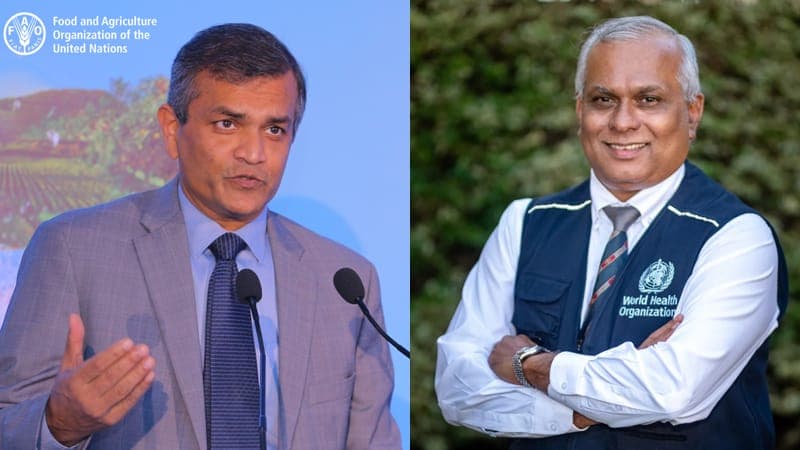
By Vimlendra Sharan, FAO Representative in Sri Lanka and the Maldives and Dr Rajesh Sambhajirao Pandav, WHO Representative to Sri Lanka.
An antibiotic that no longer works is more than a medical concern. It can mean a child’s infection becomes harder to treat, a farmer loses valuable livestock, or a food producer faces higher costs and reduced market opportunities. Antimicrobial resistance (AMR) is already affecting lives, livelihoods and economies. It demands action not only in hospitals, but also on farms, in food systems, in our communities and across the environment.
This is the message of World AMR Awareness Week, observed from 18 to 24 November 2026 under the theme “One Health, one action: Prevent AMR now”. It reminds us that every decision matters: how antimicrobials are prescribed and used, how infections are prevented, how animals are raised, and how medicines and waste are managed. Protecting the effectiveness of these essential medicines is a shared responsibility.
The AMR Challenge: Why Action Cannot Wait
The scale of the challenge is sobering. In 2021, bacterial AMR is associated with more than 4.7 million deaths annually worldwide and without urgent action, AMR could cause up to 39 million deaths by 2050, and cost the global economy more than US$3.4 trillion annually, disproportionately affecting low- and middle-income countries.
The consequences extend far beyond these numbers. AMR can prolong illness and hospital stays, increase the need for expensive second-line treatments and make routine medical procedures such as surgery, childbirth and cancer treatment considerably riskier. At the same time, resistance threatens animal health, agricultural productivity, food security and trade, with serious implications for smallholder farmers and communities whose livelihoods depend on healthy animals, sustainable fisheries and resilient food systems.
Resistance also does not stop at the boundaries of hospitals, farms or households. Resistant organisms and antimicrobial residues can move through wastewater and waste from healthcare, agriculture, animal production, aquaculture and communities. Stronger sanitation, waste management and environmental surveillance are therefore an important part of closing these pathways.
This is why preventing infections and using antimicrobials responsibly are ultimately investments in both health and development. And because resistance moves between people, animals, food and the environment, no single sector can address it alone.
Sri Lanka’s One Health Response
Sri Lanka has an important foundation on which to build. Its first National Strategic Plan for Combating AMR introduced in 2017 recognizes that effective action must connect human health, veterinary services, agriculture and the environment, and helped broaden the national response beyond viewing AMR primarily as a hospital prescribing issue. The current National Strategic Plan for 2023–2028 takes this further, recognizing that effective action must connect human health, animal health, agriculture, aquaculture, food production and the environment.
Surveillance is central to this response. Since establishing a national coordinating centre for AMR surveillance in 2018, Sri Lanka has strengthened laboratory-based data collection through WHO’s WHONET platform and participation in the Global Antimicrobial Resistance and Use Surveillance System, while FAO’s collaboration with national partners is helping advance surveillance across animal health, fisheries and food-production systems. Together with growing attention to environmental surveillance, these efforts support a more integrated understanding of resistance across sectors.
Alongside stronger surveillance, Sri Lanka is strengthening antimicrobial stewardship, including through WHO’s Access, Watch and Reserve classification, while advancing infection prevention, responsible use and action on environmental pathways.
Bringing complementary expertise to action
The Food and Agriculture Organization of the United Nations (FAO) works with national institutions, including the Department of Animal Production and Health (DAPH), and partners across the One Health sectors to translate these commitments into practical improvements. Our approach is straightforward: prevent infections wherever possible; strengthen the evidence needed to identify and understand resistance; and equip professionals and producers to use antimicrobials responsibly when they are genuinely needed.
Across livestock, aquaculture and food production, this work supports healthier production systems that reduce the need for antimicrobials while protecting animal health, food safety and livelihoods.
The World Health Organization (WHO) works with the Ministry of Health and One Health partners across the continuum of Sri Lanka’s response to AMR. Through the Fleming Fund, WHO has supported stronger laboratories and surveillance across human and animal health, fisheries, aquaculture and the environment, including capacity at the Medical Research Institute, Veterinary Research Institute, National Aquatic Resources Research and Development Agency and environmental-sector laboratories.
Support for antimicrobial stewardship complements these investments, linking the ability to detect and understand resistance with better antimicrobial use, clinical practice and public-health action.