
Top News
A Tourism Banking Super App that could earn twice for Sri Lanka?
Oct 14, 202610:13 AM

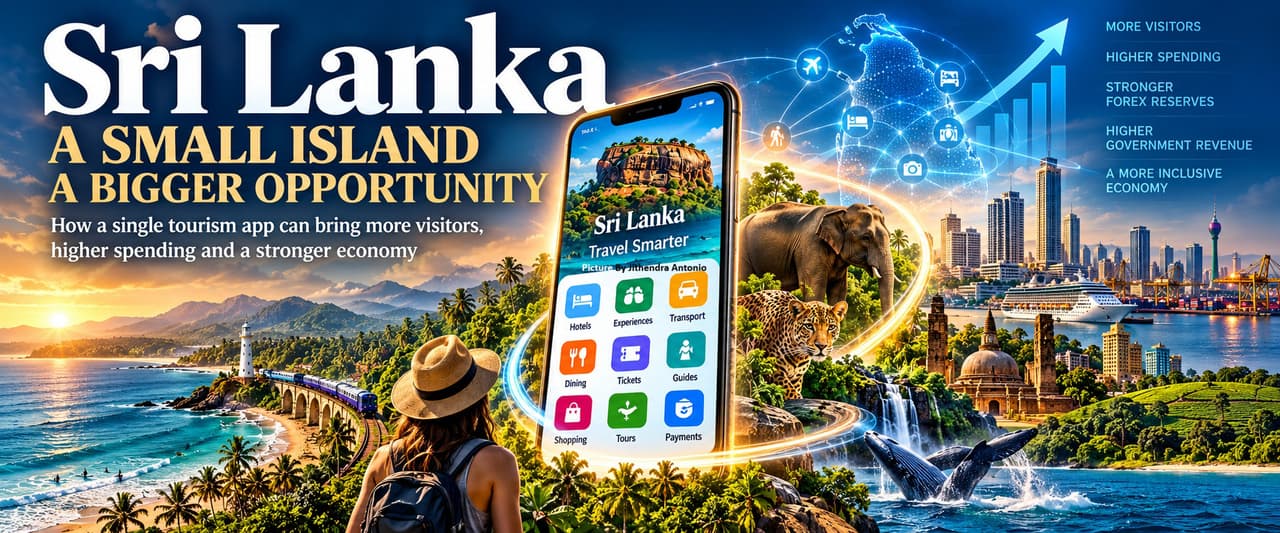
A US$300 Million Tourism Super App? How Sri Lanka Could Connect Foreign Exchange, Telecom, National Parks, Government Resorts and Every Major Tourist Experience into One National Revenue Engine
By Jithendra Antonio The next great opportunity in Sri Lankan tourism may not be another hotel, another airport terminal or another advertising campaign. It may be the creation of a government-backed digital platform that connects the tourist, the bank, the mobile network, the national park, the heritage site, the government bungalow, the restaurant and the local entrepreneur—turning a fragmented visitor economy into a connected commercial ecosystem. Sri Lanka has become remarkably good at counting tourists. It knows how many visitors arrive each month, which countries they come from, how arrivals rise during the winter travel season and how quickly the numbers can collapse when a terrorist attack, pandemic or economic crisis intervenes. The country has spent years rebuilding the tourism industry after the end of the civil war on 18 May 2009, recovering from the Easter Sunday attacks, surviving the pandemic and navigating the economic collapse that exposed the country's dependence on foreign exchange. The numbers tell a story of recovery. Sri Lanka received 447,890 tourists in 2009. By 2018, arrivals had climbed to 2,333,796. The pandemic reduced the annual figure to 194,495 in 2021. Recovery followed, and in 2025 the country recorded 2,362,521 arrivals, generating approximately US$3.2 billion in tourism revenue. But the next phase of tourism development demands a different question. What if Sri Lanka could earn revenue not only from the tourist's holiday, but from the financial, digital, transport, communications, accommodation and entertainment services surrounding that holiday? What if, immediately after landing, a visitor could access a Tourism Account, select a local mobile SIM or eSIM, obtain a reloadable debit card, book a safari, purchase a ticket to Sigiriya, reserve a government-owned bungalow, arrange an airport transfer, buy travel insurance, book a whale-watching excursion, pay a restaurant bill and discover lesser-known attractions—all through one trusted application? What if the same platform connected those tourists to thousands of Sri Lankan businesses while giving participating government institutions a modern commercial distribution channel? And what if the government could earn revenue from the financial infrastructure, the telecommunications distribution, the booking marketplace, the ticketing systems and the digital services—without having to own every hotel, operate every tour or employ every driver? This is the proposition behind a Sri Lanka Tourism Super App: a commercially integrated platform built around a Tourism Bank, a visitor-selected telecommunications connection, digital payments, public attractions, government leisure properties and a nationwide marketplace of private tourism businesses. The financial ceiling could be substantial. Under an aggressive but explicitly illustrative model aligned with a four-million-arrival tourism economy, a mature platform might generate approximately US$200 million to US$350 million in annual gross revenue across its connected businesses. That is a high-end scenario, not a forecast, an official government estimate or a guaranteed profit. Achieving it would require a large share of tourist spending to move through the platform, commercially viable banking margins, substantial merchant participation, effective telecom partnerships, reliable technology and competent management. But the scale of the opportunity deserves a more serious examination than another discussion about selling SIM cards at an airport. The prize is to build a connected commercial gateway into Sri Lanka's entire visitor economy.
 The real business begins when the aircraft lands Consider a tourist arriving at Bandaranaike International Airport. The visitor needs an internet connection. The visitor may need rupees, transport, a hotel, a route to the south coast, a ticket to a heritage site, a wildlife safari or a reservation at a restaurant. The visitor may need to understand how to pay, where to go, which services are trustworthy and how to obtain assistance when something goes wrong. At present, those needs can be scattered across airline websites, telecom counters, bank counters, international booking platforms, hotel applications, taxi services, attraction ticket offices, travel agents and individual operators. Every business sees a portion of the customer. No single platform necessarily captures the complete commercial relationship. That fragmentation creates an opportunity. A Tourism Super App would offer a single digital entry point. A visitor could download the application before departure or use a simple onboarding process at the airport. The tourist would choose a preferred telecom operator and package, open or activate an eligible Tourism Account, select a payment method and begin planning the journey. The application could then recommend services according to the visitor's interests. A family travelling with children might see wildlife experiences, family-friendly accommodation and transport options. A visitor interested in archaeology might be offered heritage tickets, museum visits and a multi-day Cultural Triangle itinerary. A traveller heading to Arugam Bay might see accommodation, surf schools, transport and nearby experiences. A visitor interested in wildlife could compare safari operators, select a park entry slot where available, reserve a jeep and pay through the same system. Each transaction would create a potential revenue opportunity. More importantly, the app would connect the tourist to local businesses that might otherwise be difficult to discover or book. The platform would not need to own every underlying service. It would need to make those services easier to find, trust, reserve and pay for. That distinction is central to the business model. The largest digital marketplaces are often valuable not because they own every asset being sold, but because they control the customer relationship, the distribution channel and the transaction infrastructure. Sri Lanka could apply that principle to tourism.
 The Tourism Bank: the financial engine beneath the app The first pillar would be a specialised Tourism Bank or a dedicated tourism-banking operation established through a legally and commercially appropriate structure. At the airport, a visitor could be offered a Tourism Account with a proposed minimum opening balance of US$100. The account could be linked to a physical debit card, a virtual card and the super app. Visitors could add funds through approved international transfers, eligible cards or other authorised funding methods. The account would allow the visitor to make payments at participating Sri Lankan merchants, subject to the relevant payment-network and foreign-exchange arrangements. The bank could earn revenue from several distinct activities. Foreign-exchange services. A visitor who converts foreign currency into rupees may generate an exchange margin for the bank. That margin would depend on the actual conversion, funding route, competition, wholesale costs and applicable regulations. Payment services. The bank could earn eligible income from card issuance, payment processing, merchant acquiring or network-related arrangements. The exact economics would depend on contracts and the division of revenue among the bank, payment network and other providers. Account services. Optional premium features, replacement cards, selected account services and other transparently priced products could contribute revenue. A basic account should remain simple and affordable if widespread adoption is the objective. Merchant banking. Participating hotels, restaurants, tour operators and retailers could use the bank for settlements, working capital, business accounts and other financial services. Business lending. Subject to prudent underwriting, the bank could lend to tourism enterprises that demonstrate credible cash flow, including guesthouses, transport operators, restaurants, craft producers and local suppliers. The objective would be to create a banking business that benefits from the commercial activity generated by tourism, rather than relying exclusively on fees charged to arriving visitors. The distinction is important. If the product is built around excessive fees or an unattractive exchange rate, tourists will seek alternatives. If it provides reliable payments, transparent conversion, broad acceptance and useful services, the account becomes part of the travel experience rather than an obstacle to it.
 The foreign-exchange question The bank's role in national foreign-exchange management must also be described accurately. Customer deposits are liabilities owed to customers. They cannot simply be treated as government revenue. A bank's foreign-currency holdings do not automatically become the Central Bank's official reserves. Any transfer of foreign currency to the Central Bank or another authorised counterparty must occur under applicable rules and through legitimate transactions. The bank could still help formalise tourist payments, provide more reliable information about spending and potentially increase the share of visitor funds entering the domestic financial system through authorised channels. The economic benefit would depend on the additional foreign exchange captured compared with what would have entered the formal system anyway. That is a measurable commercial question—and one that should be answered through a properly designed pilot rather than inflated claims.
 The telecom line: turning the tourist's first internet connection into a business relationship The second pillar would be a telecom distribution platform integrated into the app. A tourist arriving in Sri Lanka typically wants mobile connectivity quickly. The super app could allow the visitor to choose from participating licensed mobile operators, compare prepaid packages and activate a physical SIM or eSIM where supported. The tourist might choose a short-stay package for a three-day visit, a larger data bundle for a two-week holiday or a package suited to remote work and longer stays. The choice would remain with the customer. The super app would not need to become a telecommunications operator itself. It could act as a distribution, activation and customer-service channel under commercial agreements with licensed operators. The platform could earn a commission for each activated line or package, a revenue share on eligible top-ups, and potentially a fee for other services agreed with the telecom partner. The telecom operator would retain its own share of the revenue and remain responsible for the regulated telecommunications service. The super app would earn distribution income for bringing in the customer and simplifying activation. At the high end, the opportunity becomes interesting because the service is not limited to the first SIM sale. A visitor who buys a seven-day package might purchase another data bundle, extend the stay or return to Sri Lanka months later. The app could provide top-ups, roaming information, travel alerts and destination services. A repeat visitor might keep the app installed and use it for future trips. The platform could also offer local businesses a digital communications channel, subject to user consent and privacy protections. The essential point is that the telecom connection gives the app a practical reason to be installed and used from the beginning of the journey. Once a visitor is connected, the application can offer accommodation, attractions, transport, ticketing and payments. The mobile line is not the whole business. It is a customer-acquisition channel into the wider ecosystem. What could telecom distribution earn? Consider an illustrative scenario in which 70 per cent of four million annual visitors purchase a participating SIM or eSIM package through the platform. That would represent 2.8 million package sales. If the average package sale were US$20, the total value of packages sold would be US$56 million. But that US$56 million would be telecom sales volume, not the super app's revenue. Most of the revenue would belong to the telecom operator. If the platform received an illustrative 10–20 per cent distribution commission, its revenue would be approximately US$5.6 million to US$11.2 million. Actual results would depend on package prices, the share of visitors who buy through the app, negotiated commission rates, taxes, wholesale costs and customer usage. The platform should not assume that every tourist will purchase a new SIM. Some will roam on their home networks, use an existing eSIM, rely on Wi-Fi or already have a suitable local connection. The commercial opportunity lies in offering a convenient choice, not in pretending every visitor is a guaranteed sale. Sri Lanka already has a regulated telecommunications market, and the Telecommunications Regulatory Commission publishes sector statistics. The proposed model should therefore be developed with licensed operators and within the existing regulatory framework, rather than as an attempt to bypass it. The public attraction network: national parks become bookable digital products The third pillar could connect national parks and other public attractions to the platform. Sri Lanka has 28 national parks, according to the Department of Wildlife Conservation. The country's wildlife offering ranges from iconic parks such as Yala and Wilpattu to Udawalawe, Horton Plains and other protected areas with different landscapes, ecosystems and visitor experiences. These places are not merely scenic backdrops. They are destinations with ticketing, transport, guide services, vehicle requirements, visitor management, conservation obligations and opportunities for local businesses. The super app could offer a single discovery and booking interface for eligible experiences, including:
- National park entry and authorised permits.
- Safari vehicle bookings with licensed or approved operators.
- Whale-watching and marine experiences where legally authorised.
- Guided nature walks and interpretation services.
- Museum and heritage tickets.
- Approved boat services and other designated visitor experiences.
- Transport links between accommodation and attractions.
- Nearby food, accommodation and local experiences.
- Hotels, guesthouses, villas and registered homestays.
- Licensed tour operators and local guides.
- Airport transfers, private drivers and authorised transport providers.
- Restaurants, cafés and culinary experiences.
- Surf schools, diving operators and other activity providers.
- Wellness services and approved spa operators.
- Local craft producers and cultural experiences.
- Boat trips, excursions and other legally authorised activities.
- Share of arrivals that activate the app.
- Share of activated users who fund a Tourism Account.
- Average amount loaded and average amount spent.
- Share of eligible visitor spending processed through the platform.
- Number of active merchants and their repeat booking rates.
- Average booking value and effective commission rate.
- Telecom activation rate and top-up frequency.
- Public-attraction bookings processed digitally.
- Repeat use by returning visitors.
- Customer acquisition cost compared with revenue per active user.
- Refund, fraud and complaint rates.
- Net contribution after payment-network and operating costs.
- Banking and eligible foreign-exchange services.
- Payment and merchant services.
- Telecom distribution and top-up commissions.
- Accommodation and activity-booking commissions.
- Public-attraction ticketing service fees.
- Government-property booking services.
- Travel insurance and other partner referrals.
- Business software and merchant services.
- Commercial partnerships and carefully governed advertising.
 (The writer is a Consultant specialised in Data Analytics with a Special Focus on Sri Lanka’s Future Direction, and in the fields of Sustainable Energy, ESG, Investments and telecommunications. He can be reached at jithendra.antonio@gmail.com.)