

Top News
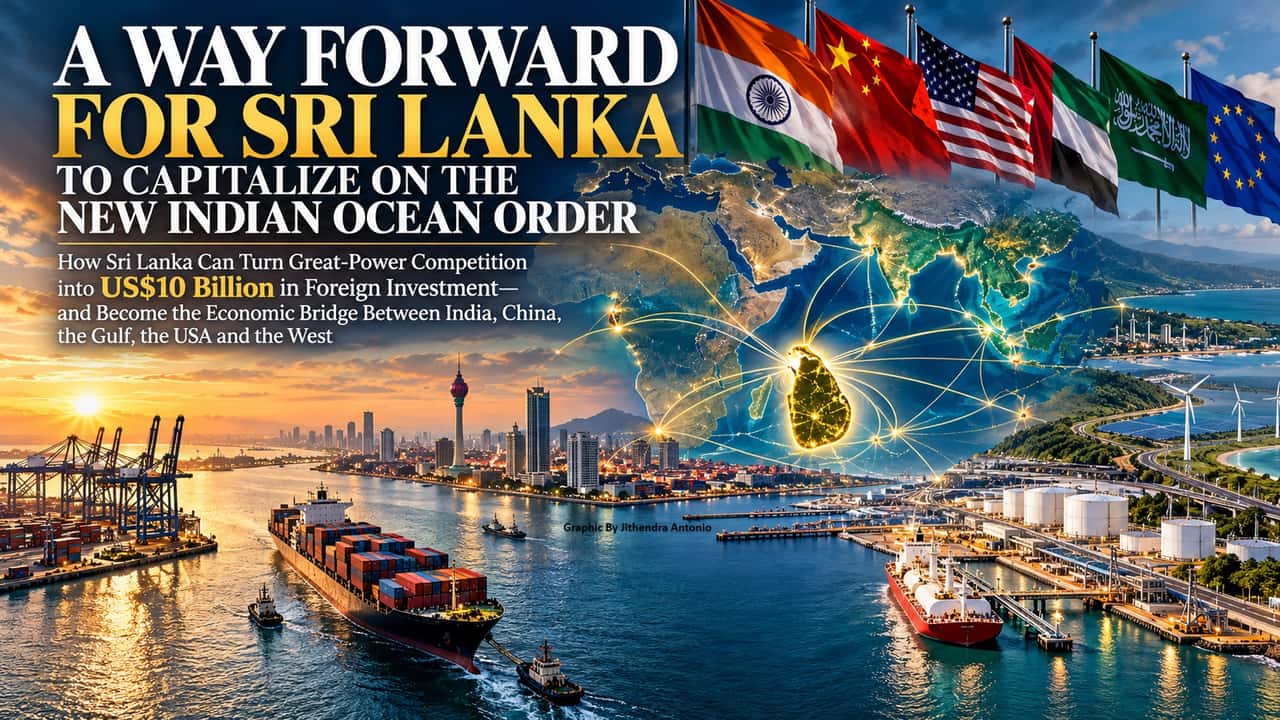
A Way Forward for Sri Lanka to Capitalize on The New Indian Ocean Order

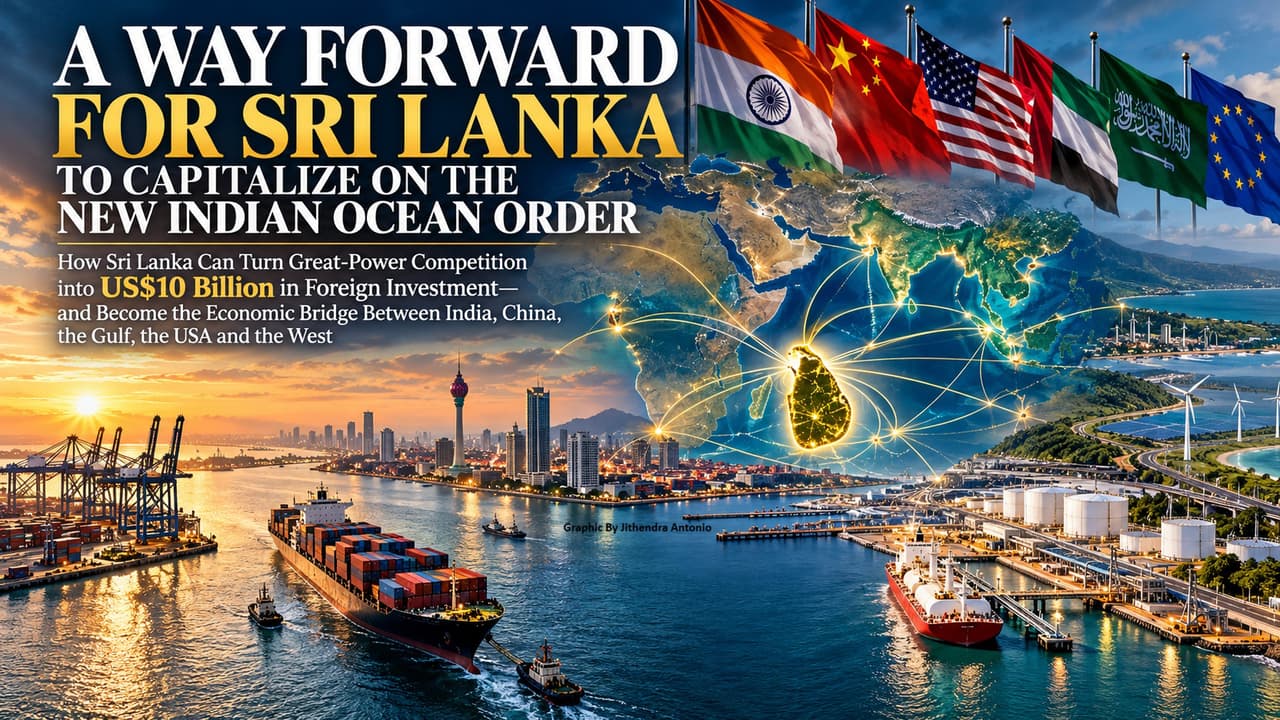
How Sri Lanka Can Turn Great-Power Competition into US$10 Billion in Foreign Investment—and Become the Economic Bridge Between India, China, the Gulf, the USA and West
By Jithendra Antonio From Trincomalee’s energy reserves to Colombo’s maritime gateway, from Hambantota’s industrial potential to Mannar’s renewable-energy frontier, Sri Lanka has an opportunity to transform its geography into economic power. The challenge is to attract capital from competing powers without surrendering the freedom to decide its own future. The warning from an Indian Ocean strategist In June 2026, Indian Ocean security entered a fresh round of scrutiny when Keerthi Martyn published “Navigating the Currents: Sri Lanka’s National Security Debate in the New Indian Ocean Order” through the Observer Research Foundation, subsequently republished by the Center for a New American Security. (Link -https://www.orfonline.org/public/uploads/upload/20260623112717.pdf ) Martyn’s assessment raises an uncomfortable question for Colombo - Can Sri Lanka preserve its freedom of action when its location, infrastructure and economic vulnerabilities make it increasingly important to larger powers? The chapter opens with a striking geographical observation. Sri Lanka lies at the crossroads of the Indian Ocean, approximately 10 nautical miles from major sea lanes carrying a substantial share of global energy and container traffic. Martyn argues that this location makes the island both a significant maritime actor and a focus of strategic competition. He identifies intensifying US–China rivalry, China’s infrastructure investments, American maritime-security partnerships and India’s growing influence over Sri Lanka’s security and defence decisions as central pressures shaping the island’s choices. The opening passage also cites a previous article I wrote on January 27, 2025, widely published article, “Sri Lanka’s Maritime Revolution: Must-Do Strategy to Unlock Global Trade Power from Heart of Indian Ocean,” as a reference supporting the strategic significance of Sri Lanka’s location. The citation places the island’s maritime potential within a wider debate about national security and international competition. Martyn’s argument extends beyond geography. His assessment highlights the risks posed by domestic governance weaknesses, limited maritime capabilities, inadequate preparedness for supply-chain disruptions and the difficulty of maintaining strategic flexibility when external powers pursue competing interests. His discussion of the 2026 Iran crisis illustrates how quickly diplomatic choices, maritime incidents and energy vulnerabilities can become interconnected. The Indian Ocean, meanwhile, is not a contest involving only three capitals. It connects India, China, the United States, the Gulf states, Israel and the wider Middle East with Singapore, Japan, South Korea, Australia, Indonesia, Malaysia, Thailand, Bangladesh, Pakistan, the Maldives, East Africa and Europe. Each has different commercial, diplomatic or security interests in the region. The result is a complicated environment in which ports, energy terminals, telecommunications, shipping routes, data infrastructure and investment agreements can acquire significance far beyond their immediate commercial purpose. But there is another way to read the emerging order. What if Sri Lanka stopped treating great-power competition principally as a threat to be managed and began treating it as an economic opportunity to be structured? What if Colombo could attract Indian manufacturing, Chinese industrial investment, American technology, Gulf capital and Israeli innovation under a transparent national framework—while retaining control over its own laws, infrastructure and strategic decisions? That is the economic proposition at the heart of this article. The New Indian Ocean Order does not guarantee Sri Lanka a fortune. It creates an opportunity for the island to earn one. The Ambition - US$10 billion in additional FDI over 20 years Sri Lanka should adopt a national target of attracting US$10 billion in additional realised foreign direct investment between 2027 and 2046, separate from investment already counted under Colombo Port City. The target is a proposed policy ambition, not an existing government commitment or a forecast of guaranteed investment. The arithmetic is straightforward - US$10 billion over 20 years represents an average of US$500 million annually. The harder task is to attract that money consistently, direct it towards productive sectors and ensure that it generates exports, employment, technology transfer and tax revenue. Sri Lanka has demonstrated that investment on a billion-dollar annual scale is possible, although official figures vary according to whether loans, reinvested earnings and other forms of capital are included. The Central Bank of Sri Lanka and the Board of Investment should therefore establish a common public reporting framework that distinguishes equity capital, intercompany borrowing, reinvested earnings, acquisitions and greenfield investment. The national target should count money actually deployed, not merely memoranda signed or projects announced. It should also measure the results: new export revenue, skilled employment, local supplier participation, wages, technology transfer and the amount of foreign exchange retained in the economy. Sri Lanka needs neither a slogan nor another collection of investment announcements. It needs a pipeline of bankable projects supported by credible institutions.- India - Convert Geographic Proximity into an Economic Partnership
- China - Welcome Industrial Capital, But Make Every Project Earn its Place
- The United States - Turn Maritime Security into a Wider Commercial Relationship
- The seven Gulf states - Connect Capital with Energy, Logistics and Global Markets
- Israel - Technology Partnerships in Water, Agriculture and Resilience
- The wider Indian Ocean - Singapore, Japan, South Korea and the ASEAN Economies
- The Project Pipeline - Where the US$10 Bn could go
 The categories should be refined through feasibility studies and investor discussions. A project spanning several sectors must be counted only once. Trincomalee - An Energy and Logistics Hub Develop storage, marine fuels, liquid-bulk handling, pipelines and associated logistics where commercial studies support the investment. Hambantota - A Port-Linked Industrial Economy Attract export manufacturers and industrial service companies that can use the port efficiently, subject to infrastructure readiness and proven demand. Colombo - Higher-Value Maritime and Financial Services Expand ship services, cargo finance, insurance, logistics technology and professional services that earn foreign exchange. Mannar and Suitable Coastal Locations - Renewable Energy Progress resource assessments, grid planning and competitive procurement before committing to large-scale offshore or export-oriented energy projects. National Digital Infrastructure Modernise customs, cargo documentation, trade finance and port scheduling to lower the cost of doing business across the country. Agricultural and Food-Processing Regions Attract investment in cold storage, processing, packaging, quality control and export distribution to raise the value of agricultural output. The purpose of this pipeline is to give investors specific opportunities to evaluate.
- Colombo Port City - A Major Project, not a substitute for National Development
- The reforms that will determine whether the capital arrives
- Genuine Investment Single Window - Publish approval requirements and timelines, coordinate agencies and make it possible for investors to track applications without navigating multiple disconnected institutions.
- Contract Stability and Transparent Procurement - Investors need confidence that agreements will be enforced and public-interest safeguards will remain credible. Contracts and concessions involving public assets should be subject to appropriate disclosure and oversight.
- Bankable Project Preparation - Every priority project should have a feasibility study, environmental assessment, financing structure, land and utility plan, revenue model and identified responsible authority before it is promoted internationally.
- Reliable Energy and Logistics - Power reliability, grid capacity, port efficiency and customs modernisation are core investment infrastructure. Their improvement lowers costs for businesses across every sector.
- Skills and Technology Transfer - Foreign investment should be linked, where appropriate, to apprenticeships, vocational training, university partnerships and opportunities for local suppliers.
- Public Accountability - Sri Lanka should publish an annual investment scorecard showing announced projects, approvals, financial close, capital received, operational status, employment, exports, tax contributions and project cancellations.
- What Sri Lanka Must Avoid
- Keerthi Martyn, “Navigating the Currents: Sri Lanka’s National Security Debate in the New Indian Ocean Order,” Observer Research Foundation, June 2026; republished by the Center for a New American Security. https://www.orfonline.org/public/uploads/upload/20260623112717.pdf
- Jithendra Antonio, “Sri Lanka’s Maritime Revolution: Must-Do Strategy to Unlock Global Trade Power from Heart of Indian Ocean,” Daily FT, 27 January 2025. https://www.ft.lk/columns/Sri-Lanka-s-maritime-revolution-Must-do-strategy-to-unlock-global-trade-power-from-heart-of-Indian-Ocean/4-772234
- High Commission of India, Colombo, “India–Sri Lanka Economic and Trade Engagement.” https://www.hcicolombo.gov.in/page/india-sri-lanka-economic-and-trade-engagement/
- President’s Office of Sri Lanka, “Seven Memoranda of Understanding Exchanged Between India and Sri Lanka Covering Multiple Sectors,” 5 April 2025. https://www.presidentsoffice.gov.lk/news/seven-memoranda-of-understanding-exchanged-between-india-and-sri-lanka-covering-multiple-sectors/
- Embassy of Sri Lanka in Beijing, “US$3.7 Billion Foreign Direct Investment Secured During President’s First State Visit to China,” 16 January 2025. https://www.beijing.embassy.gov.lk/media-detail/455
- High Commission of India, Colombo, transcript of the special briefing on the Prime Minister’s visit to Sri Lanka, 5 April 2025. https://www.hcicolombo.gov.in/section/speeches-and-interviews/transcript-of-special-briefing-by-mea-on-prime-minister-s-visit-to-sri-lanka-april-05-2025/
- World Bank Group, Sri Lanka Country Partnership Framework 2026–2030.
 (The writer is a Consultant specialised in Data Analytics with a Special Focus on Sri Lanka’s Future Direction, and in the fields of Sustainable Energy, ESG, Investments and telecommunications. He can be reached at jithendra.antonio@gmail.com.)