


Apparel industry says a US$50 million forex leakage claim needs to be tested, and that exporters need cost certainty
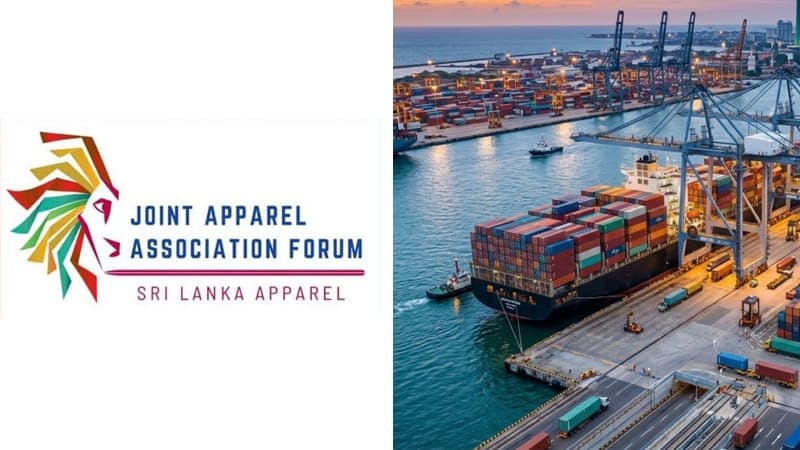
The Joint Apparel Association Forum (JAAF) is calling on the authorities to test a reported claim that Sri Lanka “could be losing” more than US$50 million a year in foreign exchange through Colombo Port charging arrangements before any changes are made to the rules that exporters rely on.
The claim was made by the Ceylon Freight & Logistics Association (CEYFFA), whose General Secretary, Inam Caffoor, raised it at a press conference reported in the Sunday Island on 31 October 2026. The report provides no evidence, gives no calculation, period, container volume or transaction data, and its wording is “could”, not “is”.
“Apparel exporters ship every day, and they plan their costs around the freight charges they are quoted,” said Yohan Lawrence, Secretary General, JAAF. “A figure of this size deserves scrutiny. But the rules that ensure fair trading, prevent unjustifiable charges should not be rewritten on a claim that has yet to be backed by evidence.”
For JAAF’s members, the stakes are high.
Gazette No 2334/26 of 31/03/2023 covers the four cardinal principles that protect both importers and exporters from service providers who may charge exorbitant fees in addition to freight for the carriage of goods. The four principles upheld by this gazette are:
Principle 1 – the cost of carriage of containers from origin to destination must be identified as all-inclusive freight, without breaking them into land costs and freight components.
Principle 2 – Contracting party pays: i.e. the service provider can only recover costs of the service from the contracting party using the service and not from a third party (eg exporter for an FCA contract) with no contractual liability.
Principle 3 – goods landed at port could only indicate “Freight Pre Paid” or “Freight Collect”. The concept of “Zero Freight” was not allowed.
Principle 4 – in the case of imports into Sri Lanka, the only charge permissible outside the freight was the Delivery Order (DO) fee. All other costs had to be calculated in the all-inclusive freight.
This framework gives shippers a single, “all inclusive” payment for freight, and one charge paid locally, that of a Delivery Order Fee. The DO fee has to be filed with the Director General of Merchant Shipping and published on their website. Some companies already charge upto 100,000 for the simple act of issuing a Delivery Order. The National Chamber of Exporters has noted that before 2013 importers and exporters faced nearly 50 separate charges, and it has warned against going back to that regime, something that CEYFFA seems hell bent on doing.
JAAF also sees gaps in the leakage claim itself. The port’s own charge is set by tariff, and the Sri Lanka Ports Authority has reportedly collected its charges from shipping lines in US dollars since June 2022. Money paid to a Sri Lankan port or terminal operator is a foreign-exchange inflow, not a leak. The rest of the freight rate is the shipping line’s payment for carrying cargo by sea, which is earned overseas on every international shipment. A legitimate freight payment to a foreign carrier is not automatically an unlawful outflow.
A simple test of scale shows why the detail matters. Colombo handled about 1.10 million import and export containers (TEUs) between January and October 2025, so a US$50 million loss spread across that cargo would equal roughly US$38 to US$45 per TEU. That arithmetic proves nothing by itself, but it shows that a credible estimate has to start from actual transactions.
JAAF is asking for five questions to be answered: Who is losing the money?, Who is receiving it?, Which transactions are involved?, What is the legal basis?, How was the figure calculated?
It also urges the Director General of Merchant Shipping, the Sri Lanka Ports Authority, the Central Bank of Sri Lanka and Sri Lanka Customs to request the underlying evidence from CEYFFA, carry out a formal examination and publish the findings. JAAF supports CEYFFA’s call for a consultative mechanism that includes all stakeholders, and believes exporters should have a seat at that table.
“If a loss exists, we should find it and fix it,” said Mr. Lawrence. “If it does not, the public should be told that too. Our members need stable, transparent costs to compete, and that is best protected by following the evidence.”