


Commercial banks in Sri Lanka adopted a more cautious stance on credit growth in the third quarter of 2026, slowing their overall willingness to lend despite an uptick in loan demand from businesses and consumers.
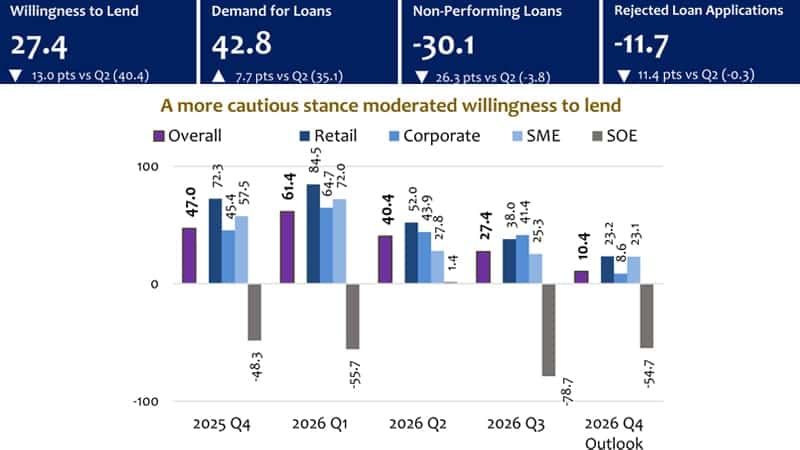
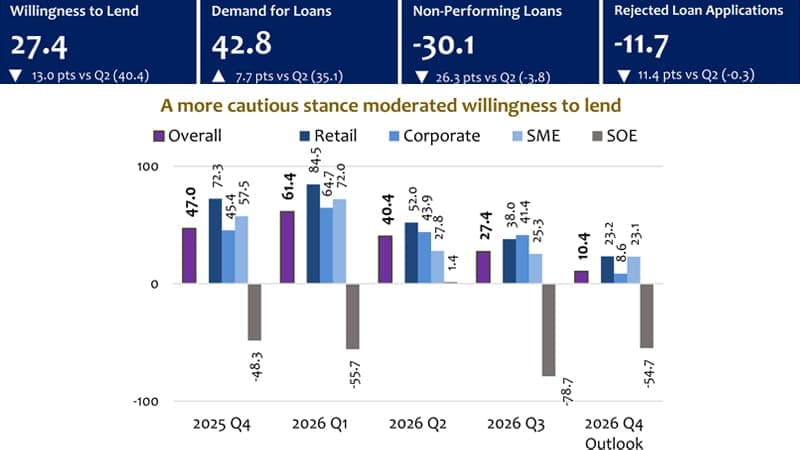
According to the latest Credit Supply Survey released by the Statistics Department of the Central Bank of Sri Lanka, the overall willingness to lend diffusion index dropped by 13.0 points to 27.4 in the third quarter of 2026, down from 40.4 in the second quarter. The survey, which covers all Licensed Commercial Banks and Licensed Specialised Banks across retail, corporate, small and medium enterprise (SME), and state-owned enterprise (SOE) sectors, showed a moderation in lending appetite across retail (38.0), corporate (41.4), and SME (25.3) categories. Meanwhile, willingness to extend credit to SOEs contracted sharply, registering an index value of -78.7. The Central Bank attributed the broader lending slowdown to the gradual transmission of monetary policy tightening measures introduced in May 2026, alongside banks' more selective risk appetite and regulatory exposure limitations.
In contrast to tightening credit supply, overall demand for loans expanded during the quarter, with the demand index rising by 7.7 points to 42.8 from 35.1 in the second quarter. Higher credit demand was recorded across all sectors, led by retail borrowing at 50.0, corporate loans at 43.6, SOEs at 36.1, and SMEs at 27.9. The Central Bank noted that loan demand was driven primarily by an expansion in working capital requirements, increased demand for short-term and consumption financing, and ongoing recovery in broader economic activities.
The survey also pointed to a marked improvement in asset quality, with the overall index for non-performing loans (NPLs) falling by 26.3 points to -30.1 in the third quarter from -3.8 in the prior quarter. The decline in NPLs was observed across all four sectors, marking a reversal of second-quarter increases in the corporate, SME, and SOE segments. Central Bank analysis attributed the NPL reduction to accelerated recovery actions, portfolio revival measures, and loan rescheduling resulting in stage upgrades. Concurrently, overall loan application rejections fell to an index of -11.7, supported by improved loan proposal quality, consistent credit evaluation standards, and stable applicant risk profiles.
Looking ahead to the fourth quarter of 2026, banks expect their willingness to lend to increase at a further moderated pace, with the overall index projected at 10.4 amid anticipated inflationary pressures, rising operating costs, and restrictions on leasing facilities. However, loan demand is forecasted to remain positive at an index of 35.1, underpinned by higher import financing requirements, seasonal demand, and working capital needs. Financial institutions also anticipate that improvements in NPL levels (projected at -32.6) and lower application rejections (-5.7) will persist into the final quarter.