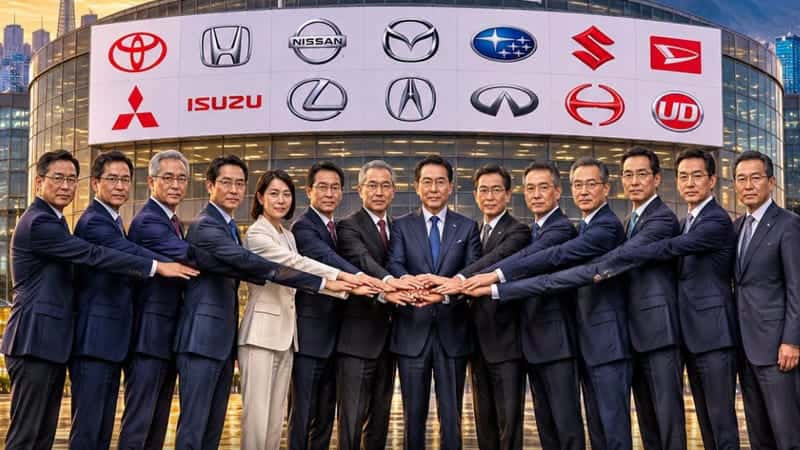



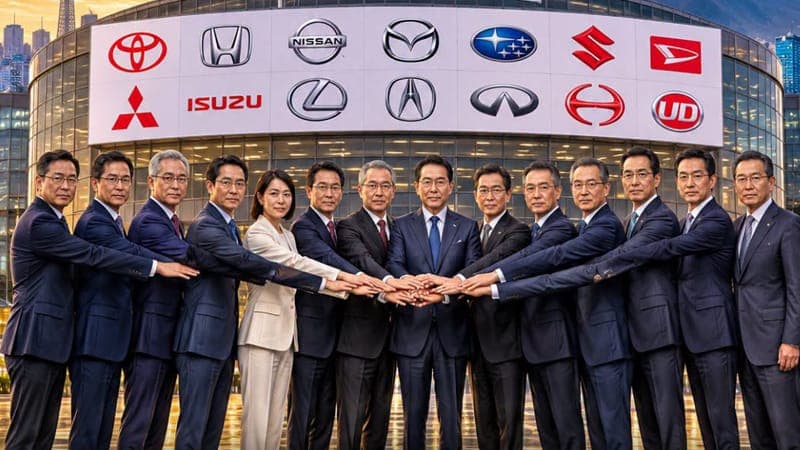
The Japan Automobile Manufacturers Association (JAMA) has decided that the best way to keep the industry alive is to standardize core parts across all Japanese car brands.
Dsf.my - In an unprecedented cross-company overhaul of Japan’s automotive supply chain, all 14 member automakers of the Japan Automobile Manufacturers Association (JAMA)—including Toyota, Honda, Nissan, Mazda, Subaru, Suzuki, and Mitsubishi—have partnered with the Japan Auto Parts Industries Association (JAPIA) to establish unified industry-wide standards for core vehicle materials and components.
Announced in Tokyo on 19 November 2026, the joint initiative targets non-visible, high-cost building blocks that have historically been governed by proprietary, brand-by-brand engineering rules. By harmonizing technical specifications and testing criteria across rival manufacturers, Japan’s auto sector aims to slash procurement waste, ease pressure on Tier-1 and Tier-2 vendors facing labor shortages, and free up R&D capital to fend off rapidly expanding Chinese electric vehicle rivals.
Speaking at the Tokyo press briefing, JAMA Chairman (and Toyota Vice Chairman) Koji Sato underscored the urgency driving the alliance:
“We all share this strong sense of crisis, creating a momentum for change. Based upon our sense of a crisis, we decided to choose these three areas. We will lay the foundation for the auto industry to remain a key industry in Japan.”
Three Initial Standardization Pillars: Steel, Resins, and Wire Harnesses
Because customers neither see nor select brands based on raw sheet metal grades, underbody polymers, or internal wiring looms, JAMA and JAPIA identified three immediate priority areas—each led by a dedicated OEM working group:
Harmonized Steel Quality Criteria (Led by Mazda): Historically, individual Japanese carmakers enforced bespoke metallurgical requirements and evaluation tests, forcing steelmakers and stamping suppliers to maintain hundreds of slightly different low-volume steel grades. Working alongside the Japan Iron and Steel Federation, automakers will consolidate low-volume steel varieties and unify quality assessment standards.
Unified Plastic & Resin Recycling Protocols (Led by Subaru): To secure a stable domestic supply of recycled polymers and meet tightening circular-economy regulations, JAMA members will standardize how automotive plastics are sorted, traced, and evaluated for quality, while aligning vehicle designs for easier end-of-life disassembly.
Universal Wire Harness Specifications (Led by Toyota): According to Sato, Japanese automakers currently specify roughly 70,000 different wiring harness variations—requiring suppliers to maintain unique molds, assembly boards, and manual work instructions that hinder factory automation. The new framework introduces a universal color-coding scheme (including standardized orange coding for high-voltage EV cables), uniform connector insertion forces, greater adoption of lighter aluminum wiring to reduce copper usage, and simplified circuit architectures.
Implications for ASEAN Supply Chains and Malaysian CKD Operations
While the standardization roadmap begins in Japan, its ripple effects will extend directly into Southeast Asia’s deeply integrated Japanese component ecosystem—including Malaysia’s vendor network supporting Perodua, Proton, Toyota, Honda, Nissan, and Mazda.
For regional wire-harness, metal-stamping, and polymer injection-molding suppliers that currently run separate tooling lines and quality-assurance audits for different Japanese principals, unified material specifications promise shorter development cycles, higher factory automation rates, and lower per-unit tooling costs. Once these initial three categories are bedded in, JAMA and JAPIA plan to expand standardization progressively across additional vehicle components.
Will Malaysia use this opportunity to push forward our own local industry and materials? Well, it seems we’re not even in the conversation at the moment. Our neighbours in Thailand have been involved in high-level meetings and just a day after JAMA’s announcement, the Thailand Board of Investment confirmed a combined investment of approximately US$4.1 billion would come to Thailand over the next 3-4 years. Thailand will align with JAMA’s members to upgrade their existing production ecosystem and remain the Detroit of Asia. Meanwhile, Malaysia will continue to be treated as an unserious player with customized incentives and new arbitrary goalposts set by whichever minister in charge.