

February, 7, 2022
Perceived Economic Opportunity Index 2021 [PEOI] Q4: October to December, 2021
The Foundation of Economic Freedom in Sri Lanka (FEFSL) presents here a summary of perceptions of the people of Sri Lanka about their own and the nations’ future as at the last quarter of 2021. This monthly nation-wide tracking study, reported quarterly, is based on a unique measurement developed by FEFSL. The study is now into the second decade and contains a rich volume of data that can be used by itself or in conjunction with other data to analyze and correlated perceptions of Sri Lankan citizens on a range of issues.
The trend for the last decade is clear. Unfortunately, Sri Lankan people have not had the satisfaction of looking forward to a better tomorrow for most of that time. The post-war euphoria that elevated the positive perceptions died down quickly. In retrospect it becomes apparent that the incumbent government was unable to leverage on the golden opportunity to go beyond the military victory and build a genuine peace among the communities. On the economic front, the debt-fueled construction boom that started in 2010 ended abruptly by 2013 as needed structural and institutional reforms were not undertaken. Growth since then has been only moderate. But the series of events starting with the constitutional coup in October 2018, the Easter attack in April 2019 and the continuing pandemic since March 2020 has made matters much worse for Sri Lanka. A series of policy blunders in agriculture and fiscal and monetary management have exacerbated to situation.
This regular measurement does not provide answers to the question on how perceptions on economic prospects can be improved or what the role of the government or any other stakeholder is in that process. It is for all concerned to consider multiple options. That way, it is hoped that necessary action will be taken to give hope to the population; particularly to the young people who seem to be wanting to leave Sri Lanka in droves.
1.0 Methodology
The PEOI is calculated based on monthly data collected by PepperCube Consultants on an island-wide random survey of face-to-face interviews among 500 persons. For the third quarter of 2021, the surveys took place from 01 to 31 for October; from 01 to 30 for November and from 01 to 31 for December 2021. This quarterly report, therefore, based on a total survey of 1,500 persons over three months, provides an ongoing commentary on how Sri Lankans feel about their economic future at this present moment. It also provides the reader with the ability to compare the current sentiment since July 2011.
2.0 Presentation of Findings
As always, monthly survey data is presented quarterly. The focus is on perception on economic opportunity. Perceptions on one’s ability to save and on corruption are regularly presented. The survey also tracks perceptions on cost of living, development of the country, media freedom and law and order among others. Selected assessments are reported periodically.
2.1 Perceived Economic Opportunity
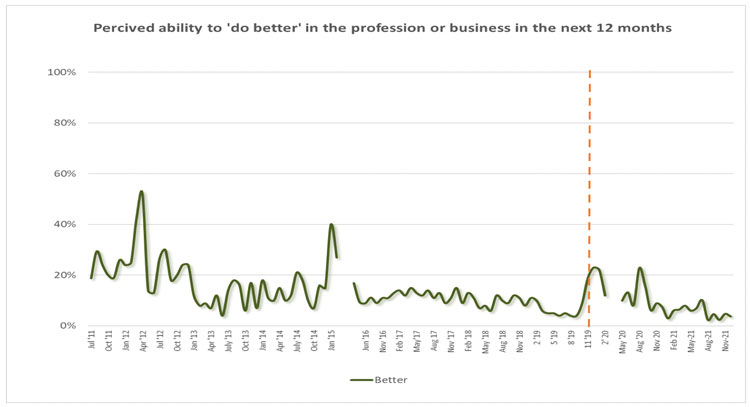
The question posed to the respondents is whether they believe their economic opportunities, be it in the workplace or in their business, would increase, stay the same, or diminish in the year ahead.
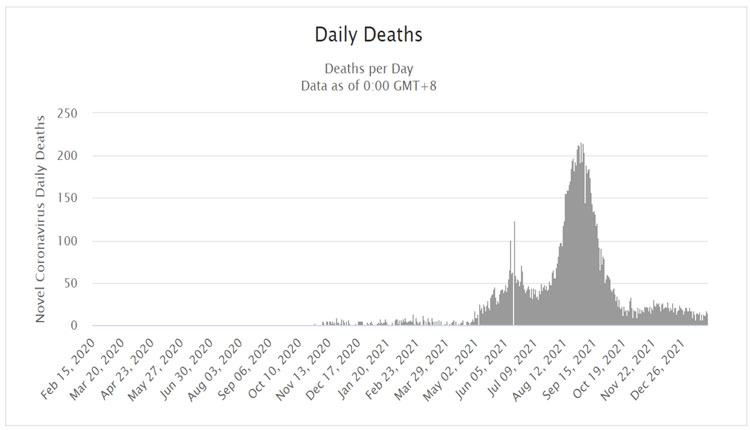
At the mid-point of the third quarter of 2021 only 2.0 percent mentioned they expected their economic opportunities to improve in the coming year. An unprecedent figure; the absolute low for the 10-year period of measurement. This was due to the extremely high Covid19 death rates reported across Sri Lanka by August 2021 and what seemed at that time to be a relentless increase in the pandemic infections. But, as this world-o-meter graph depicts, these high death rates started to fall in September and came down sharply in the successive three months of October, November, and December 2021; from over 200 deaths per day in late August to under 20 deaths per day by end December. Thus, by the end of the third quarter the sentiment was still very low but at 5.0 percent a little better than the all-time bottom.
The question then is why did the perception of optimism fall in the last quarter of 2021 when the pandemic seemed and was very much under control? The perceived economic opportunity was a mere 2.0 percent in October, 5.0 percent in November and back down to 4.0 percent at the end of 2021. The reasons behind this hitting the bottom in optimism thus is likely due to matters beyond the pandemic. The economic situation was turning dire during the last quarter of 2021. Prices of essentials were rising rapidly and even a kilogram of rice, the basic staple food, had more than doubled since the end of 2019; from roughly LKR 80/kg to approximately LKR 160/kg. Ither grains and vegetables were becoming scarce, and the quality of produce was dropping at the same time. This crisis was purely man-made, in that, the government banned the import of chemical fertilizer and weedicides overnight on a certain-to-fail policy of turning Sri Lanka into a nation of pure organic agriculture. Ironically, the advisors and officials who opposed this ad-hoc policy were removed. Hard core elements of the government hierarchy and most visibly the top leadership of the military backed the President on this call.
In general, beyond agriculture policy, economic management of the Gotabaya Rajapaksa government was causing major hardships to the people. A series of policy decisions had led the economy to perhaps the deepest crisis in decades. Sri Lanka was running out of dollars and at the same time printing unprecedented amount of rupees. Having got shut out of the global financial market due to downgrades by the major sovereign rating agencies mainly due to the sharp fall in government revenue caused primarily by the deep tax cuts that caused the Treasury to forego more than a quarter of expected tax revenue Sri Lanka was unable to roll over its maturing foreign debt. It basically printed its way out of domestic debt. The government, instead of seeking a reform program with the International Monetary Fund to resolve the balance of payments crisis early on, or not initiating any debt restructuring activity even later as the crisis grew, used the foreign reserves of the Central Bank to make international debt payments. This caused Sri Lanka’s official reserves fall from just under USD 6.0 billion at the start of the year to USD 1.5 by the third week of December 2021. The obvious consequence was the inability to finance imports as the Central Bank was unable to release sufficient dollars to pay for imports ranging from cooking gas and kerosene to medicines, to milk powder to many other essentials.
People queuing up to buy kerosene outside Colombo
With lines forming at cooking gas outlets, at milk powder sales points, at fuel pumps and other retailers and with trepidation as to whether electricity would be shut off and with the full knowledge that the country was running out of dollars it seems very likely that the level of optimism dropped to the all-time low by October, rising again marginally only to fall again by end of December.
2.2 What will happen to the development drive?
This chart is based on the answers to a particular question in the survey as to the perception on the progress of development activity in the coming twelve months.
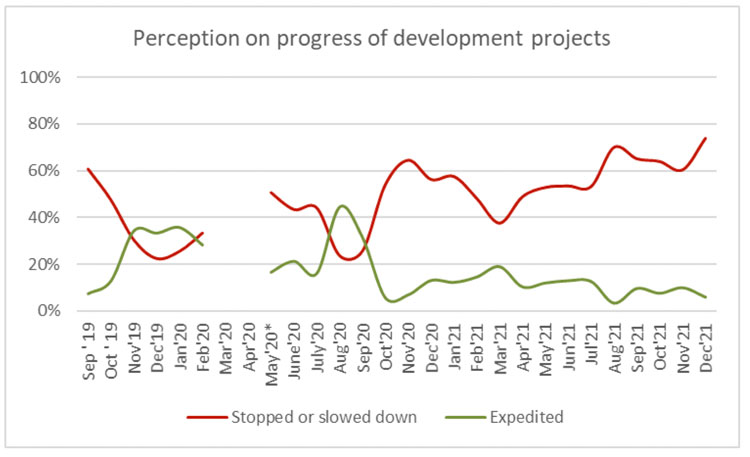
The period of two years is depicted here to indicate the movement of perception towards the presidential and parliamentary elections and thereafter. The negative perception of stopping or slowing down development projects fell dramatically from 60 percent to 20 percent with the change of presidency in November 2019 and again after the August 2020 general going up in the interim due most likely to the pandemic.
But consider the situation as at end 2021. A massive 74 percent believe development projects will suffer while only 7 percent feel optimistic about their progress. This perception is obviously of a general or macro nature. But taking together with the earlier findings at the individual or micro context, the confidence of the people in the overall economic management of the government seems to be almost at the very bottom.
2.2 Perception on Ability to Save
Here our objective is to determine the perceptions on the ability to save; an inadvertent way to estimate cost of living as well.
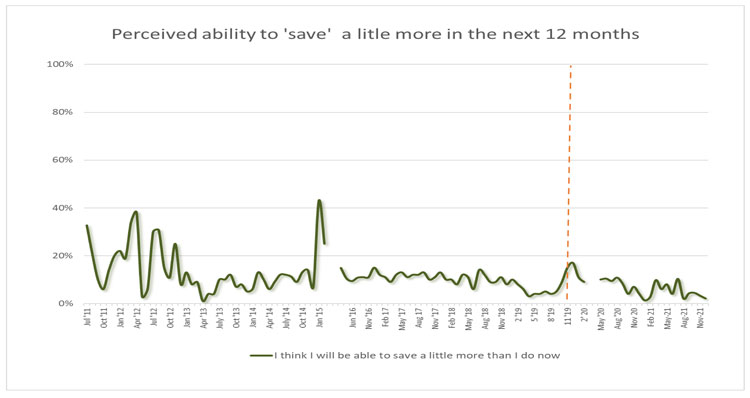
To assess the ability to manage the cost of living and to have something left over, we asked the respondents about their expected personal savings in the coming 12 months. The perception of the public’s ability to save a ‘little more’ than what they do at present has fallen to an all-time low of just 2.0 percent. This is a reflection on how desperate the people of Sri Lanka have become. As explained earlier, prices of food as well as non-food items have been increasing at a very rapid rate. Also, after many years, perhaps over two decades, the government imposed various quantitative restrictions on purchases from state owned outlets while certain items, such as milk powder, disappeared from the shelves of supermarkets.
Inflation in Sri Lanka registered double digits for the first time since 2013 January. The National Consumer Price Index (NCPI) saw a year-on-year increase of 14.0 percent with food inflation rising to 21.5 percent. Supply side reasons, particularly the calamity in agriculture caused by the ban on chemical fertilizer, certainly caused food prices to rise but the monetary accommodation of fiscal profligacy in the face of sharply falling government revenue is at the core of the inflation problem.
The lack of hope in their ability to save is a most unfortunate reality in the current context of Sri Lanka. Unless the economy turns around and opportunities for individuals to improve their economic well-being it is impossible to expect a turnaround in this situation. While the government is hopeful that the current predicament can be overcome with what they term a ‘homegrown solution’ many in the opposition along with scores of independent professional economists seem not convinced by the rhetoric.
2.3 Perception on Corruption
The question posed is if the respondents perceive that corruption will lessen in the coming 12 months.
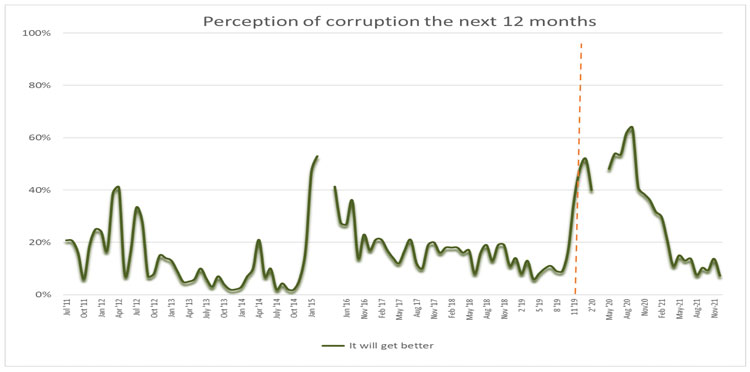
The positive sentiments among the people that corruption will become less fell from the record high of 64 percent after the general election in August 2020 to a very low figure of just 7.0 percent. This fall in confidence on corruption at such a rapid pace is a serious concern and goes to show the disappointment in the government relative to what was expected.
3.0 Concluding Thoughts
The positive feeling about the future that was seen with the election of President Gotabaya Rajapaksa in November 2019 fell somewhat soon thereafter and got worse with the onset of the Covid19 pandemic. Then again hope for better days rose with President Rajapaksa’s party winning the general election with the installation of former President Mahinda Rajapaksa as Prime Minister in August 2020 in the middle of the unprecedented disruption of the economy due to the Covid19 pandemic lock-down.
But by the end of 2021 that optimism had completely disappeared. The perceived ability to improve one’s economic opportunity recorded the lowest ever figure of an abysmal 2.0 percent in October and settling at just 4.0 percent at the end of the year. Our continuous monthly measurements suggest that the pandemic was not the reason for this dramatic fall in confidence. It is very likely that the major policy errors of the government that has caused unprecedented suffering on the people are directly responsible for this outcome.
The first quarter of 2022 is going to be an enormous test for the government. With the omicron variant of the Covid19 virus spreading fast, the main agriculture season seeing significant reduction in harvest, last remaining dollar reserves being used to pay foreign debt causing serious shortfalls in availability of foreign exchange to pay for imported inputs and consumables including food and medicine, how the government addresses these issues will determine whether the situation will fall to the ablute bottom or make even a nominal turn around. It must be kept in mind if the government continues to mishandle the situation, people’s frustrations could certainly boil over, and the peaceful situation turned in to one that would no one wishes to experience.
The Foundation of Economic Freedom appreciates the generous support by the Friedrich Naumann Foundation for Freedom to undertake this work.
Video Story