

March, 14, 2023
Perceived Economic Opportunity Index 2022 [PEOI] Q4: October 01 to December 31, 2022
The Foundation of Economic Freedom in Sri Lanka (FEFSL) presents here a summary of perceptions of the people of Sri Lanka about their own and the nations’ future as at the end of the fourth quarter of 2022. Started in July 2011 this forward-looking nation-wide tracking study, conducted monthly and reported quarterly, is based on a unique measurement developed by FEFSL.
We concluded our third quarter 2022 report with the statement “Sri Lanka is crumbling. The nation must be saved before it implodes.” We went on say “[a] slight glimmer of hope seems to have set in after the nation’s reigns were taken over by President Ranil Wickremesinghe.” However, what we find is that the glimmer of hope is fading.
We said in our last quarterly assessment that “The nation is bankrupt and unless the proposed painful economic reform agenda is successfully implemented Sri Lanka’s creditors will not agree on a debt restructuring program. Without a debt deal Sri Lanka will not be able to stabilize the economy and move towards a medium-term structural adjustment program and kick start its growth engine. Whether the Wickremesinghe-SLPP government can clear this hurdle is a serious question. While the main opposition party has been generally supportive of economic reforms, which has been a major positive for the government in its negotiations with the IMF, it has recently begun to question the practicality of some of the key proposals on increases in taxes and the lack of a strong social safety network. Many of the other opposition parties, trade unions and several civil society groups however are planning to ratchet up their protests.”
At the end of 2022 the position remained unclear. Yes, certain difficult reforms were undertaken in terms of taxes; both personal and corporate taxes were raised significantly, and the VAT rate was almost doubled. Electricity tariffs were hiked, but internal battles between the government and the regulator have held back the increase the government insists is necessary to reflect costs. The pain of reforms has hit the people hard, not just the low-income segment but a fair section of society. We assume perhaps more than half the population. Protests have begun across the country, but not as fierce as they were running up to the fall of the previous government, nevertheless significant enough to build a large anti-government wave. It is important to note that a new political formation (National People’s Power) with an ideological foundation of strong left (Janatha Vimukthi Peramuna) is gaining ground promising ‘relief’ to the people without reform. In this context, the local government elections, due early March is now in the balance. The government is insisting that the treasury is not able to allocate the required funds to conduct the polls. Immaterial of the legal requirement to let the people exercise their franchise, it looks almost certain that the Ranil Wickremesinghe government would block that opportunity, albeit it being to elect members for local government.
1.0 Methodology
The PEOI is calculated based on monthly data collected by PepperCube Consultants on an island-wide random survey of face-to-face interviews among 500 persons. Surveys for this assessment were conducted from 01 to 31 October; from 01 to 30 November and from 01 to 31 December, 2022. This quarterly report is therefore based on a total survey of approximately 1,500 persons over three months and provides an ongoing commentary on how Sri Lankans feel about their economic future at this present moment. It also provides the reader with the ability to compare this sentiment since July 2011.
2.0 Presentation of findings
As always, monthly survey data is analyzed and presented quarterly. The focus is on perception of economic opportunity. Perceptions of one’s ability to save and of corruption are regularly presented. The survey also tracks perceptions on cost of living, development of the country, media freedom and law and order among others. A selected assessment on one of these questions is reported periodically.
2.1 What will happen to my opportunities at work or in my business?
The question posed to the respondents is whether they believe their economic opportunities, be it in the workplace or in their business, would increase, stay the same, or diminish in the year ahead.
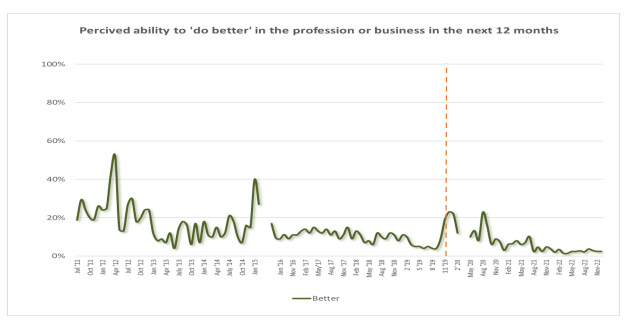
Optimism, having hit the lowest it has ever been, at just 1.4 percent at the end of March 2022 picked up to 3.7 percent in September with the harsh economic situation improving at the margin giving the people a glimmer of hope. The most important event was the announcement that Sri Lanka had reached a Staff Level Agreement with the International Monetary Fund (IMF). The hope was for Sri Lanka to elevate this staff agreement into an agreement with the executive board of IMF for a USD 2.9b Extended Fund Facility program over a four-year disbursement schedule based on implementation of agreed reforms. The political leadership continued to provide hope that this would be done before the end of 2022 and that soon thereafter multilateral lenders such as the World Bank and the Asian Development Bank would pour in funds for budget support. With this promise not materializing and the living standards of vast majority of the people crumbling, the little hope has now begun to fade. By December 2022 optimism had fallen to a mere 2.4 percent, second only to the figure in March was the lowest since the inception of the index eleven years ago.
This fading of hope is driving people from all walks of life to vote with their feet. Be they doctors or engineers, or unskilled employees, large numbers are seeking opportunities overseas. Staggering numbers of professionals are leaving. Even more staggering numbers wish to leave. The below chart depicting the results of a national survey of 1,000 individuals selected from across the country by the Center for Policy Alternatives (CPA) reveals this shocking truth; that almost 80 percent of the youth wishes to migrate out of Sri Lanka.
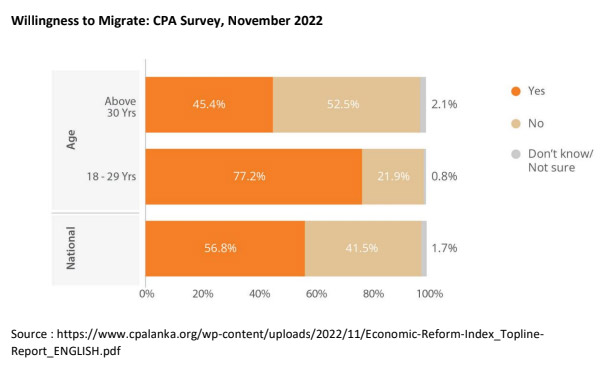
Source : https://www.cpalanka.org/wp-content/uploads/2022/11/Economic-Reform-Index_Topline-Report_ENGLISH.pdf
This cross sectional finding, read with the trend in the falling optimism in the future of Sri Lanka for the last so many years, should not surprise the intelligent reader.
2.2 How much can I save?
Here our objective is to determine the perceptions on the ability to save. This is also a way to estimate the cost of living. The cost of living is the combination of income one receives and the expenses one must meet to maintain a certain lifestyle. Given the catastrophe many have seen their incomes fall; some having lost it all by losing their employment. Only some, who can set their own prices, have been able to adjust their income upwards with rising costs. However, expenses have skyrocketed.
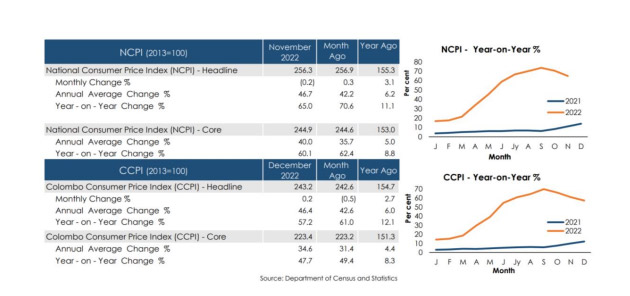
As seen in the table and chart below inflation reached dizzy heights, in excess of 70 percent, towards the third quarter. However, inflation began to fall slowly during the last quarter with the hiking of policy interest rates by the Central Bank.
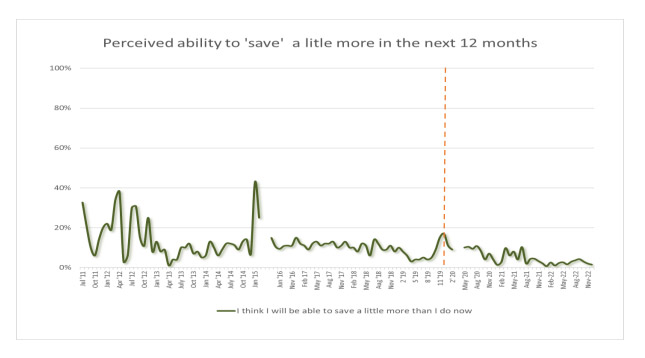
To assess the ability to manage the cost of living and to have something left over, we asked the respondents about their expected personal savings in the coming 12 months. After the perception of the public’s ability to save a ‘little more’ than what they do at present fell to an all-time low of a mere 1.0 percent at the end of the first quarter, it rose to 4.2 percent in September reflecting the slight up-beat in confidence as reflected in the hope for the future. But by the end of the fourth quarter, this perception fell once again to the previous all-time low of 1.0 percent. The fact that the falling inflation has not registered any significant uptick has to be that the massive rise in costs have completely eroded the stagnant income and the hope for the coming months is fading.
2.3 What about national development projects?
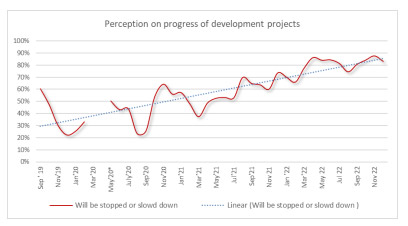
On an ad hoc basis, we consider certain other aspects of public perception. For some time now we have considered ‘development projects’ here interpreted as large construction-related mega projects. As far as the public is concerned, they do not see development projects coming back on stream for a long time to come. This trend from mid-2020 is clear that the perception on the progress of development activity in the coming twelve months is almost nothing with 85 percent of respondents believing that these projects would either completely stop or seriously slow down.
In fact, almost all government construction projects have come to a grinding halt. Highway and expressway projects have been completely stopped. Port construction has stopped. Even the Colombo airport project was stopped by the Japanese and the equipment moved out. Only a few large private hotel projects are ongoing. With interest rates soaring even house construction has slowed to a minimum. This crisis in the construction sector has now become a national issue.
2.4 Will corruption reduce?
The question posed is if the respondents perceive that corruption will lessen in the coming 12 months. It is evident that the hope for reduced corruption post the two elections is completely gone.
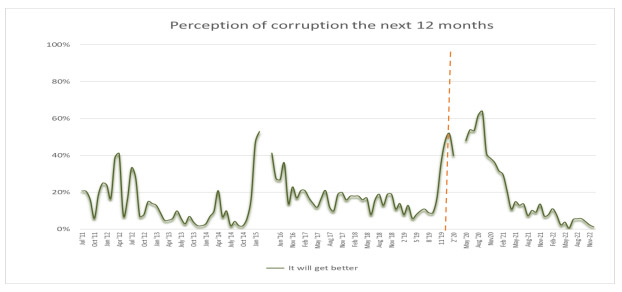
It is noteworthy that the perception of corruption is at the worst it had been for the last eleven years with the hope of corruption reducing in the coming year falling to a mere 1 percent as it did in May 2022.
3.0 Concluding Thoughts
The optimism about the future that was seen when President Gotabaya Rajapaksa was elected by a huge majority in November 2019 disappeared as he and his government floundered and bankrupted Sri Lanka for the first time in history. After he was chased away by an unprecedented uprising of the people a glimmer of hope arose as the nation’s reigns were taken over by President Ranil Wickremesinghe in July 2022. However, as at the end of 2022, this optimism has begun to fade again.
The future of the nation depends on the ability of the government to stabilize the economy and turn it around. It must be said that the tough but necessary action of the Central Bank has worked in creating some stability in the macro economy. But the government must now undertake painful economic reforms that would reset the economy for it to grow again. These reforms are also critical in ensuring that Sri Lanka is able to obtain Board approval of the International Monetary Fund (IMF) based on the Debt Sustainability Analysis undertaken earlier in the year to begin disbursements of the proposed USD 2.9b Extended Fund Facility (EFF). However, in order for the IMF Board to approve the EFF, specific and credible financing assurances from Sri Lanka’s official creditors, led by China, India and Paris Club members given Sri Lanka’s debt is currently unsustainable. Thus, the next few months are crucial.
While the main opposition party has been generally supportive of economic reforms it is questioning the practicality of some of the key proposals on increases in taxes and the lack of a strong social safety network. This is natural given the hardship faced by the masses, particularly the low income. It is only after January that the tax increases will hit home and how the combined impact of higher taxes with sky high inflation, loss of income and further upward adjustments of utility tariffs will affect the masses will be understood. It is very likely that opposition parties, trade unions and civil society groups would undertake protests.
Sri Lanka is at a crossroad. Either the nation will rise from this calamity stronger upon a complete overhaul of the economy that would be painful to the people, or without reforms, it will crumble into a vicious cycle that will end up in total disaster.
The Foundation of Economic Freedom appreciates the generous support by the Friedrich Naumann Foundation for Freedom to undertake this work.
Video Story