

December, 11, 2023
Perceived Economic Opportunity Index [PEOI] 2023 Q3: July 01 to September 30, 2023
We said at the end of the second quarter of 2023 that the distant glimmer of hope that had appeared with the change of Presidency some months ago was flickering.
The Foundation of Economic Freedom in Sri Lanka (FEFSL) presents here a summary of perceptions of the people of Sri Lanka about their own and the nations’ future as at the end of the third quarter of 2023. Started in July 2011, this forward-looking nation-wide tracking study, conducted monthly and reported quarterly, is based on a set of questions and answers developed by FEFSL to measure the mood of the people of Sri Lanka on their perceived opportunities into the future.
In concluding our second quarter 2023 report, we said “The glimmer of hope that people of Sri Lanka saw with President Ranil Wickremesinghe taking over from Gotabaya Rajapaksa who abandoned the nation in July 2022 continues to be alive, yet it seems to be fragile. Hope for the future has all but disappeared and most have very little optimisms about the future. Those who can find opportunities overseas, be they professionals or unskilled workers, are leaving in large numbers. The situation is rather gloomy. Data from the last eleven years suggest that it would be at the next election that the people will have an opportunity to revive their hope and also the data suggests that unless something significant changes in terms of taking the nation out of the economic rut it has fallen into that hope would once again disappear.”
The third quarter of 2023 had mixed results; hope went up for with the announcement of the government that it had successfully concluded the domestic debt restructure as a stepping stone to restructure its vast foreign debt along with the hope of the second tranche of the IMF funds being released soon. But hope diminished with the IMF second tranche getting delayed due also the continuing nationwide criticism of the domestic debt restructure on its lack of equitability. The ‘Aswesuma’ social safety net program of the government, while almost tripling benefits and increasing the coverage, albeit for a much shorter duration, rather and exit mechanism after a number of years, ran in to sever controversy as opposition to the selection of recipients without proper census to identify the poor continued to overshadow the positives. On the other hand those who had up to then received the previous ‘Samurdhi’ benefits but were no longer eligible protested on the grounds of unfair exclusion. The government then decided to temporarily keep those former beneficiaries also in the new lists. The economy stabilized but at a new equilibrium in which the price level was almost double that of the pre-crisis equilibrium. This was a massive blow to the low income and the new poor.
With the nationwide local government elections continuing to be postponed on the ‘excuse’ of lack of funds, protests continued in many parts of the nation, but once again, as in the previous quarter in less vigor.
The nation seems to be experiencing a feeling of frustration. Having had hope rise in November 2019, having lost all hope in the summer of 2022 and once again a glimmer of hope appearing and almost disappearing once again, the people of Sri Lanka seem to be tired and exasperated.
1.0 Methodology
The PEOI is calculated based on monthly data collected by PepperCube Consultants on an island-wide random survey of face-to-face interviews among 500 persons. Surveys for this assessment were conducted from 01 to 31 July; from 01 to 31 August and from 01 to 30 September, 2023. This quarterly report is therefore based on a total survey of approximately 1,500 persons in three months and provides an ongoing commentary on how Sri Lankans feel about their economic future at this moment and the next twelve months. It also provides the reader with the ability to compare this sentiment since July 2011.
2.0 Presentation of specific findings
As always, monthly survey data is analyzed and presented quarterly. The focus is on perception of economic opportunity. Perceptions of one’s ability to save and of corruption are also regularly presented. Further, the survey tracks perceptions on cost of living, development of the country, media freedom and law and order among others. A selected assessment on one of these questions is reported periodically.
2.1 What will happen to my opportunities at work or in my business?
The question posed to the respondents is whether they believe their economic opportunities, be it in the workplace or in their business, would increase, stay the same, or diminish in the year ahead.
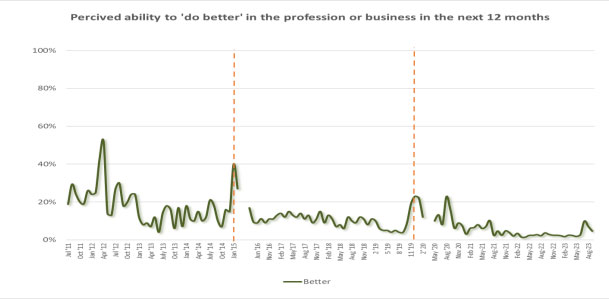
Optimism, having fallen to its lowest in mid-2022 to a mere 1.4 percent picked up to 3.7 percent in September that year with a glimmer of hope with the announcement that Sri Lanka had reached a Staff Level Agreement (SLA) the International Monetary Fund (IMF) to receive a USD 2.9b bail-out package. With the EFF getting delayed, optimism fell again to 2.4 percent by end of 2022. But as the IMF Board approving the EFF and disbursing the first tranche and all major creditor nations agreeing to restructure Sri Lanka’s debt, the sentiment improved with perception of a better tomorrow moving up a tad bit to 2.5 percent at the end of the first quarter 2023. People’s optimism about their own success fluctuated slightly and ended the second quarter at 2.8 percent in June 2023. Third quarter saw much better results with the finalization of the domestic debt restructure and the introduction of the Aswesuma program, albeit with much controversy. July saw a blip with optimism increase to 9.9 percent, the highest reading since the crisis, but soon it fell to 7.0 percent in August and by September optimism fell to 4.6 percent. This is keeping with the difficult operating environment with increased taxes and the general economic stagnating along with disappointing indicators all around. It is quite obvious that the public are unable to see any meaningful breakthrough.
Looking at the historical trends the unfortunate reality is that Sri Lankans have continued to lose hope in their future over the last decade or so. The two markers are when optimism rose: with the change of government in January 2015 and at a much lower level in November 2019.
The question for the policy makers in government is how can this trend be reversed? Or, rather, can this trend be reversed without a change in government? From the point of view of the citizens, it is a very sad predicament, to be stuck at a woefully pessimistic scenario. It is no surprise that migration figures continued to be extremely high in the quarter. Just as we saw last quarter young people are continuing to vote with their feet.
While the macroeconomic data suggests a stabilizing economy, albeit at a much higher price level, micro data here is undeniably strong that a terrible sense of hopelessness has set in.
2.2 How much can I save?
Here our objective is to determine the perceptions on the ability to save. This is also a way to estimate the cost of living. The cost of living is the combination of income one receives and the expenses one must meet to maintain a certain lifestyle.
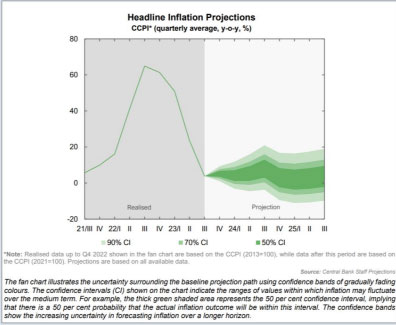
As seen in the Central Bank of Sri Lanka (CBSL) chart here inflation reached dizzy heights towards the third quarter of 2022. However, inflation began to fall rapidly since then reaching low single digits by the third quarter 2023 with the hiking of policy interest rates by the CBSL and the impact of the base effect.
The projection for the rest of the year continues to be reasonably low. A significant event during this quarter and why inflation projections are low was the passage of the new CBSL Act that completely restricted monetary financing of the budget; in other words ‘printing money’ which was a key reason for the crisis of 2021/22. Soon the Government is to agree with the CBSL on the inflation target for the next several years which by law will have to be met.
While it is a significantly positive development, what matters to the person in the household is the cost of living. How much can I buy with LKR 10,000 after huge increases in prices reflecting the bout of uncontrolled inflation and burdened by numerous increases in taxes and utility tariffs. This reality is depicted below in a typical political cartoon, often with the blame being squarely apportioned to the government and the IMF. The citizen is squeezed to death with bills and taxes and there is nothing left.
To assess the ability to manage the cost of living and to have something left over, we asked the respondents about their expected personal savings in the coming 12 months.
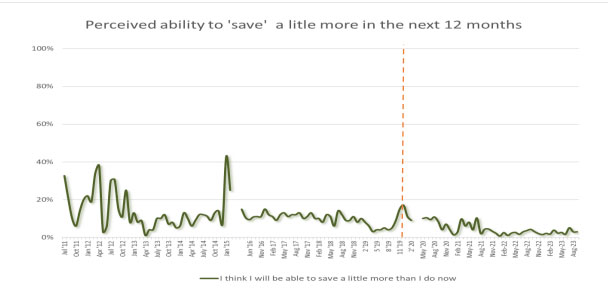
By the end of 2022 those who thought they could save a little more than at present were at a low of 1.4 percent. But as inflation began to fall this perception gradually rose to 3.8 percent by the end of the first quarter 2023. However this figure fell to a mere 1.6 percent at the end of the second quarter 2023. With inflation falling rapidly people’s hope to save even a little bit of their earnings increased to 5.1 percent in July, but fell again to 2.9 percent respectively for August and September 2023.
2.4 Will corruption be reduced?
The question posed is if the respondents perceive that corruption will lessen in the coming 12 months. It is quite clear that people of Sri Lanka seem to have lost hope in attacking corruption. It is significant that post the change of the presidency in 2019 and the parliament in 2020 hope rose but soon it fell.
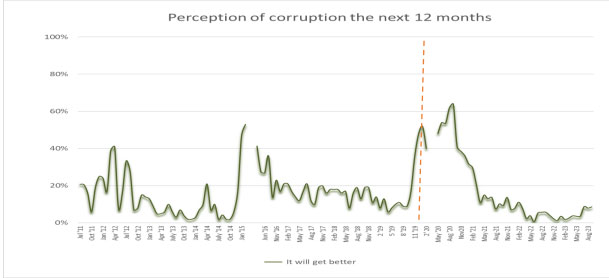
The perception of reducing corruption was around 3.6 percent at the end of third quarter 2023. But with the government and opposition together agreeing to legislate the new anti-corruption Act in line with global best practices has seen a significant increase in the hope that corruption would be fought aggressively with the perception of reducing corruption rising to 8.6 percent.
2.5 A Question on Global Integration
Besides the questions we ask respondents monthly to establish trends, we also seek to understand how people react to current issues. Given the lack of hope in the economic conditions and the need to reverse this trend, there are two schools of thought developing in the current discourse. One is a more insular structure where domestic players are protected with high import tariffs and other levies, duties, and quantitative restrictions. This is relevant because what seem to be a significant section of society is of the view that it was the liberalization of the late 1970s that created an ‘open economy’, even the factually incorrect as many restrictions remained, that caused the economic crisis of Sri Lanka by ‘killing off’ domestic industry and ‘privatizing’ state owned enterprises. The other. Much smaller group is to open the country and integrate with the world. This calls for trade reform including lowering of tariffs and forcing domestic producers to compete with regional and global manufacturers.
The question we asked was “Some people say it is good to reduce import duties and allow domestic industries to compete with other countries and capture a bigger global market share. They say that is how our neighboring countries are developing and that model will create export jobs locally. What do you think?”
Should Import Duties be Reduced and Domestic Industries Made to Compete
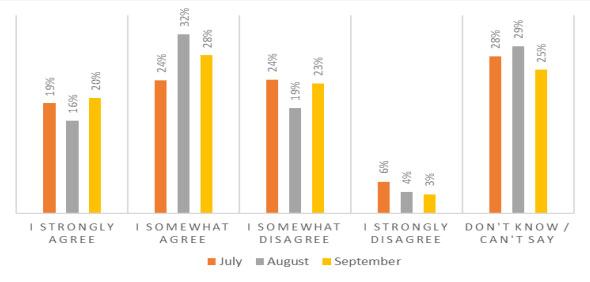
The responses to the question above continue to be unexpected with those agreeing strongly or agreeing somewhat being more than those disagreeing with a fair number unable to comment. We plan to monitor this trend to assess if this thinking will be sustained.
3.0 Concluding Thoughts
The glimmer of hope that people of Sri Lanka saw with President Ranil Wickremesinghe taking over from Gotabaya Rajapaksa who abandoned the nation in July 2022 continues to be alive, yet very fragile. Hope for the future among Sri Lankans have all but disappeared and most are very pessimistic about the future. The citizenry is frustrated and desperate. Data from the last eleven years suggest that it would be at the next election that the people will have an opportunity to revive their hope.
The Foundation of Economic Freedom appreciates the generous support by the Friedrich Naumann Foundation for Freedom to undertake this work.
Video Story