

May, 4, 2024
Perceived Economic Opportunity Index [PEOI] 2024 Q1: January 01 to March 31, 2024
This is what we said at the end of 2023 “The fourth quarter seems disastrous from the point of view of the people. Nothing the government is doing seems to ignite hope in the people even though the macro economy is certainly stabilizing with inflation falling, interest rates coming down and the exchange rate also stabilizing. This is while the revenue numbers have been increasing and the pressure on the treasury reducing with increased tax collections and market pricing of utilities. This is a double-edged sword. While the economics have been improving the politics have become even more divisive. The left is on a relentless attack on the IMF led program driven by fiscal discipline and withdrawal of money printing capabilities of the Central Bank. The budget presented for 2024 did not go well with the people as it calls for even further taxes to be levied on the people while expanding the net. The attempt to restructure state owned enterprises have had massive backlash with opposition parties questioning the rationale, while some of the far-left parties have along with their trade unions outright opposed all moves at restructure accusing the government of attempting to ‘sell off’ national assets.”
The situation has hardly moved from the above assessment thus far this year except for a very slight improvement; a few green shoots perhaps. While it is accurate that the statistics suggest that the nation’s macroeconomic situation has improved significantly, the pain and suffering of the masses does not seem to have eased. Their desperation continues to linger.
The Foundation of Economic Freedom in Sri Lanka (FEFSL) presents here a summary of perceptions of the people of Sri Lanka about their own and the nations’ future as at the end of the first quarter of 2024. Started in July 2011, this forward-looking nation-wide tracking study, conducted monthly and reported quarterly, is based on a set of questions and answers developed by FEFSL to measure the mood of the people of Sri Lanka on their perceived opportunities into the future.
1.0 Methodology
The PEOI is calculated based on monthly data collected by PepperCube Consultants on an island-wide random survey of face-to-face interviews among 1,000 persons (The sample was increased from 500 to 1,000 from January 2024). Surveys for this assessment were conducted from 01 to 31 January; from 01 to 28 February and from 01 to 31 March, 2024. This quarterly report is therefore based on a total survey of 3,018 persons in three months and provides an ongoing commentary on how Sri Lankans feel about their economic future at this moment and the next twelve months. It also provides the reader with the ability to compare this sentiment since July 2011.
2.0 Presentation of specific findings
As always, monthly survey data is analyzed and presented quarterly. The focus is on perception of economic opportunity. Perceptions of one’s ability to save and of corruption are also regularly presented. Further, the survey tracks perceptions on cost of living, development of the country, media freedom and law and order among others. A selected assessment on one of these questions is reported periodically.
2.1 What will happen to my opportunities at work or in my business?
The question posed to the respondents is whether they believe their economic opportunities, be it in the workplace or in their business, would increase, stay the same, or diminish in the year ahead.
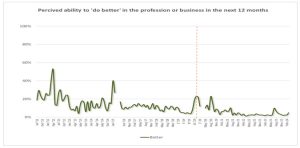
Optimism fell to its lowest in mid-2022 to a mere 1.4 percent as Sri Lanka defaulted on its external debt for the first time but picked up to 3.7 percent in September that year with a glimmer of hope with the announcement that Sri Lanka had reached a Staff Level Agreement (SLA) the International Monetary Fund (IMF) to receive a bail-out package to climb out of debt. With the IMF funds getting delayed, optimism fell again to 2.4 percent by the end of 2022. But as the IMF Board disbursed the first tranche and all major creditor nations agreed to restructure Sri Lanka’s debt, the sentiment improved with perception of a better tomorrow moving up a tad bit to 2.5 percent at the end of the first quarter 2023. People’s optimism about their own success fluctuated slightly and ended the second quarter at 2.8 percent in June 2023. The third quarter saw much better results with the finalization of the domestic debt restructuring and the introduction of the Aswesuma social safety net program. Having increased to 9.9 percent, the highest reading since the crisis, optimism fell to 4.6 percent at the end of the quarter. The fourth quarter of 2023 was a disaster. Those who thought they had a chance of advancing in the profession or business, essentially their economic opportunity ending up at a mere 1.9% in December. January and February 2024 saw optimism rise to 2.4 percent and then to 4.9 percent in March; the highest figure since September 2023 perhaps reflecting the positive news around the IMF review that took place during the month. Perhaps the most important reason would have been the reduction of electricity tariffs between 18 to 24 percent during the month and also the fall in prices of several imported goods due to the strengthening of the currency; it rose to LKR 300 to the USD from LKR 325 at the end of 2023.
Looking at the historical trends the unfortunate reality is that Sri Lankans have continued to lose hope in their future over the last decade or so. The two markers are when optimism rose was with the change of government in January 2015 and once again with the change of government in November 2019. But that change spelt disaster and the nation’s optimism has disappeared as seen above.
With the unofficial campaign having started for the presidential election slated for later this year the people are being promised many a relief by various political parties. The question, however, is how much of these promises can become reality? Moreso, will the new President, if there is a change, be willing to continue the reform process that took the nation out of the utterly hopeless situation it was in? These questions will only be answered later in the year but closer to the election the sentiment will become visible.
2.2 How much can I save?
Here our objective is to determine the perceptions on the ability to save. This is also a way to estimate the cost of living. The cost of living is the combination of income one receives and the expenses one must meet to maintain a certain lifestyle. The ability to save, which was low anyway, fell to the bottom with the bout of unprecedented inflation reaching 65 percent towards the third quarter 2022.
However, as seen in the Central Bank of Sri Lanka (CBSL) chart for end March 2024, inflation began to fall rapidly since then reaching a mere 1.0 percent by the first quarter 2024 with the hiking of policy interest rates by the CBSL in late 2022, the impact of the base effect and falling demand. Improving the supply side situation also certainly helped ease inflation.
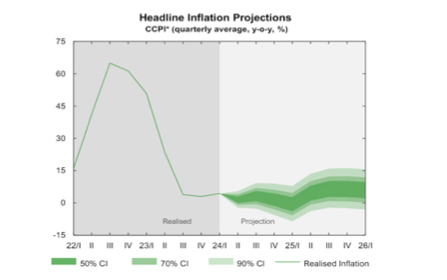
The projection for the next 12 months is reasonably low. With the passage of the new Central Bank Act, the government and the CBSL have agreed on a 5.0 percent target for the coming years.
The 2024 budget proposed an LKR 10,000 monthly increase in public sector salaries from April of 2024. But subsequently it was revised so that the eligible would receive half of that amount starting January and the rest as planned in April. The government requested the private sector to provide a raise in salary to their employees as well, but only some firms were able to do so. In the worst hit estate sector, plantation workers have been agitating for an increase in their wages, but the planation companies have been resisting the calls on the premise that it can be done only if linked to productivity.
To assess the ability to manage the cost of living and to have something left over, we asked the respondents about their expected personal savings in the coming 12 months.
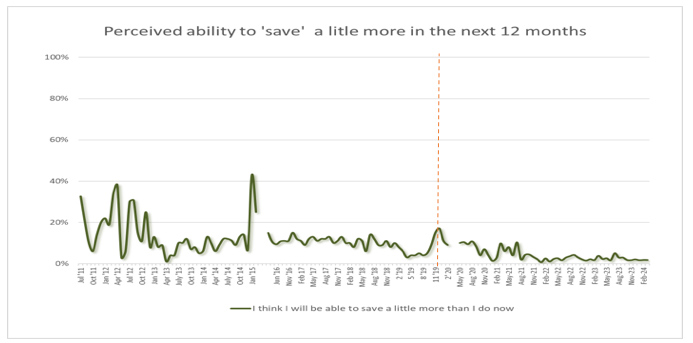
By the end of 2022 those who thought they could save a little more than at present were at a low of 1.4 percent. But as inflation began to fall this perception gradually rose to 3.8 percent by the end of the first quarter 2023 and with inflation falling rapidly it increased to 5.1 percent in July but fell again to 2.9 percent by September 2023 with increasing taxes and utilities. It had fallen to 2.0 percent by end December 2023. Throughout the first quarter of 2024, people’s ability to save little more remained below 2.0; at 16 percent in January, 1.8 percent in February and 1.7 percent in March. This goes to show how desperate the people have become. It is quite obvious that the general population has hardly any hope for the future.
2.4 Will corruption be reduced?
The question posed is if the respondents perceive that corruption will lessen in the coming 12 months. It is quite clear that people of Sri Lanka seem to have lost hope in attacking corruption. It is significant that post the change of the presidency in 2019 and the parliament in 2020 hope rose but soon it fell.
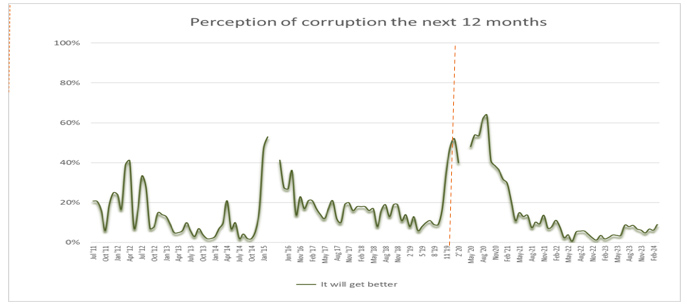
The perception of reducing corruption was around 8.6 percent at the end of third quarter 2023. This was very likely the result of government and opposition coming together to agree on legislation on the new anti-corruption Act in line with global best practices. However, that sentiment had reduced somewhat with the figure falling to 4.8 percent by end of the fourth quarter.
In a turn of events, the perception of fighting corruption saw a significant rise during the first quarter 2024. This is very likely due the signal event of the arrest of a sitting cabinet minister; Keheliya Rambukwella. He was accused of misappropriation in the procurement of medicines and medical equipment during the crisis. Even though the government was able to defeat the no faith motion against him in Parliament the courts directed his arrest, a very rare occurrence. The case is ongoing.
2.5 A Question on Global Integration
Besides the questions we ask respondents monthly to establish trends, we also seek to understand how people react to current issues. Given the lack of hope in the economic conditions and the need to reverse this trend, there are two schools of thought developing in the current discourse. One is a more insular structure where domestic players are protected with high import tariffs and other levies, duties, and quantitative restrictions. This is relevant because what seem to be a large section of society is of the view that it was the liberalization of the late 1970s that created an ‘open economy’, even the factually incorrect as many restrictions remained, that caused the economic crisis of Sri Lanka by ‘killing off’ domestic industry and ‘privatizing’ state owned enterprises. A smaller group is to open the country and integrate with the world. This calls for trade reform including lowering of tariffs and forcing domestic producers to compete with regional and global manufacturers.
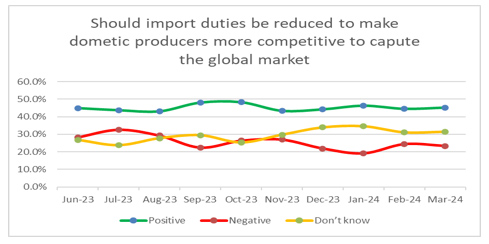
The responses continue to be unexpected with those agreeing to be more than those disagreeing with a fair number saying they are unable to comment. The We plan to monitor this trend to assess if this thinking will be sustained.
3.0 Concluding Thoughts
Hope continues to elude Sri Lankans despite a few downward adjustments in prices due to the strengthening currency. The only bright spot is that the perception of fighting corruption has increased marginally with the jailing of a cabinet minister. By and large the data suggests Sri Lankans are quite desperate. A glance at the data from the last almost thirteen years suggest that it would be at the next election that the people will have an opportunity to revive their hope.
The Foundation of Economic Freedom appreciates the generous support by the Friedrich Naumann Foundation for Freedom to undertake this work.
Video Story