

February, 12, 2026
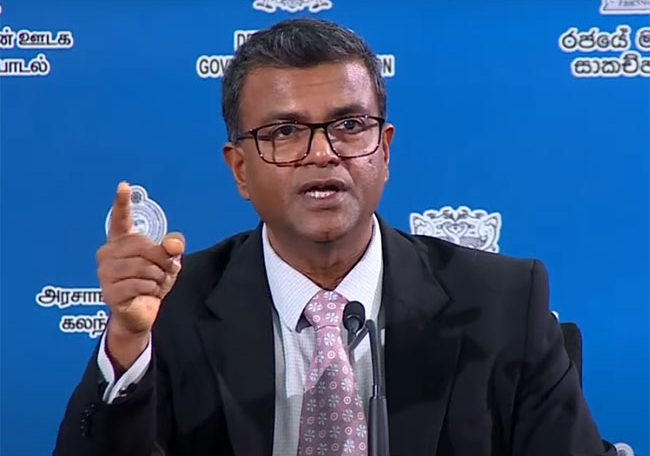
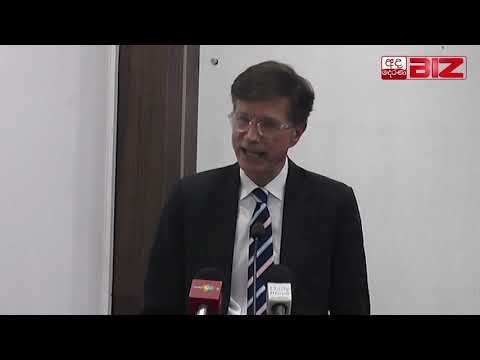
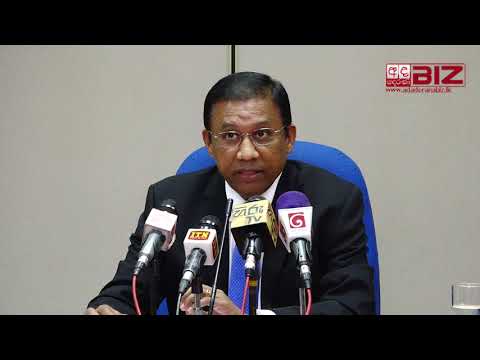
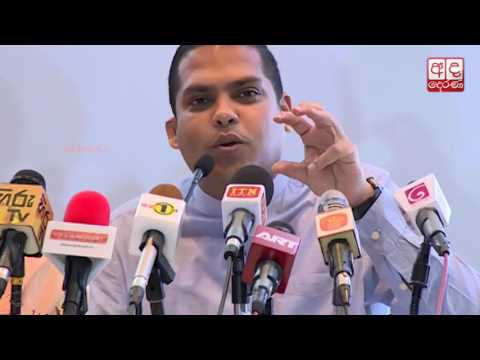
Sri Lanka is on track to complete its external debt restructuring and secure the next tranche of IMF funding, Treasury Secretary Dr. Harshana Suriyapperuma told International Sovereign Bond (ISB) holders yesterday, highlighting improved macroeconomic stability and strong reform momentum under the IMF Extended Fund Facility (EFF).
He said agreements have been reached with creditors representing nearly 99% of Sri Lanka’s external debt, with more than 92% already restructured, while public debt has declined significantly to around 105% of GDP by mid-2025 from a peak of 145% in 2022. Despite the $4.1 billion damage caused by Cyclone Ditwah, recovery spending has been transparently incorporated into the 2026 Budget without derailing fiscal consolidation, he noted.
Today, I will talk to you and walk you through the key highlights of the mid-2025 Public Debt Report, recent macroeconomic developments, and the status of all public sector reforms and debt restructuring progress. I will also address the economic implications of Cyclone Ditwah and the policy response that is now fully under way.
As you know, Cyclone Ditwah, recorded by the UN and the Sri Lankan Meteorological Department as one of the most destructive climate events in recent decades, struck in November 2025.
It affected roughly 20% of the country’s landmass, displaced over 100,000 citizens, and caused an estimated $ 4.1 billion in damage to homes, roads, electricity networks, and social infrastructure. According to the UN (OCHA) and the World Bank rapid damage assessment, transport and housing were the hardest-hit sectors. This was a major shock, but our macroeconomic foundation, built since the 2022 crisis, has remained resilient.
The reform momentum under the IMF Extended Fund Facility (EFF) strengthened institutions, and better fiscal discipline allowed us to integrate recovery spending into the 2026 Budget in a transparent manner, without undermining our medium-term consolidation path. We are also pleased to present updates on the performance of the new administration elected at the end of 2024. The Government’s continued adherence to structural reforms has allowed Sri Lanka to maintain strong IMF program performance and move closer to completing its external debt restructuring.
Participants are welcome to submit questions through the chat function. All answers will be consolidated and published on the Finance Ministry website after this call, together with today’s presentation materials.
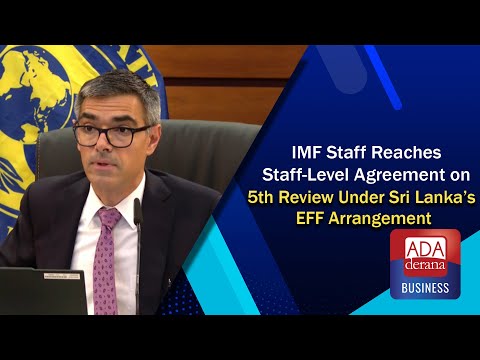
At the end of 2025, IMF staff reached a staff-level agreement on the Fifth Review, with Board approval deferred to early 2026 to allow additional time to assess the impact of the cyclone.
We expect to complete the review and obtain approval early this year, possibly following the decision in March.
As stated by the IMF, our ambitious reform agenda continues to deliver commendable outcomes despite significant socio-economic disruptions, political tensions, unprecedented debt restructuring efforts, and, more recently, evidence of climate risk impacting our island. Indeed, our program remains on track to end in 2027, as initially established with the IMF during our first engagements in 2022.
Upon completion of the fifth Executive Board review, Sri Lanka would have access to an additional $ 350 million, bringing total IMF financial support disbursed under the arrangement to about $ 2 billion. Such disbursements, combined with our performance under the program, showcase a powerful vote of confidence from the international community in our reform agenda.
The cyclone’s total recovery and reconstruction needs are estimated at $ 4.1 billion, of which $ 1.62 billion is required for 2026, in line with joint statements by the World Bank, Asian Development Bank (ADB), and the UN. This cost spans housing, transport, irrigation systems, health infrastructure, and coastal protection. Importantly, the full fiscal impact has been incorporated into the 2026 Budget.
In parallel, we have prioritised transparency by presenting all cyclone-related allocations under dedicated budget lines and updating the Budget to integrate reconstruction costs without compromising the overall fiscal consolidation path.
We mobilised rapid support from our development partners, including $ 206 million in emergency financing from the IMF and timely assistance from the World Bank through the reallocation of funds towards affected sectors. We also extend our gratitude to bilateral partners and on-the-ground organisations whose early relief efforts helped stabilise conditions immediately after the disaster.
Reconstruction spending is expected to provide a moderate near-term boost to domestic activity, consistent with patterns observed after the 2017 floods and other recent climate events. While tourism saw temporary disruptions in November 2025, arrivals rebounded strongly in the first quarter of 2026, supported by resilient source markets such as India, the UK, and Russia, as well as generally positive global sentiment. Reflecting this progress, the IMF reiterated in its Executive Board statement confidence in Sri Lanka’s resilience and strong commitment to the reform programme.
Since the election, the new administration has continued implementing key reforms in line with the five pillars of the IMF program. Particular focus has been given to strengthening support for the vulnerable through reforms to the social safety net and to growth-enhancing reforms by fostering private sector-led growth and creating a conducive business environment. On the fiscal side, revenue-based fiscal consolidation is continuing in line with revenue targets set by the IMF, while fiscal structural reforms are advancing to ensure growth-based macro-fiscal stability.
Currently, we are focused on raising Government revenues incrementally by strengthening tax administration and compliance, with ongoing efforts to improve the VAT system and collection, and possibly adjust tax structures for FY 2027 as agreed with the IMF.
State-owned enterprise (SOE) reforms continue to advance. The flagship initiative remains the unbundling of the CEB into five specialised entities — generation, transmission, distribution, system operation, and market operations. This restructuring aims to enhance governance, transparency, and financial discipline and is aligned with global best practices.
The public enterprise reform process is progressing, working closely with international partners to finalise governance frameworks, audit processes, and transition timelines. In parallel, the Government continues to implement cost-reflective electricity pricing to eliminate quasi-fiscal losses, a key IMF structural benchmark.
Sri Lanka’s public debt stock as of June 2025 reinforces our significant progress towards long-term sustainability. From a peak of 145% of GDP in June 2022, public debt has now decreased to about 105% of GDP, thanks to the combined effect of external debt restructuring and an increase in nominal GDP reflecting Sri Lanka’s strong economic performance.
External debt consists of around 35% of Government debt stock, balanced across multilateral, bilateral, and commercial sources. Multilateral debt accounts for 36% of total Government external debt, followed by commercial debt at 34% and bilateral debt at 30%. Approximately 81% of commercial debt comprises ISB issuances, with the remainder consisting of foreign currency term financing facilities. The ADB and the World Bank are the major multilateral creditors, representing over 85% of total multilateral debt.
Under bilateral debt, 59% is represented by non-Paris Club countries, while about 41% are Paris Club countries. Investors are welcome to access detailed data reporting on the Ministry of Finance website. The Public Debt Management Office publishes a comprehensive Public Debt Report on a semi-annual basis, as well as quarterly debt bulletins.
About 75% of Sri Lanka’s external debt is contracted at fixed interest rates, while 22% is at floating rates, helping to limit interest rate volatility. Currency diversification remains limited, with the majority of exposure in US dollars. These statistics are calculated on contractual flows of external debt as of mid-2025 and include a minority of facilities still undergoing restructuring.
We expect average interest rates to decline further as agreements are implemented and average tenure to lengthen. We are now very close to completing debt restructuring fully aligned with IMF program parameters. Agreements have been reached with creditors representing nearly 99% of Sri Lanka’s external debt, and more than 92% has already been fully restructured, supported by steady progress in bilateral signings with members of the Official Creditor Committee (OCC).
On the bilateral side, the majority of eligible claims have now been restructured, with discussions continuing only with a small number of non-OCC bilateral creditors and certain other lenders, where negotiations have taken slightly longer than anticipated.
On the commercial front, restructuring was largely completed in December 2024, when Sri Lanka exchanged 98% of its outstanding ISBs for new instruments and finalised revised loan agreements with others. Court proceedings remain ongoing with sole holdout bondholder Hamilton Reserve Bank, and a discovery process is currently underway.
As of February, Sri Lanka has signed agreements with nine OCC members covering $ 4.2 billion in claims — Japan, India, France, Hungary, the UK, Austria, Australia, Denmark, Germany, and Belgium. Agreements with Spain and Korea have been finalised and are awaiting formal signature, while discussions with remaining bilateral creditors are progressing constructively.
Sri Lanka is on track to achieve all IMF debt sustainability targets, even assuming the first threshold of the variable MLBs is triggered. Debt indicators have continued improving relative to previous IMF reviews due to improved macroeconomic conditions.
The restructuring has restored access to external financing, with multilateral and bilateral disbursements resuming, and domestic market conditions normalising due to lower yields. The Central Bank has stopped providing monetary financing to the Government, supported by improved fiscal performance.
After completion of the international sovereign bond exchange in December 2024, all three major international rating agencies upgraded Sri Lanka’s long-term issuer rating to CCC+.
Sri Lanka’s economic growth has exceeded expectations with nine consecutive quarters of positive real GDP growth. The IMF projects 4.2% growth for 2025. Although the cyclone led the IMF to trim the 2026 forecast to 2.9% from 3.1%, the Central Bank expects growth of 4.5% to 5% for 2025 and 2026.
Sri Lanka improved its primary balance from a deficit of 3.7% of GDP in 2022 to a surplus of 3.8% in 2025. The easing of vehicle import restrictions in 2025 generated over Rs. 904 billion in tax revenue, compared with the original projection of Rs. 441 billion.
Foreign exchange reserves continue to build. The current account moved from a $ 1.8 billion deficit in 2022 to a provisional $ 1.7 billion surplus in 2025.
In closing, we remain firmly committed to completing restructuring, implementing growth-enhancing reforms, and strengthening governance and transparency.
Video Story