

March, 30, 2026
Business Sentiment - Geopolitics Clouds BIZ Confidence
March brought a wave of challenges that spilled over from extreme tensions in the Middle East into Sri Lankan waters, raising concerns about the island’s economic outlook and hinting at potential difficulties in the months ahead.
The ripple effect of escalating tensions between the US-Israel combine and Iran – and the broader regional instability in the Gulf States – has had noticeable implications for Sri Lanka.
Here at home, tensions intensified when an Iranian tanker plying the Indian Ocean was torpedoed by the United States, prompting Sri Lanka to intervene in accordance with international maritime obligations by assisting with rescue and repatriation efforts.
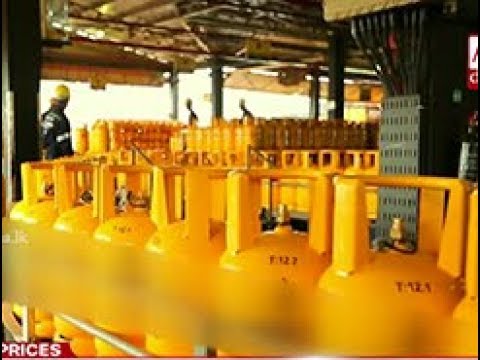
At the same time, domestic pressures have mounted: a shortage of domestic gas, which was already in the pipeline, worsened amid the Middle East crisis – though some observers attribute this to local supply issues vis-à-vis a ‘mafia.’
The price of Brent crude oil surged as tensions escalated, surpassing US$ 100 a barrel in the second week of March – for the first time since November 2022.
Indeed, the impact was immediately felt locally: fuel prices have been increased twice since then, adding renewed pressure on both households and businesses.
The tourism industry is also expected to feel the impact: some sources estimate that a week’s closure of airspace in the Middle East would cost the country nearly US$ 15 million in forex inflows. Also under threat are inflows from workers’ remittances.
While reports suggest the conflict is testing the world’s economic resilience, President Anura Kumara Dissanayake has assured that Sri Lanka can withstand the potential fallout from the Middle East crisis – until the end of April, at least.
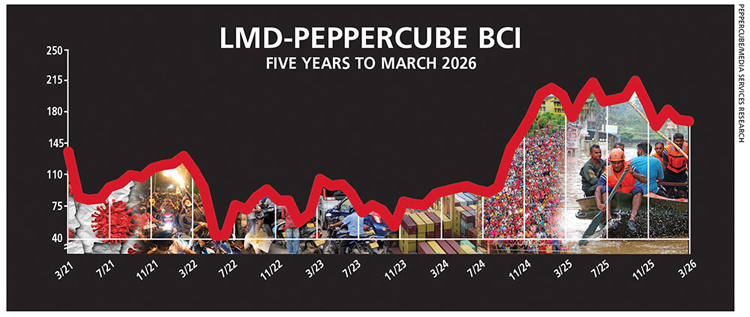
THE INDEX Against this backdrop, the latest LMD-PEPPERCUBE Business Confidence Index (BCI) took another dip, falling by three points from 171 in February to 168 in March.
Despite the decline however, the barometer remains 43 notches above its historic median of 125 but sits 19 points below the 12 month average of 187. By comparison, the index stood at 197 in March last year.
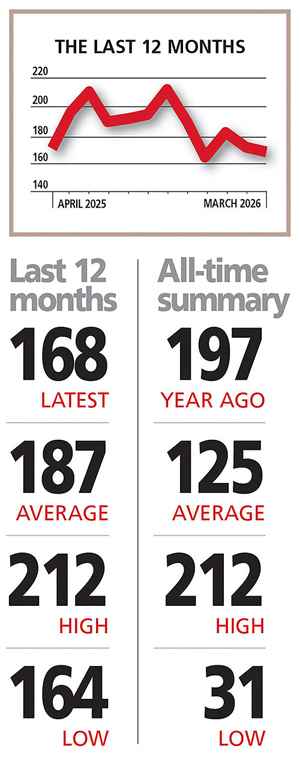
According to PepperCube Consultants, the March BCI reflects the initial systemic shock triggered by the outbreak of the conflict.
Meanwhile, the Governor of the Central Bank of Sri Lanka Dr. Nandalal Weerasinghe has stated that Sri Lanka is now better equipped than it was during the economic crisis to absorb shocks stemming from oil price volatility.
PROJECTIONS Looking ahead, the trajectory of the BCI will largely depend on how global geopolitical tensions evolve – and how effectively Sri Lanka manages the domestic spillover.
If energy prices stabilise and supply disruptions ease, the index could regain its footing in the coming months. However, prolonged uncertainty in global markets may continue to weigh on corporate confidence.
For the time being at least, businesses are likely to remain cautious, closely monitoring external developments while setting plans to navigate an uncertain economic environment.
Video Story