

April, 27, 2026

Sri Lanka's apparel exports fell 8% in the first quarter of 2026 compared to last year, but the data is revealing specific opportunities where targeted policy action could turn things around.
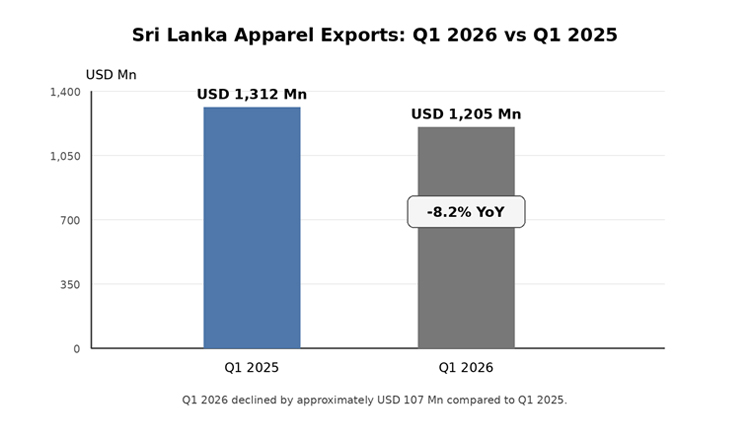
January's 3% decline deepened to 11% in both February and March. While global demand has softened, the late February escalation of Middle East tensions will likely show its full impact in the coming months as supply chains adjust.
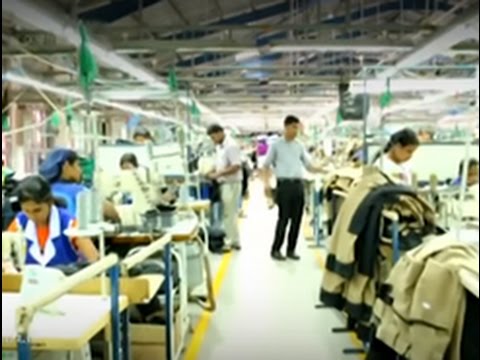
The sector is grappling with higher operating costs fuel, electricity are driving up operational costs by adding nearly USD 3 million monthly to industry expenses. For manufacturers working on tight margins, particularly smaller players, this represents a genuine challenge that smart policy can address.
On Energy for example, JAAF has consistently lobbied for meaningful reform of legislation to allow the unlock of open access and power wheeling. This will ensure that we get the maximum growth in renewable energy, reducing our reliance on fossil fuels.
USA: Shows resilience and opportunity
The United States, which buys 40% of Sri Lankan apparel, saw exports decline just under 8% in Q1 slightly better than the overall performance.
Consumer conditions are tightening with rising fuel prices and inflation approaching 4.8%, alongside geopolitical uncertainties. But this creates an opening for value-focused products and strategic positioning.
On the trade policy front, there's a need for immediate action. . After the Supreme Court ruling on reciprocal tariffs, a temporary 10% duty under Section 122 was introduced in February for 150 days. This gives Sri Lanka a defined window to engage and advocate.
The Section 301 investigations by the USTR, covering 60 countries including Sri Lanka, present a chance to demonstrate strong labour standards enforcement. With public hearings ahead, Sri Lanka can build on its previous success in negotiating down tariffs from 44% showing that proactive engagement delivers results.
While tariff refunds from the Supreme Court ruling are due to commence shortly, these will, almost always accrue to the US buyers who are the importers on record, rather than to the local garment manufacturers as shipments are primarily on either FCA or FOB terms., understanding this dynamic helps manufacturers negotiate better terms upfront and strengthens the case for government advocacy on their behalf.
JAAF has always lobbied for a parity of tariff across our competitor countries and Sri Lanka will need to show commitment in this space to ensure that we do not end up with a tariff that is higher than those of our competitors.
Continued focus on the USA tariff position needs to be front and centre of Government policy.
Europe: Securing the foundation
The European Union remains a strong second market, with Q1 exports down just under 8% manageable given global conditions. The traditional markets of Italy, Germany, the Netherlands, Belgium, and France continue to perform, while Spain's March growth hints at diversification potential.
The real opportunity lies ahead: securing GSP+ renewal beyond 2027. With clear preparation and engagement, Sri Lanka can build on its current duty-free access and potentially expand its European footprint.
India and UK: Worth building on
India delivered nearly 10% growth in Q1 proving demand exists in accessible markets. The current 8 million piece cap under ISFTA hasn't changed in 20 years, which means there's enormous room to grow if that limit is raised through ISFTA revisions or the proposed ETCA agreement.
The UK market is responding positively to recent Developing Countries Trading Scheme improvements. Womenswear and school-wear segments are gaining traction, creating a foundation for broader market recovery.
The action plan
From JAAF’s perspective, Q1 has brought clarity on what needs to be done next. Priorities are clear: accelerate energy reform to ease cost pressures, secure GSP+ to protect and expand access to Europe, engage proactively with the US during the Section 122 window and Section 301 hearings, and move forward on trade access with India to unlock a high-growth market.
These are not long-term ambitions. They are immediate, actionable steps with clear timelines and tangible impact.
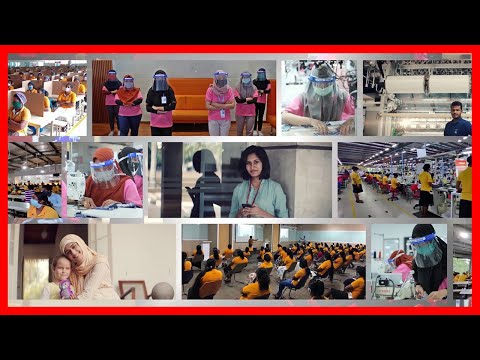
Sri Lanka’s apparel sector has navigated difficult cycles before and adapted. The fundamentals remain strong, with a skilled workforce, established buyer relationships, and proximity to key markets. With timely policy support, the industry is positioned not just to manage current pressures, but to strengthen its footing in a more competitive global landscape.
Video Story