

May, 27, 2026
By Prof. Samitha Hettige
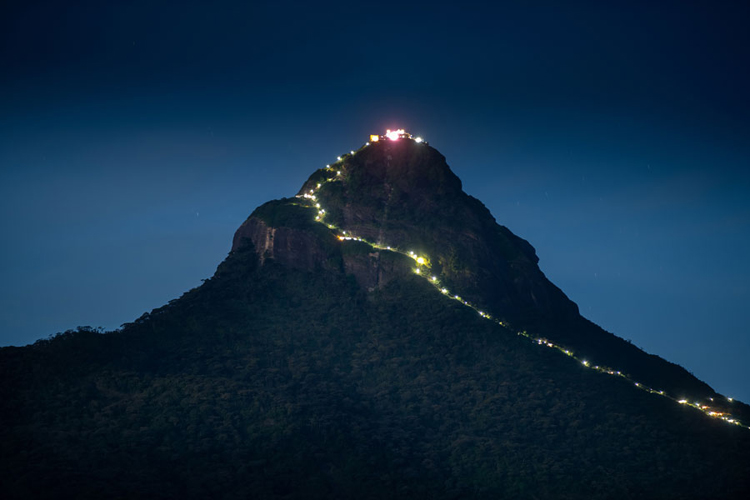
The Sripada (Adam's Peak/ Samanala kanda) pilgrimage season running from December full moon day to May full moon day ended recently. President Premadasa was the last head of state to climb the mountain (early 1990s) after King Nissnaka malla (Ref. Mahavansa). The ‘Samanala’ hydroelectric power station (‘Laxapana dam’) built across the ‘Maskelioya-oya’ downstream of the ‘Laxapana’ water fall is also located in close proximity. When the Samanala hydroelectric power station was completed, then government built the power line to illuminate Adam’s peak when Sir John Kotelawala was minister of public works. Since then Sri Lanka has constructed many power transmission lines stretching over hundreds of kilo meters. The longest of them all is the approx. 150 KM long ‘Polpitiya-Hambantota’ 220kV, double circuit, three phase transmission line with one Optical Fiber Ground Wire (OPGW) & one Galvanized Steel Wire (GSW). It includes 484 towers & is the first & longest 220kV transmission line in Sri Lanka that exclusively uses Chinese products (Ref. sunjelec.com).
International Standards of Chinese power transmission.
Chinese engineers developed a new international standard for corrosion testing of conductive materials used in power transmission systems. It marks a significant step forward in global grid safety & reliability. The "Corrosion of metals & alloys – Testing methods for corrosion of conducting alloys in AC electric current condition," was officially published by the International Organization for Standardization (ISO) recently. Total length of global power transmission & distribution lines at present exceeds 80 million KM (Ref. Media). They use conductive materials such as copper & aluminum & their alloys are used in transmission cables & associated hardware. During live operation, alternating current, fluctuating electromagnetic fields & atmospheric corrosion agents interact in ways that can significantly degrade materials. The impact is more in coastal & industrialized regions & corrosion is a major challenge for grid operators. More than 30% of overheating & fractures in conductor materials are directly linked to corrosion. Thus it is a key threat to the long term safety of power infrastructure. The new standard specifies seven critical parameters. They include;
Above conditions simulate electromagnetic field distribution on transmission conductors operating at frequencies of 50 or 60 hertz, enabling more realistic corrosion kinetics & corrosion rate measurements (Ref Chinese standards Organization). The new standard is expected to support more precise corrosion prediction, differentiated anti corrosion strategies & service life assessments for transmission equipment. It could also help reduce maintenance & operational costs by more than 10%. The release of the standard highlights is expected to increase global recognition of Chinese technical capabilities in corrosion testing for power conductor materials. They are also expected to support the development of strategic emerging industries while contributing to safer & stable operation of global energy infrastructure.
Wind power & Natural gas standards
Chinese proposal on international standard on offshore wind power also has been officially approved by the International Electrotechnical Commission (IEC). It is the first IEC international standard in this field. Chinese experts are leading it with counterparts from France, Germany & UK. The new standard is expected to establish a comprehensive framework for harmonic assessment across the entire life cycle of offshore wind projects (planning, construction & operation).
The ISO has also released five international standards for the natural gas sector led by China. They are supposed to provide a "Chinese solution" for improving efficiency & safety in global energy industry with quantitative benchmarks. Notable among the new standards are the;
Experts say these standards shall reduce trade & arbitration disputes in global energy industry. Sri Lankans expecting rising energy bills & all who suffer from the Iran conflict would know the value of resolving energy sector conflicts.
Views expressed are personal. Photo source www
Video Story