Reuters - Oil prices fell on Thursday after a ceasefire deal between Israel and Lebanon
boosted hopes for a broader agreement to end the U.S.-Israeli war with Iran that could lead to a reopening of the Strait of Hormuz.
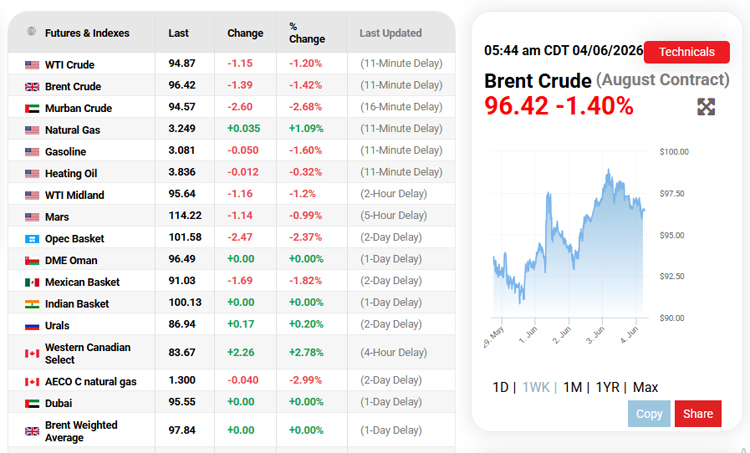
Trade was cautious and losses were limited. Brent futures were down $1.14, or 1.2%, to $96.67 a barrel at 1022 GMT, while U.S. West Texas Intermediate crude was down 90 cents, or 0.9%, to $95.12.
The two contracts rose about 2% on Wednesday after renewed Middle East
hostilities, including Iranian attacks on Kuwait and U.S. military strikes near the Strait of Hormuz.
Israel and Lebanon said late on Wednesday they had agreed to
implement a ceasefire, raising hopes for a deal between Washington and Tehran. Iran has made any agreement conditional in part on an end to fighting between Israel and Hezbollah, an Iran-aligned group in Lebanon.
"Iran insists on a halt to Israel's aggression toward Lebanon, meaning Hezbollah, and indeed there does seem a breakthrough," PVM Oil analyst John Evans said.
Lebanese President Joseph Aoun said on Thursday that the ceasefire would come into force within 24 hours of all concerned parties approving it.
U.S. President Donald Trump suggested on Wednesday there could be progress in negotiations with Iran as soon as this weekend.
Iranian Foreign Minister Abbas Araqchi said on Wednesday Tehran's contacts with Washington had not been cut off, but no progress had been made in the negotiations, adding both sides were studying texts that were exchanged.
In the U.S., the Republican-led House approved a resolution on Wednesday to block Trump from continuing the war against Iran. To take effect, the resolution would need Senate approval and two-thirds majorities in both chambers to override an almost certain Trump veto.
"In our view, the path of least resistance for prices remains to the upside as long as flows remain restricted," UBS analyst Giovanni Staunovo said.
Deputy Prime Minister Alexander Novak
said on Thursday that Russian oil production has fallen since the start of the year due to unplanned refinery maintenance, marking the first time a Russian official has acknowledged the decline.
Meanwhile, U.S. crude stockpiles
fell by 8 million barrels to 433.7 million barrels in the week ended May 29, the Energy Information Administration said on Wednesday. That was a much bigger drop than the 4-million-barrel draw analysts had expected in a Reuters poll.
Slowing Chinese demand has also helped temper rising prices.
Iranian oil prices
slipped into discounts for the first time since April, while Russian crude premiums eased as traders cut prices to entice Chinese buyers amid sluggish demand, trade sources said.