

June, 19, 2026
Anyone who has tried to make a sensible decision about money in Sri Lanka knows how it usually goes. You open one bank's website, then another, then a few more. One shows its rates inside a PDF. Another hides the number a few clicks deep. A third has not been touched in months, and there is no way to tell. An hour later you have a messy list in a notepad and you still are not sure you are comparing the same thing.
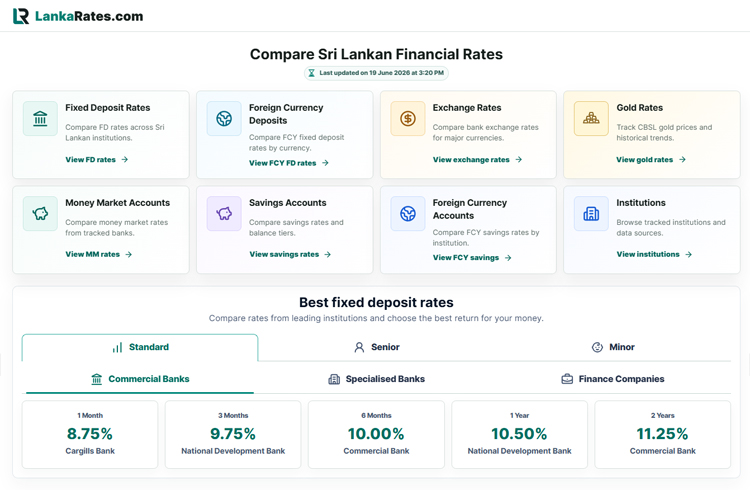
LankaRates.com was built to fix exactly this. It is a free website that collects rates from banks and financial institutions around the country and puts them in one place. You can line them up against each other, look at how they have moved over recent weeks and months, and click through to see where each number came from.
AT A GLANCE
Comparing rates in Sri Lanka has always taken more work than it should. The questions are ordinary ones. Which bank has the best fixed deposit rate right now? How has the rupee moved against the dollar over the last month? Which savings account actually pays more once you read past the headline number? The information is out there, but it is scattered across dozens of sites in dozens of formats, and putting it together by hand takes ages.
LankaRates.com closes that gap. It gathers the numbers from across the market, keeps a record of how they change, and lays everything out in one consistent format, so a comparison that used to take an hour takes a few seconds.
It is not just a page of numbers. Each section is built around a question people actually ask:
Two areas do most of the heavy lifting, so they are worth a closer look.
The exchange rates section lists buying and selling rates for the currencies people here actually use, from the US dollar, sterling and euro to the Australian and Singapore dollars and the main Gulf currencies. It keeps telegraphic transfer rates separate from currency note rates, so you are reading the right number for the way you are moving money. The useful part is the split: when money is coming to you, the bank's buying rate is what matters, and when you are buying foreign currency, the selling rate does. Each list is sorted so the best option for your situation sits at the top.
The fixed deposit section covers banks and finance companies across the market, with general and senior citizen rates wherever banks publish them. The usual one, three, six and twelve month terms are all there, but so are the promotional deposits banks quietly run on odd periods like 100, 200 or 400 days, the kind of thing you would never spot checking a single website. The built-in calculator does more than convert a single rate: set the amount and how long you want to lock it away, and it runs the numbers across every option to show which banks give you the best return, in real money rather than a headline percentage.
The rest of the site works the same way. The savings and money market sections show what banks pay on balances you want to keep within reach, tiered by how much you hold, so you can tell at a glance whether your account is falling behind. Separate sections cover foreign currency fixed deposits and foreign currency savings, handy if you are paid from abroad or keep savings outside the rupee. And the gold section tracks prices by karat and weight with full history, following Central Bank figures.
Most rate websites only show you today. But you do not change banks every week, so a single day's snapshot is not much use on its own. What you really want to know is which banks give you good value over time, and for that you need history.
Think about someone who gets paid from abroad and converts the money every month. It does not help much to know which bank had the best exchange rate on one random day. It helps a lot more to know which banks usually offer better rates over the long run. Because LankaRates.com keeps a record going back in time, you can see that pattern in the history charts and settle on a bank you can rely on month to month.
Savings work the same way. If you know which banks tend to pay more on fixed deposits and savings accounts, you can put your money where it earns the most and leave it there. Over a few years, even a small difference in rate adds up to real money.
The aim is not to tell anyone where to put their money. It is to make the information easy to find and easy to check for yourself.
Every comparison site eventually gets the same two questions from its users. Where did this number come from, and is it still current? LankaRates.com tries to answer both. Each figure links back to the bank or official source it came from, so you can check it yourself. Each set of rates also shows the date and time it was last updated. A lot of financial information online gives no sign of whether it is from this morning or last year, so it is easy to act on something out of date without realising. Here you can see how old the numbers are before you trust them.
The site also stays out of the business of recommending. It does not rank banks by who pays for a better spot, and it does not push any particular product. It is meant to be a neutral place to narrow down your options, not a sales pitch.
Financial data is technically public, but public does not mean easy to get to. Spread across dozens of sites in different formats, it is out of reach for most people who do not have time to chase it down. LankaRates.com does that work once and shares the result.
It is free, it works on phones and computers, and it keeps things simple. No jargon, no sign-up, just the numbers laid out clearly. The site keeps growing as more history builds up and new features get added, with the longer-term goal of giving a fuller and more open picture of money in Sri Lanka.
You can start at lankarates.com.
Explore LankaRates.com
Video Story