

July, 14, 2026
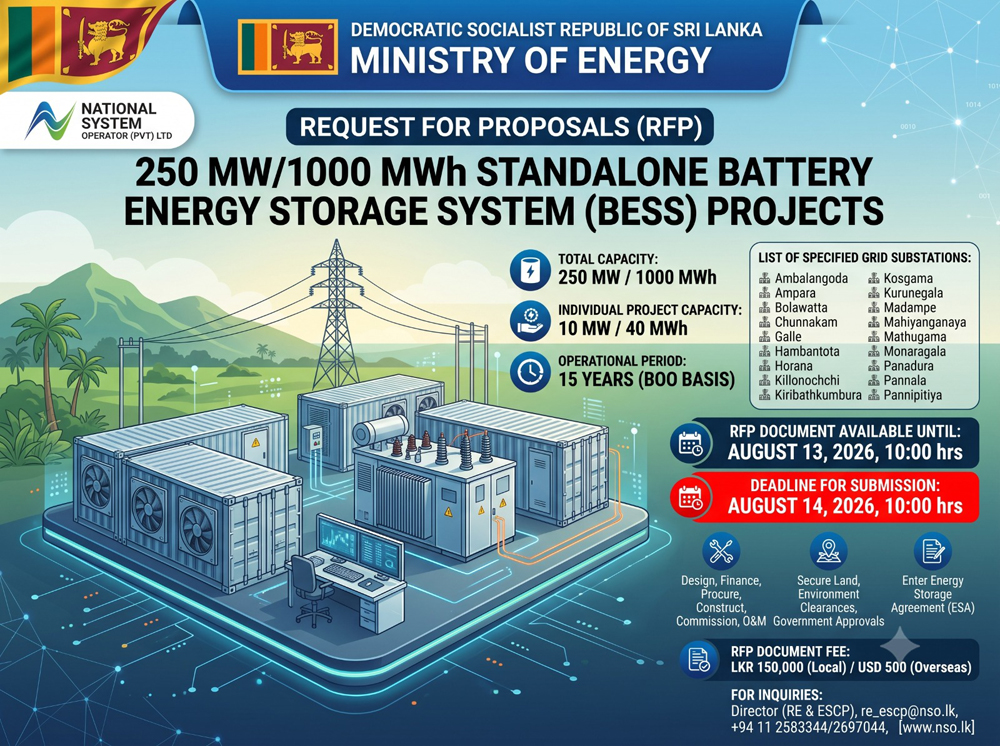
The National System Operator (Pvt) Ltd (NSO), operating under Sri Lanka's Ministry of Energy, has launched an International Competitive Bidding (ICB) process for the establishment of a 250 MW/1000 MWh Standalone Battery Energy Storage System (BESS), one of the largest grid-connected storage procurements the country has undertaken to date.
Under the tender, reference number TR/REP&PM/ICB/2026/001/C, developers will build 10 MW/40 MWh capacity blocks at 25 grid substations across the island, including Ambalangoda, Ampara, Bolawatta, Chunnakam, Hambantota, Kurunegala, Matara, Galle and Monaragala, among others. Projects will be developed on a Build, Own and Operate (BOO) basis, with successful bidders entering into a 15-year Energy Storage Agreement with the NSO. Connection will take place at the 33kV voltage level.
Proposals are due by 10.00 hrs on August 14, 2026. The RFP Document is available until August 13, 2026, for a non-refundable fee of LKR 150,000 for local proponents, or USD 500 for overseas proponents. Developers are required to design, finance, construct, commission, operate and maintain their projects, cover the full cost of grid interconnection, and secure all environmental and statutory approvals before proposals are considered by the Cabinet Appointed Negotiation Committee.
The tender reflects a broader global shift toward battery storage as core power infrastructure. According to the International Energy Agency's Global Energy Review 2026, the world added 108 gigawatts of new battery storage capacity in 2025, a 40 percent increase over the previous year, with installed capacity now around eleven times higher than in 2021. The IEA's Electricity 2026 report projects that global storage capacity will need to grow roughly sixfold, to about 1,500 gigawatts, by 2030 to support the international goal of tripling renewable generation.
Industry observers say the ability to offer investors a stable, storage-backed renewable grid has become an increasingly important factor in attracting foreign direct investment, particularly from export-oriented manufacturers. Data from the RE100 initiative, which tracks major multinational companies committed to sourcing 100 percent renewable electricity, shows manufacturing now accounts for around 28 percent of member companies' total electricity demand, the second-highest share of any sector. Companies including Apple, Google, Infosys, Tata Motors and TSMC have built renewable energy procurement into their operations and increasingly expect the same from suppliers and host countries.
The BESS tender is aligned with Sri Lanka's existing energy and climate policy framework. Under the National Energy Policy (2019), the country has committed to developing indigenous renewable resources, diversifying its generation mix, and reducing dependence on imported fossil fuels to below 50 percent of primary energy supply by 2030. The Cabinet of Ministers has approved a target of generating 70 percent of the country's electricity from renewable sources by 2030, a commitment reflected in Sri Lanka's Nationally Determined Contributions under the Paris Agreement.
At the national climate level, the Ministry of Environment's Carbon Net Zero 2050 Roadmap and Strategic Plan sets out a sector-by-sector pathway toward carbon neutrality by 2050, spanning energy, transport, industry, waste, agriculture and forestry. Sri Lanka reaffirmed this commitment in its third Nationally Determined Contribution, submitted in September 2025, which sets an economy-wide emissions reduction target for the 2026–2035 period. Grid-scale battery storage, officials say, is one of the practical pieces of infrastructure needed to make that renewable-heavy, net-zero-aligned grid a reality rather than a long-term aspiration.
Video Story