

August, 3, 2026
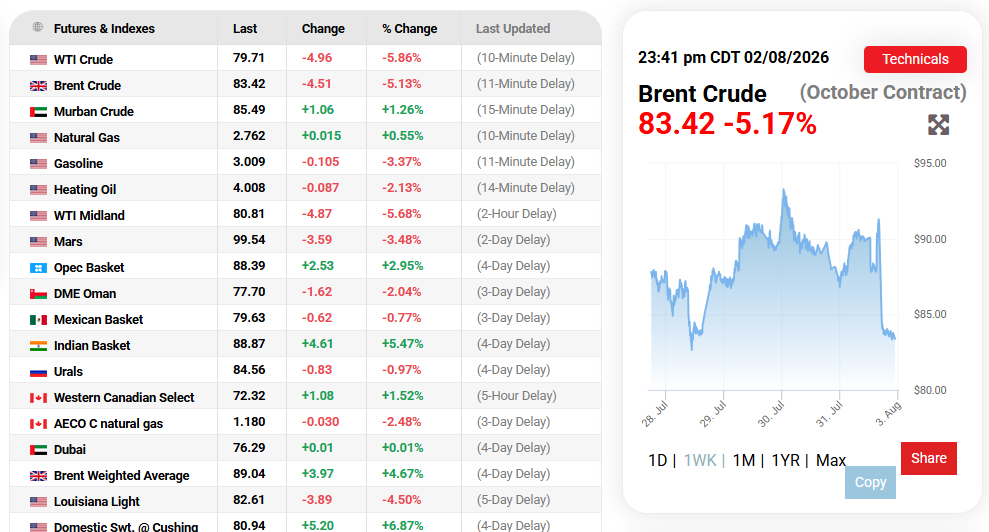
Oilprice - Oil prices fell sharply in early Asian trade on Monday (03) after President Trump called off another round of military strikes on Iran, raising hopes that a diplomatic route to reopening the Strait of Hormuz and averting a broader regional conflict could be found.
At the time of writing, West Texas Intermediate futures were trading at $79.77 per barrel, down 5.88%, while Brent futures had fallen to $83.47, down 5.07%.
The most recent selloff comes after a very volatile July in which both benchmarks surged more than 20% as renewed hostilities between the U.S. and Iran and a blockade of Saudi ports by the Houthis stoked fears of prolonged supply disruptions through the Strait of Hormuz and the Red Sea.
On Saturday, it seemed that disruptions would worsen further when Trump warned that the U.S. was preparing to launch what he described as the "biggest attack since World War II" against Iran. The President then called off that planned attack, saying regional leaders had convinced him that a deal was close.
As has happened so many times since this war started, the prospect of de-escalation saw oil prices tumble when markets opened on Monday. Only time will tell whether this time will be any different or if it is a repeat of previous efforts at diplomacy.
On the shipping front, two Saudi oil tankers successfully transited the Bab el-Mandeb Strait over the weekend, showing that Red Sea traffic is still moving. The United Kingdom Maritime Trade Operations agency, however, reported three additional tanker attacks since Saturday, showing that maritime risks remain elevated in the region.
Adding to the downward pressure on oil prices, the OPEC+ group approved a production quota increase of roughly 188,000 barrels per day for September, completing the unwinding of one layer of its voluntary production cuts. In normal circumstances, that news would have a significant impact on prices, but as actual output increases have remained limited due to disruptions across the region, the news is less immediately relevant.
It isn't just the U.S. making sounds about diplomacy, with Iranian officials saying negotiations with Oman over a new shipping arrangement through the Strait of Hormuz are in their final stages. Tehran has continued to insist that vessels will no longer be permitted to use the previous southern shipping lane off Oman's coast, indicating that even if the Strait reopens, shipping patterns could change significantly.
If negotiations hold and shipping in the region can return to normal, much of July's geopolitical premium could continue to unwind in the coming weeks. But without a broader agreement, any renewed military escalation or disruption to Gulf exports would likely send crude prices surging higher.
By Josh Owens for Oilprice.com
Video Story