

September, 1, 2026
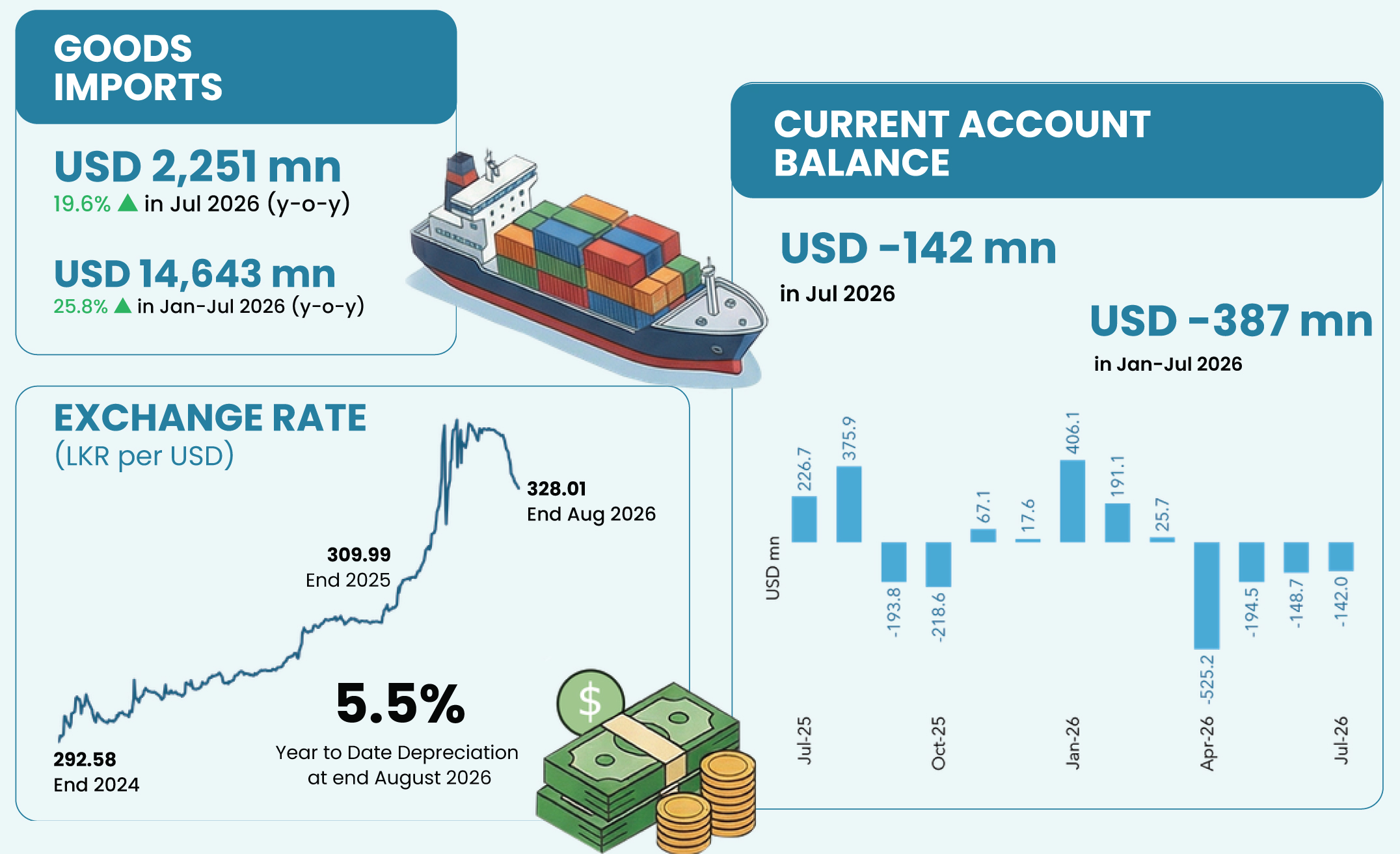
Sri Lanka’s external current account recorded a deficit of US $142 million in July 2026, marking the fourth consecutive month in negative territory as the nation navigates severe headwinds from geopolitical developments in the Middle East. According to the latest data, the cumulative external current account has slid into a deficit of US $387 million during the first seven months of 2026 (January–July), presenting a stark contrast to the surplus recorded during the corresponding period of 2025.
The primary catalyst for this shift is a widening merchandise trade deficit, which expanded significantly due to elevated import expenditures and weaker export performance. During the January–July 2026 period, Sri Lanka’s cumulative trade deficit ballooned to US $6.5 billion, up from US $3.9 billion recorded during the same period in 2025.
A massive surge in fuel costs remains a heavy anchor on the trade balance. Although monthly fuel import expenditures declined marginally from US $465 million in June 2026 to US $453 million in July 2026, fuel import costs skyrocketed by 68.0% year-on-year in July 2026. This spike was predominantly driven by higher expenditure on crude oil imports. Over the first seven months of the year, cumulative fuel import spending reached approximately US $3,622 million, representing a 59.9% year-on-year increase compared to the same period in 2025.
In addition, motor vehicle import expenditures, encompassing both personal and commercial vehicles, stood at US $241 million for the month of July. This brought the cumulative vehicle import bill for the January–July 2026 period to US $1,495 million.
As a result of these soaring import costs, Sri Lanka’s terms of trade deteriorated on a year-on-year basis in July 2026, as the prices of imports rose at a faster pace than those of exports—a trend that has persisted throughout the January–July 2026 cumulative period.
The services sector, traditionally a key pillar of support, provided mixed signals. The services account recorded a surplus of US $244 million in July 2026, reflecting a 23.0% decline compared to July of last year. However, on a month-on-month basis, the surplus surged by 50.7% from June, bolstered by a revival in tourism earnings. Reflecting an ongoing, year-on-year moderation in the services account, the cumulative surplus for the first seven months of the year fell by 22.4% to US $1.8 billion.
In terms of physical arrivals, tourist numbers dipped marginally by 1.7% year-on-year in July 2026. Cumulative tourist arrivals for January–July 2026 reached 1,343,418, trailing the 1,368,288 arrivals recorded during the same period in 2025. Tourism earnings followed a similar pattern, estimated at US $286 million in July 2026, a 10.3% decrease year-on-year, but a remarkable 88.9% jump compared to June 2026. On a cumulative basis, tourism revenues for the year-to-date declined by 11.5% to US $1.8 billion.
Despite the trade pressures, strong workers’ remittances and robust official reserves have offered a vital safety net. Workers' remittances grew by 11.5% year-on-year to US $778 million in July 2026. This brought cumulative remittances during the first seven months of the year to US $5.4 billion, a substantial 21.4% increase on a year-on-year basis.
Capital markets also saw divergent trends. The government securities market recorded a notable net foreign investment inflow of US $159.4 million in July. Conversely, the Colombo Stock Exchange (CSE) experienced a marginal net foreign outflow of US $6.3 million across both primary and secondary market transactions during the month.
Crucially, the country's Gross Official Reserves (GOR) remained resilient, recorded at US $6.6 billion by the end of July 2026. This figure, which includes the currency swap facility with the People’s Bank of China (PBOC), has been supported by active foreign exchange purchases by the Central Bank.
On the currency front, the Sri Lankan Rupee (LKR) depreciated by 5.5% against the US Dollar on a year-to-date basis by the end of August 2026. However, market pressures on the rupee have begun to ease, with the currency showing some appreciation in recent weeks. This stabilization is attributed to the impact of recently implemented monetary, fiscal, and macroprudential policy measures designed to steer the economy through its external sector challenges.
Video Story