


October, 6, 2026

Fitch Ratings: Artificial Intelligence poses a material risk of credit rating downgrades for issuers in a narrow band of sectors under an adverse scenario, Fitch Ratings says in its report “Artificial Intelligence Stress Test”. Most issuers and transactions would not face broad rating changes.
Fitch conducted an AI stress test spanning the Corporates, Financial Institutions, Infrastructure and Structured Finance sectors that scored credit exposure over a five-year horizon under three adverse scenarios: disruption, over-investment and asset-impairment.
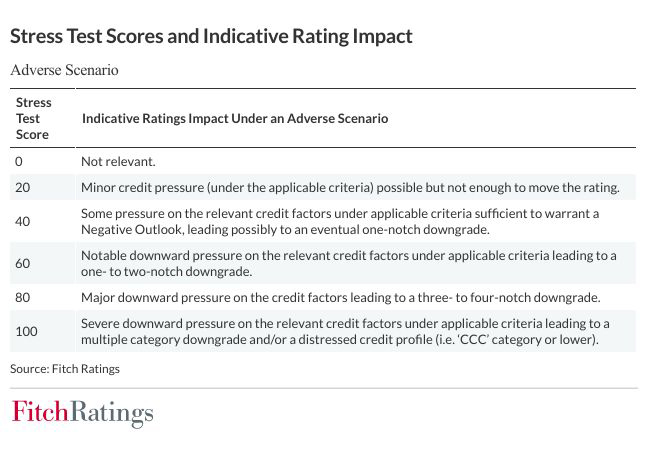
In the disruption scenario, AI erodes competitive positions faster than incumbents can adapt. The over-investment scenario includes a lower-than-anticipated AI monetization and a reduction in capital flows funding the AI ecosystem capex. And under the asset impairment scenario, there is a deterioration in loans and investments to AI-exposed entities. Each of these scenarios is calibrated to an approximately 10%-20% likelihood of occurring over the next five years and are not mutually exclusive. Scores run 0-100. At 40 or above, there could be negative rating implications for a representative entity in the sector under an adverse scenario, based on applicable Criteria. The scores are detailed in the chart below.
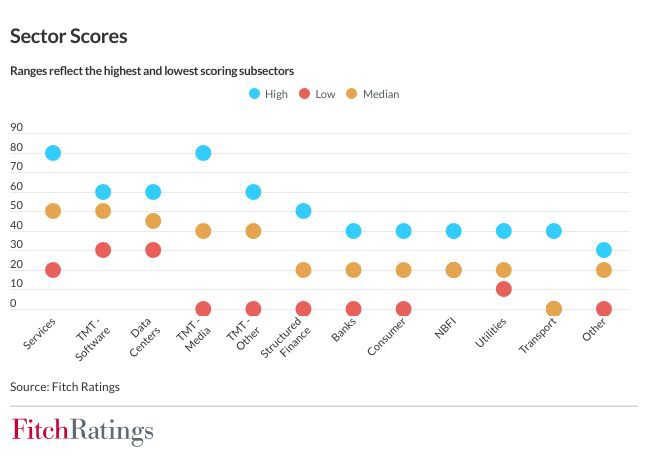
Our sector stress test covered 107 individual sub-sectors grouped into 21 broader sectors. About 86% of the sub-sectors scored 40 or below, indicating limited-to-no ratings impact. This points to generally broad sector resilience to the relevant AI adverse scenarios. However, 14 sub-sectors either scored 60 or 80, indicating more notable downward pressure on credit factors that could lead to one or more notch downgrades. These sub-sectors were concentrated in the services, data centers, and telecommunications, media & telecom (TMT) sectors. Least likely to be affected were insurance, real estate, transportation and natural resources.
A handful of sectors within FI scored 40 including those with more private client exposure (e.g. private banking and wealth management) and asset portfolio risk (e.g business development companies). Most however ranged between 0-20 reflecting protection afforded by diversification, regulation, capital buffers and risk management.
The disruption scenario gauges exposure to business disruption from rapid deployment of AI, including for tasks that are currently seen as too complex or error-prone to be substituted by AI. Incumbent sectors have limited time to adapt business models, and business moats such as high barriers to entry and switching costs are eroded. Services sectors are most exposed, with business process outsourcing and outsourced production services having the highest risk scores (80). Several other services and media/software subsectors - including insurance brokers, IT services, and cybersecurity/IT operations - scored 60. Other subsectors are more insulated, benefiting from regulation, client relationships, enterprise integration or switching costs.
The over-investment scenario centers on sectors’ exposure to investment in the AI eco-system. It focuses on a loss of confidence in AI’s return on investment, limiting access to capital and resulting in a sharp drop in capex by hyperscalers and other AI value-chain participants. Risk exposure concentrates in semiconductors, memory/storage and AI training facilities, which all scored 60. AI training centers in remote locations with concentrated, lower-quality tenants are likely to be more exposed. GPU/AI compute ABS has the highest Structured Finance score at 50, reflecting exposure to AI-specific collateral and counterparty performance if AI investment weakens.
The asset-impairment scenario – stress to AI-exposed loans and investments rather than direct business disruption – is a risk more relevant for certain Financial Institutions, particularly Business Development Companies which score 40, and are a factor in Structured Finance.
This first phase of the AI Stress Test, which identified where sector-level exposure is most acute, will be followed later by issuer-level analysis, applying the same three-scenario framework across individual Corporate, Financial Institutions and Infrastructure issuers. For full details of our sector-by-sector analysis, please refer to the report available to subscribers through the link above. We also plan a webinar, the details of which will be posted on our events page shortly.
Video Story