

August, 21, 2019
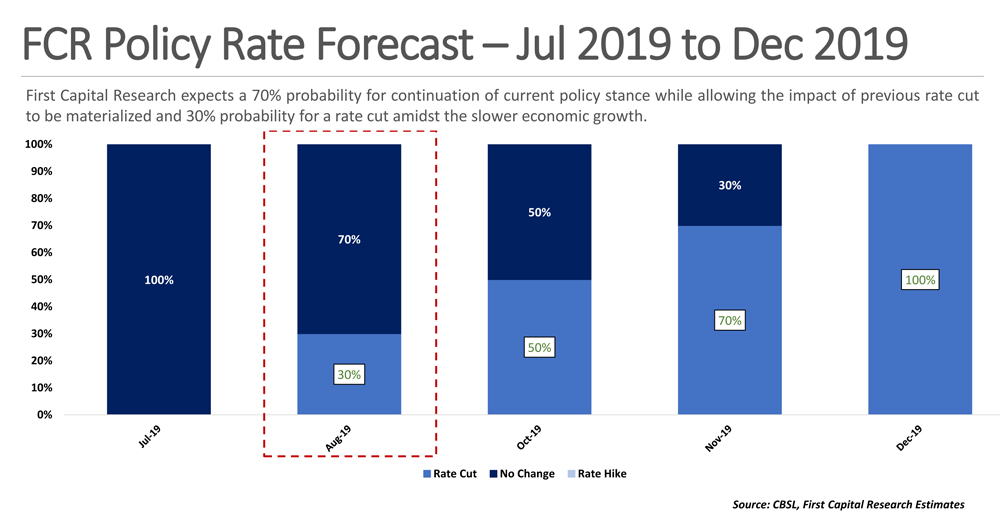
With manufacturing and credit signaling signs of recovery in economy and vulnerabilities affecting the external outlook, Sri Lanka’s First Capital Research believes that the Central Bank may delay the monetary easing while allowing the impact of the previous rate cut to materialise.
Accordingly First Capital Research assigned a higher probability of 70% for a neutral policy stance at the upcoming policy meeting.
“Considering the slowness in the revival of economic growth, we would not rule out a possible lending rate cut though presently at a lower probability,” the research arm said.
“Thereby, we maintain our Aug 2019 expectation of a 30 probability for a 25 bps rate cut for the SLFR as mentioned in our previous report. However, we are more biased for a rate cut towards 4Q 2019,”
First capital further noted that activities in the economy have been improved although at a slower pace while credit growth and lending slightly picking up in June.
In the external front, The Federal Reserve cut its rates for the first time since 2008 by 25bps ranging from 2.00% -2.25% to provide more support to the economy.
Accordingly first capital expects slower growth and rising risks will impel the Fed to cut rates further before the end of this year.
The anticipation comes as Goldman Sachs just announcing that it reduced its GDP projections by 0.2% and Bank of America Merrill Lynch said it sees increasing chances of a recession in the next 12 months.
As trade tensions escalate and economic indicators weaken, Wall Street is beginning to anticipate more aggressive interest rate cuts from the Federal Reserve.
Following the US rate cut, India, Philippines, and New Zealand also cut their policy rates citing growth concerns.
Central banks in a number of other countries including Malaysia, Russia, Ukraine, Nigeria, South Africa, Egypt, Brazil and Paraguay also lowered interest rates recently.
Although, lower US rates and eased monetary conditions worldwide was expected to assist Sri Lanka in attracting more foreign inflows, heavy foreign outflows have occurred in the recent 2 weeks with dollar bonds and rupee bonds spiking across the yield curve.
Global trade tensions and heightened political uncertainties due to the upcoming elections are expected to have influenced foreign investors to revert back to the safe haven of the US Dollar and other less risky asset classes.
Thereby, the Rupee also has shown signs of weakness continuously depreciating over the last 4 weeks.
Video Story