

November, 10, 2020
The convincing win by the SLPP at the general election to cement the win at the presidential election seem to have failed to strengthen hope on economic opportunities in the face of a possible second wave of the pandemic.
Methodology
The PEOI is calculated based on data collected on an island-wide random survey of face-to-face interviews of 500 persons.
Presentation of Findings
We have experimented with presentation of the findings of the survey over the years since we initiated the study in July 2011 and settled on highlighting the share of respondents who perceive their economic opportunities would get better in the coming 12 months in comparison to the present. Answers to a couple of other selected questions (from eleven we pose to the respondents) are regularly presented while others we do whenever we see fit.
Perceived Economic Opportunity
The question posed to the respondents is if they believe their opportunities, be it in the workplace or in their business would increase, stay the same or diminish in the year ahead.
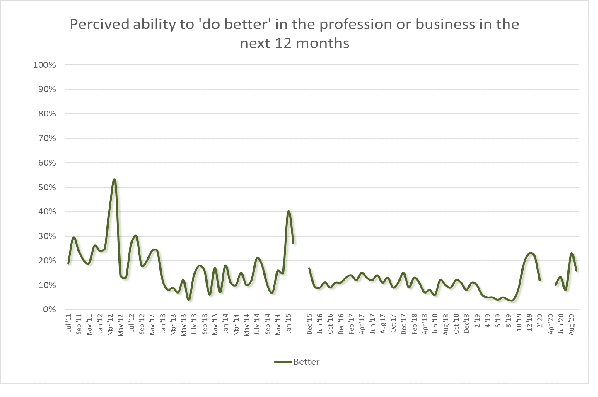
The economy moving back to a ‘new normal’ with the lockdown almost over and a convincing win for the Sri Lanka Podujana Peramuna (SLPP) of President Gotabaya Rajapaka and his Prime Minister brother Mahinda Rajapaksa in early August, renewed the hope of economic opportunities among the people. [Note: These results are prior to the second coronavirus lockdown.] By end August 2020, 23 percent of those surveyed felt that the opportunities would get better; this is exactly equal to the figure obtained post the presidential elections of November 2019 when President Rajapaksa assumed office. However, this sentiment was much lower than the 40 percent registered when President Sirisena won the election in January 2015.
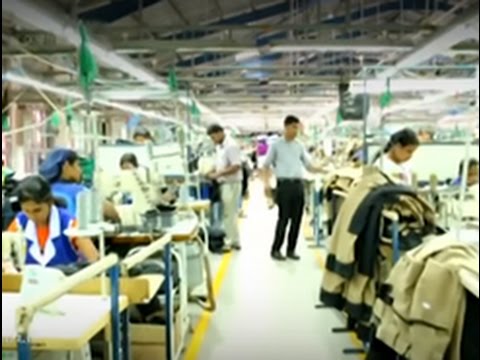
The renewed hope was certainly understandable and expected given the fear of a long and uncertain lockdown that would have caused severe economic hardship on the people seem to have gone away. People were looking forward to restarting their livelihoods and enterprises were beginning to slowly ramp up capacity. While those in tourism related, construction and retail etc. were hardest hit, prospects for many other sectors seemed positive. But as news spread of a possible second wave of the coronavirus hitting the country with an unconfirmed cluster appearing at an apparel factory in the town of Minuwangoda in the Gampaha district by end September, the mood changed again with positive sentiment falling to 16 percent. The fall in confidence seem to have been limited because the severity of a possible second disruption was not known at the time. The government position was that there could be some possible isolated cases but the health authorities were in control of the situation.
Thus, the perceptions on economic opportunities in the first three quarters of 2020 was impacted by two major opposite shocks; one positive, the electoral victories of the Rajapaksa dominated SLPP giving hope of a more effective government; and the other negative, the unprecedented shock to the economy due to the lockdown of vast swathes of the island due to the spread of the pandemic. Going in to the final quarter of 2020 the sentiments of the population would hinge on the impact of the second lockdown and the expectation of the ability of the new government to contain the spread of the virus in order to ensure economic activity to take place.
Perception on Ability to Save
Here our objective is to determine the perception on saving.
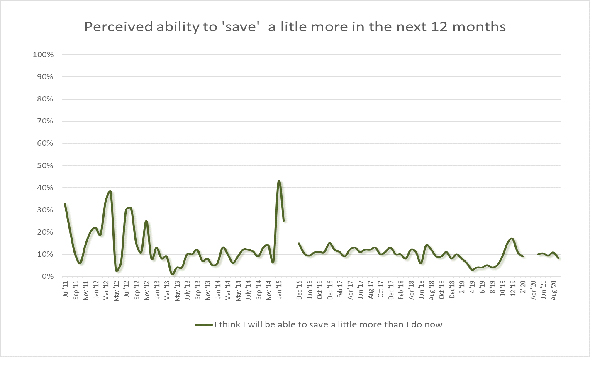
Having obtained their views on cost of living and ability to save some of what they earn, we asked the respondents on their perceptions on their personal savings in the coming 12 months. The perception on the public’s ability to save a ‘little more’ than what they do at present continued to remain at the low levels of around 10 percent recorded after the November 2019 presidential election. While the sentiment for economic opportunities did rise after the general election in August before dissipating again, the probable reason for stickiness here could be that savings of most would have diminished significantly during the last lockdown and also the uncertainty of obtaining sufficient income to save in the emerging unpredictable scenario.
It is noteworthy that other indicators, particularly by the Central bank of Sri Lanka, suggest that indebtedness among the population has increased as many were unable to meet their daily expenses due to decreasing income. While those who had outstanding loans did receive some relief due to moratoria for several months on loans and leases, large number of credit card holders had not been able to meet their minimum monthly dues.
Perception on Corruption
Every day, people complain about corruption from the highest to the lowest person of authority. Whether factual or not the perception of corruption is high. The question posed is if the respondents perceive that corruption will lessen in the coming year.
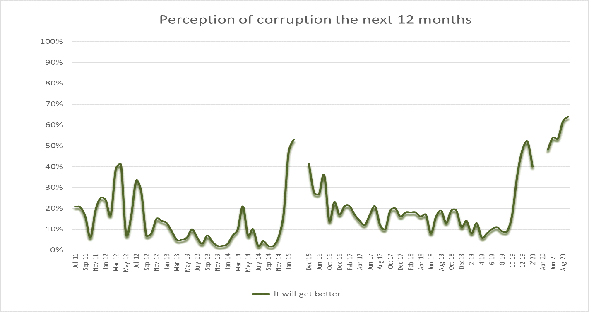
It is heartening to note that the perception among the people that corruption will fall in the coming twelve months is the highest recorded since we started measuring it almost ten years ago; at 64 percent. The steep rise, from around 10 percent just before the presidential election, is the most significant finding in many years.
Concluding Thoughts
The general perception of the public about their future as captured by the two questions on economic opportunity and ability to save reflected a significant positive movement with the election of President Gotabaya Rajapaksa in November. However, that sense of positivity was short-lived with expectations falling to levels just above what was witnessed before the election in only a matter of three months. Thereafter with the unprecedented disruption of the economy due to the Covid19 lock-down the hope for opportunity starting in May through July was very subdued. Then, with the strong win for PM Mahinda Rajapaksa and a stable government with both the presidency and the legislature in the hands of the SLPP hope emerged for renewed growth by end August. But, with the possible second wave of the pandemic perceptions dimmed again. How the opposing forces; down from the pandemic and up from political stability, will impact the perception on economic opportunity will be seen in the next quarter. The government will also present its maiden budget in the coming quarter.
Policy makers can use the perceptions identified and tracked in this unique study we have been conducting monthly since July 2011 to develop and fine-tune their policies.
Video Story