

August, 4, 2021
Sustainability is a word we hear more frequently now in the corporate domain. Organisations are waking up to the need to come up with solutions not geared just for the here and now, but for the foreseeable future. Brandix Apparel Limited saw this future well in advance, opening the world’s first LEED Platinum rated apparel manufacturing facility as far back as 2008. Today, Brandix’s Environment Sustainability Framework encompassing Air, Water, and Earth is part of its DNA, embraced by all at Brandix as a way of life.
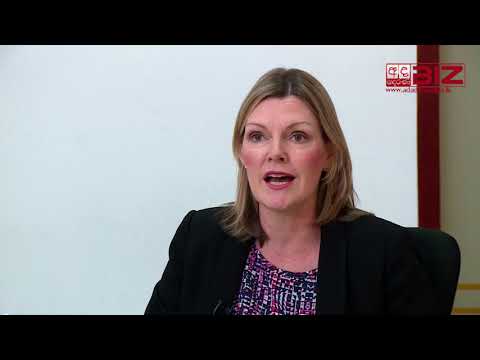
We spoke to Vinura Jayewardene, Engineer - Sustainability at Brandix; a young gun with a mission to help make Brandix’s network in Sri Lanka a net zero carbon operation by 2023. Armed with a Master of Engineering in Mechanical Engineering specializing in Sustainable Energy Systems from the University of Southampton, backed by two years of active involvement in making Brandix future-ready, Vinura shared his views on sustainability in one of the world’s most polluting industries.

Tell us about sustainability. Is it a buzz word, or is it backed by substance?
Sustainability is a go-to word in today’s context, especially in the background of the more apparent effects of unsustainable industrial practices manifesting all around us. The apparel industry was one of the early adapters of sustainable practices, and we are at the forefront of industries adopting cleaner and greener technologies. If you take Brandix, for example, sustainability is a function of our daily operations and is well-integrated across the business, as it should be.
Our sustainability programmes revolve around the elements. Renewable energy and resource optimisation come under Air, with the goal of Net Zero Carbon emissions across our manufacturing network in Sri Lanka by 2023. Under Water, we have deployed new technology to achieve zero water wastage, provide safe drinking water, and ensure Zero Discharge of Hazardous Chemicals. We envisage recycling and reusing 100% of waste under the Earth pillar, through material circularity strategies among others.
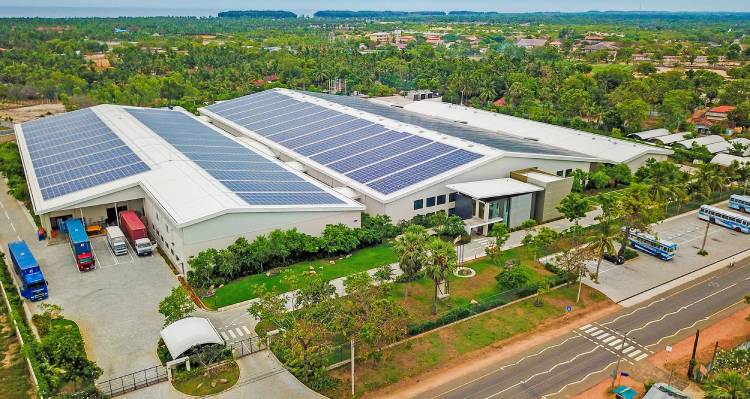
We are also proactive in ensuring our practices and infrastructure are sustainable, which led to us securing the world’s first LEED Platinum status for an apparel manufacturing facility in 2008for our factory in Seeduwa. We’ve continued in that same spirit, and our latest LEED rated facility in Batticaloa is a prime example, being the highest LEED Platinum rated facility in Sri Lanka and second highest in the world, as well as being the world’s first apparel manufacturing facility to achieve Net Zero Carbon status.
Can you expand more on what you said earlier about integrating sustainability into infrastructure?
Yes. Our built environment can be a contributor to waste or be a champion of saving, depending on its design and utility. At Brandix, we’ve been committed to green design since we began our sustainability journey in 2007. It also works well with our focus on minimizing our carbon footprint through long-term measures of energy optimization and utilizing on-site renewable energy resources across our manufacturing operations.
For example, let’s take our facility in Batticaloa. It’s designed according to US Green Building Council and ASHRAE (American Society of Heating, Refrigerating and Air-Conditioning Engineers) building guidelines. Since around 44% of energy is generally consumed for the cooling of the building, we optimized the cooling energy through the building design itself. We prudently used the orientation of the building to make it naturally cooler and added solar panels on the roof for additional insulation whilst generating energy. As a result, we save over 53% of energy in comparison to a conventional factory building.
We also utilise a Building Management System that continuously monitors and controls the facility’s energy demand and indoor air quality with a special focus on temperature and CO2 levels. This allows consistent energy consumption avoiding overuse and ensures the perfect ambient working environment for our employees working in the building.
What types of innovative methods go into making a building and operations greener, whilst also being productive?
The air quality monitor explained above is one such innovation, which completely alters user experience for the better while being sustainable. Simple yet effective innovations such as the use of Solar Tubes to complement the use of LED lighting, and internally developed air-saving devices to reduce compressed air wastage by over 40% have been deployed.
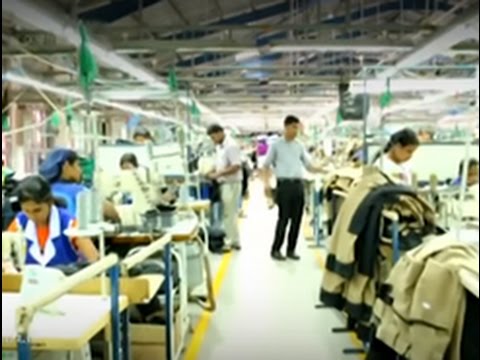
In addition, we have 1800 sewing machines at the Batticaloa premises that are operational for 16 hours every day. We have equipped these machines with low-powered VSD Servo Motors, saving 68 - 73% of energy when compared with a traditional Clutch Motor.
Our food waste composter produces compost from leftover food from the premises within a span of 24 hours, which is then used as fertilizer around the premises and given to Associates for their home gardens as well.
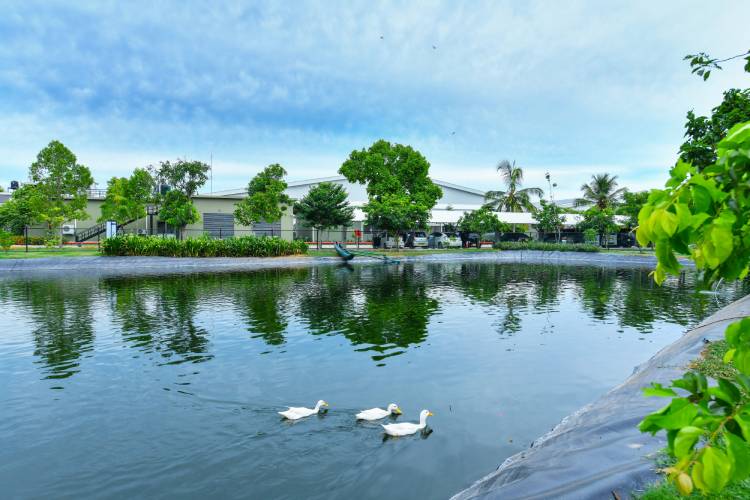
A common misconception is that sustainability is not aesthetically viable. But at our Batticaloa facility, we have a Treated Water Pond that contains water from the Sewage Treatment Plant (STP), that is full of fish, ducks, and birds that contribute to enhancing the biodiversity of the premises, as well as make it a pleasing environment for our Associates.
What are some of the achievements you picked up along the way in Batticaloa to contribute to the Net Zero Carbon target for 2023?
Our installation of a 1.65 MW rooftop solar plant was initially Sri Lanka’s largest. The annual energy yield from it is 2,975 MWh, which even exceeds the annual energy requirement of the facility, resulting in a net reduction of over 1,500 tonnes of CO2 emissions annually and an overall reduction of over 31,000 tonnes over a period of 20 years, a sizeable statistic if you look at the big picture.
Where does this drive for sustainability come from? Is it customer driven, or is the drive organic from within?
In closing, let me emphasise that sustainability is not really a choice. If we don’t do what needs to be done today for the future, we will soon find ourselves trying to find solutions to a problem that has snowballed into something uncontrollable. Choosing to view sustainability from a holistic perspective and as a commitment that came to life at Brandix with sincere intent, helps ensure business continuity and facilitates a conducive and meaningful environment to do business from.
Video Story