

April, 2, 2026
Morison, formerly J.L. Morison Son & Jones (Ceylon) PLC, a pioneer in pharmaceutical manufacturing since 1959, and now a trusted subsidiary of Hemas Holdings, continues to shape the future of healthcare in Sri Lanka, by advancing local pharmaceutical manufacturing with quality and affordability, while building future-ready human capital to take the industry forward.
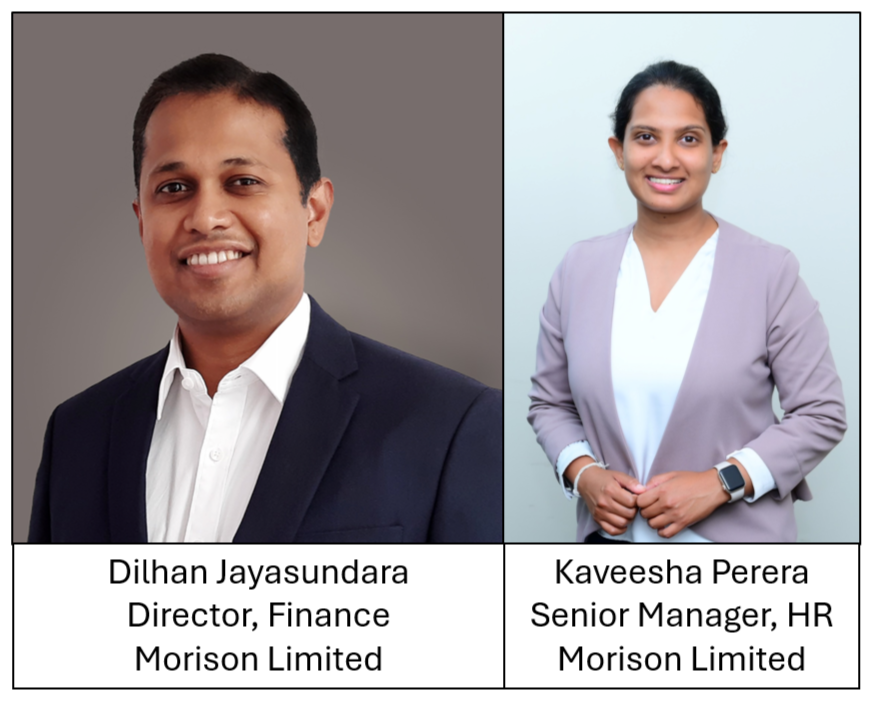
In conversation, Dilhan Jayasundara, Director Finance, and Kaveesha Perera, Senior Manager Human Resources, share perspectives on Morison’s transformation from the lens of their professional journeys within the company.
They highlight Morison’s unique position as a local manufacturer, the importance of branded pharmaceutical portfolios, the regulatory environment, and the career opportunities the industry creates for young professionals. Their insights reveal how Morison builds resilience, nurtures talent, and contributes to affordable, high‑quality healthcare to drive its purpose of ‘Making Premium Healthcare Affordable’.
Q: Tell us about yourselves and your roles at Morison
Dilhan: As Morison’s Finance Director, I shape our financial strategy, providing stewardship to drive the growth agenda of the company. With over 20 years of experience across diverse industries, I bring a broad perspective to the field, which I entered two years ago.
My role covers governance, corporate reporting, treasury, the finance operations of the two factories and a warehouse managed by a third party. Most importantly, I play a proactive role beyond the conventional finance function, supporting the company’s transformation by strengthening processes and systems as Morison evolves into a trusted pharmaceutical manufacturer in an import-dependent market. At the same time I focus on evaluating investment opportunities and maintain robust financial controls to safeguard Morison’s progress.
In terms of qualifications, I am a Fellow Member of ACCA and an Associate Member of CIMA. I hold an MBA from the University of Wales and a Bachelor of Science, Business Administration Special Degree from the University of Sri Jayewardenepura.
Kaveesha: I serve as Morison’s Senior Manager of Human Resources, with nearly 15 years of experience in HR. My career began in the apparel industry where I gained over a decade’s knowledge of HR practices, supported by a professional qualification from the Chartered Institute of Personnel Management of Sri Lanka, before transitioning into pharmaceutical manufacturing.
Moving from apparel to pharmaceuticals in 2022 was a significant but rewarding shift. The transition broadened my perspectives. Morison has nearly 400 employees and each day brings new experiences, diverse teams, and colleagues with specialized expertise. I am grateful to reinforce a workplace that encourages organizational success and individual development while contributing to a sector which directly serves the nation.
Q: What makes Morison unique as a pharmaceutical manufacturer, including its journey and long-term aspirations?
Dilhan: Morison has a long-standing industry presence. Our household OTC brands, Morison Gripe Mixture and the Morison Lacto range, are trusted by generations. However, many are not aware that Morison has been manufacturing pharmaceuticals for the last 60+ years, although our key focus was bulk generic manufacturing.
In 2018, Morison made a significant investment of LKR 4 billion to build a world-class pharmaceutical manufacturing facility in Pitipana, Homagama, marking a turning point in our strategy and future aspirations. While the main trigger for us to invest in another plant was the guaranteed Buyback orders from the government, inconsistency in policies made us rethink our direction. Today, our focus is firmly on building Morison into a trusted pharmaceutical brand in the private market, which is currently heavily dependent on imports.
Our purpose is to introduce much-needed niche and novel therapies to Sri Lanka and offering them with the highest quality yet at affordable prices. At the same time, we are laying the foundation to enter export markets.
Our differentiation lies in our six unique value propositions: Truly Sri Lankan, Global Quality, Local Price, Ethical, Novel, and Credible.
Q: Pharmaceutical manufacturing remains relatively new in Sri Lanka. What career opportunities does the industry create locally?
Kaveesha: In a science-driven industry such as ours, a workforce with strong technical expertise is essential. As Sri Lanka’s pharmaceutical manufacturing sector is still relatively new and the market is largely import‑driven, experienced professionals remain scarce. Career opportunities exist in manufacturing, quality assurance, quality control, research and development, etc.
Given the limited expertise available locally, we prioritize nurturing internal talent. We employ over 100 science graduates, primarily from local universities, with only two expatriates engaged in highly technical roles. Though our universities offer B.Pharm and B.Chem programs, graduates require practical exposure to be industry ready.
Q: With over Rs. 4 billion invested in local manufacturing, how do you view the policy and regulatory environment in supporting such long-term investments, and why is building Morison’s branded pharmaceutical portfolio critical to its strategy?
Dilhan: We invested LKR 4 billion in a facility built to global standards, targeting EU GMP certification. Constructing the same facility today would cost LKR 7 to 8 billion.
Establishing a pharmaceutical facility takes roughly two to three years followed by another year for qualification and regulatory approvals. In addition, the product development cycle of this industry is inherently long. Therefore, success in this sector requires a long-term commitment and patience. As such delays from regulators or sudden policy changes can undermine viability, making policy support critical.
I believe guaranteed government volumes and continuation of buyback agreement with government under stringent protocols would significantly strengthen investor confidence. At the same time, an efficient regulatory framework together with some brand rationalisation remain critical priorities to build a strong local manufacturing industry. Given Sri Lanka’s relatively small market size, having as many as 50 brands of the same molecule in certain cases may not be necessary.
Tax structures also require review. Imported pharmaceuticals are VAT‑exempt, however local manufacturers continue to pay VAT on packing materials and spare parts creating an uneven playing field. Further, concessions for R&D expenses would be valuable as it is investment heavy. Given that the sector involves multiple authorities including the Ministry of Finance, Ministry of Health, NMRA, and Customs, a greater alignment with a coordinated policy framework is essential.
Despite challenges, the potential is significant. Therefore, we focus on what we can control through building the right products, standards, and teams.
Patient safety is non‑negotiable. We take full accountability of the products we manufacture, from sourcing up until it reaches the patient, assuring quality at every step. Building strong brands allow us to compete with imports, secure margins, and reinvest in new product development, sustaining a robust pipeline. Ultimately, this enables us to deliver the market with high‑quality, much needed therapies in Sri Lanka.
Q: How does Morison nurture continuous learning, adaptability, and a strong workplace culture to uplift the industry?
Kaveesha: We recruit fresh graduates and provide extensive on the job and off the job training since pharmaceutical manufacturing demands adherence to complex operating procedures.
Morison’s culture emphasizes on the right attitude and aptitude. We encourage individuals to perform at their best and build on their strengths. Young professionals at our state‑of‑the‑art Homagama facility gain exposure to advanced technologies and cross‑functional opportunities, enabling personal and professional growth. I believe the opportunity to make a difference in Sri Lanka along with our purpose, ‘Making Premium Healthcare Affordable’, keeps teams motivated.
With a limited pool of industry professionals, mentoring internal talent pipelines is vital to building the sector’s intellectual property. We are proud that many employees who began their careers with us are now holding senior roles within the organization.
While migration continues to pose challenges, we firmly believe that we must do our part in developing the talent necessary for the industry as it evolves, while providing a sound solution for brain drain.
Q: What advice would you give young professionals considering a career in this field?
Kaveesha: Pharmaceutical manufacturing is not simply another career path, the medicines produced in our facilities will serve families across the nation, which could very well be our own. As such it is a responsibility demanding a firm commitment to quality. We encourage emerging professionals in the field to recognize the long‑term impact they can create for the country.
The learning curve requires time, focus, and discipline. Newcomers must undergo extensive training, follow rigorous SOPs, and take on complex testing and analysis. Joining Morison is not only about building your career but also about contributing to create a meaningful difference in Sri Lanka. With the right attitude, skills, and commitment to learning, young professionals can help shape the future of our country’s healthcare.
Video Story