

April, 9, 2026
The Ministry of Agriculture, Livestock, Land and Irrigation, with technical assistance from the Food and Agriculture Organization of the United Nations (FAO) and financial support from the Government of Japan, has announced a new USD 1.33 million project to enhance water productivity and climate resilience in Sri Lanka’s minor tank-based ecosystems.
The 12-month initiative (March 2026 – February 2027) will revitalize traditional minor tank cascade systems in Trincomalee and Vavuniya districts, directly benefiting approximately 400 smallholder farmers and strengthening local farmer organizations responsible for water management.
Sri Lanka’s minor tank systems, comprising over 10,000 interconnected village reservoirs, are the backbone of paddy cultivation in the dry and intermediate zones. However, decades of underinvestment, sedimentation near sluice gates, aquatic weed infestation, and deteriorating canals have significantly reduced their storage capacity and irrigation efficiency.
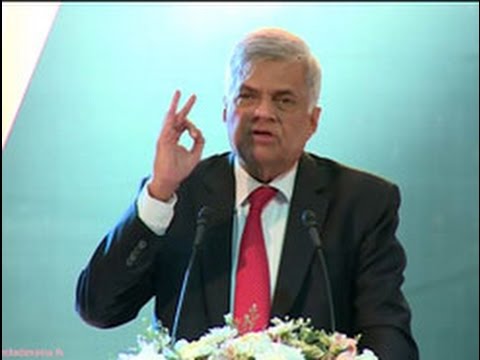
Commenting on this new initiative, Hon. K. D. Lalkantha, Minister of Agriculture, Livestock, Land and Irrigation said, "Our traditional tank cascade systems are a testament to Sri Lanka’s ancient engineering wisdom and remain central to rural livelihoods today. This timely collaboration with Japan and FAO will help restore these systems, improve water productivity, and strengthen the resilience of our farming communities in Trincomalee and Vavuniya."
This new project will rehabilitate selected minor tanks and anicuts within cascade systems, restore hydraulic functionality, and introduce climate-smart water management practices to improve water productivity and resilience.
The project will implement an integrated package of interventions, including:
Evidence from a recently concluded Japan-funded FAO initiative demonstrated that AWD and sensor-based irrigation can reduce water use by over 35 percent in certain seasons while improving yields. The new project will scale up these proven innovations within traditional tank cascade systems, combining modern technology with Sri Lanka’s indigenous water management knowledge.
H.E. Akio Isomata, Ambassador of Japan to Sri Lanka, remarked, "Japan is proud to support Sri Lanka in enhancing climate-resilient agriculture and water management. Building on the success of our previous collaboration with FAO, this project will scale up innovative technologies such as sensor-based irrigation and promote efficient water use in minor tank systems. Japan’s assistance for the project aligns with the concept of “Human Security” which the Government of Japan adopts as an important pillar of its diplomacy with the aim of protecting and empowering individuals, especially the vulnerable people, to live in dignity and free from want. We also believe this partnership demonstrates our shared commitment to sustainability and long-term prosperity for rural communities."
By improving irrigation efficiency, the initiative aims to increase cropping intensity, stabilize paddy yields, enhance soil health, and reduce pressure on scarce freshwater resources. Approximately 2,000 additional household members are expected to benefit indirectly through improved food security and income stability.
Welcoming Government of Japan’s financial support to revitalize minor tanks in Vavuniya and Trincomlaee, Mr. Vimlendra Sharan, FAO Representative for Sri Lanka and the Maldives, said, "Minor tank-based ecosystems are critical lifelines for smallholder farmers in Sri Lanka’s dry zone. By combining rehabilitation of traditional infrastructure with climate-smart technologies and farmer capacity building, this project will enable communities to produce more with less water while strengthening resilience to floods and droughts."
By restoring hydrological functionality, reducing water losses, and empowering farmers with data-driven irrigation tools, the initiative aims to create a scalable model for climate-resilient minor tank management across Sri Lanka.
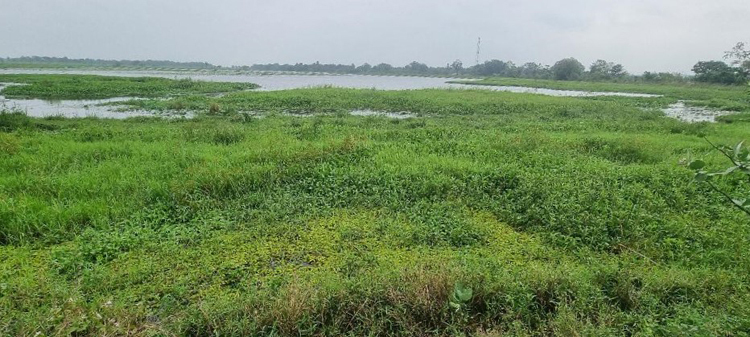
Aquatic weed overgrowth, Trincomalee
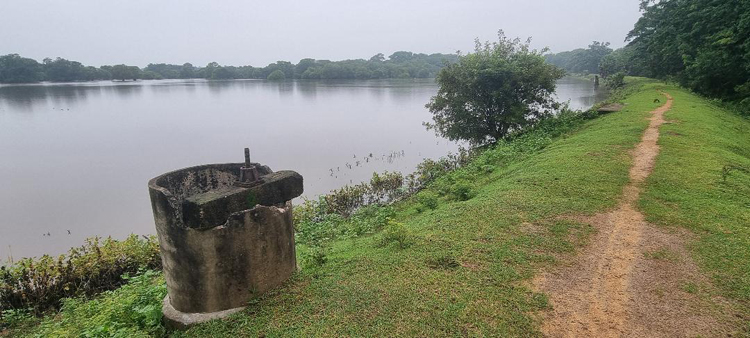
Damaged sluice gate, Vavuniya
Video Story