

December, 12, 2025
Deloitte Sri Lanka hosted the ‘CFO Conclave 2025 – Leading with Insights’, an exclusive forum that brought together the country’s leading CFOs and finance leaders to explore the evolving priorities of financial leadership in an era defined by transparency, regulation, and technology. The event provided a platform for CFOs to envisage how finance functions can adapt to growing regulatory expectations while driving strategic transformation and resilience across their organisations.
The forum featured Deloitte partners across Audit, Assurance and Tax who shared insights on financial reporting updates, developments in code of ethics, taxation, and artificial intelligence governance; areas that are increasingly reshaping the role of the modern CFO.
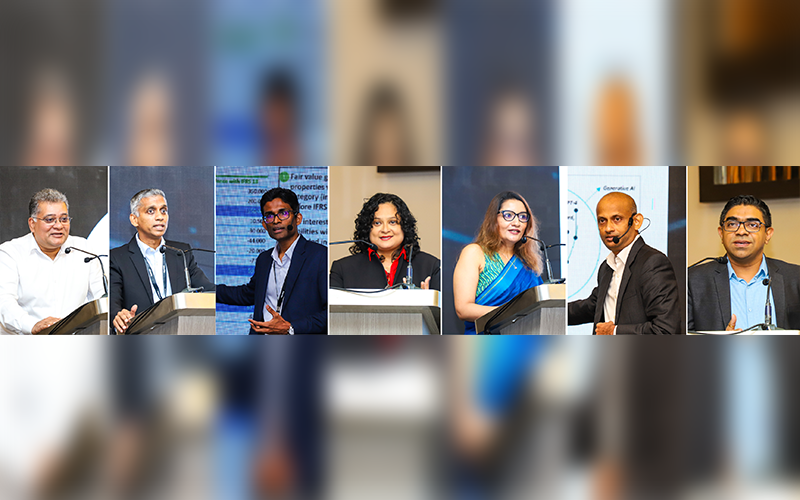
Opening the session, Channa Manoharan, Country Managing Partner of Deloitte Sri Lanka and Maldives, welcomed participants and highlighted the importance of continued dialogue among CFOs in shaping business strategy and building trust through transparency and governance. He noted that finance leaders now serve as strategic partners at the core of decision-making, helping businesses stay agile in a fast-changing environment.
The first segment focused on regulatory updates, led by Thivanka Jayasinghe, Partner – Head of Audit & Assurance at Deloitte Sri Lanka and Maldives; and financial reporting updates, led by Malinda Boyagoda, Partner – Assurance Leader and Industry Leader for Financial Services at Deloitte Sri Lanka and Maldives. The discussion unpacked the implementation of the new International Financial Reporting Standards (IFRS) 18 which will reshape how organisations present financial statements and interpret performance. IFRS 18, effective from 1 January 2027, introduces a restructured profit-and-loss format, ensuring enhanced comparability of financial results and assisting CFOs to adopt more consistent performance reporting across business units. Moving on to the topic of IFRS 19, Malinda explained how the simplified disclosure requirements will bring efficiencies to eligible entities, resulting in reduced compliance burden.
Reflecting further on the impact, Malinda Boyagoda noted, “These standards redefine the way performance is communicated. For CFOs, this means leading conversations beyond compliance, ensuring that financial information is proportionate to the needs, relevant, transparent, and capable of delivering insights that drive decision-making.”
Thivanka Jayasinghe then provided an overview of the CA Sri Lanka Code of Ethics 2025, aligned with the 2024 IESBA Code, highlighting stricter provisions on non-audit services, independence safeguards, and avoidance of actual or perceived conflicts of interest. Building on the theme of ethical leadership, he discussed the Companies (Amendment) Act No. 12 of 2025, which mandates beneficial-ownership (BO) disclosure and introduces new compliance obligations for companies to maintain BO registers. For CFOs, these developments underline the importance of strengthening governance frameworks, oversight mechanisms, and board-level accountability.
Thivanka added that the role of the CFO continues to evolve alongside these regulatory and reporting changes, requiring leaders to move beyond financial stewardship and lead digital transformation and governance initiatives that enhance confidence among stakeholders and investors.
The discussion on taxation, led by Charmaine Tillekeratne, Partner – Head of Tax at Deloitte Sri Lanka and Maldives, explored the Inland Revenue Department’s heightened focus on transfer pricing regulations relating to comparability analysis, interquartile range computation, and the treatment of delayed receivables and royalty payments. Charmaine emphasised that these developments demand greater preparedness for transfer-pricing audits and proactive engagement between CFOs and revenue authorities. She also explained how the Advance Pricing Agreement (APA) framework can provide CFOs with predictability and risk mitigation through pre-agreed tax methodologies.
Rishini Manatunga, Partner – Tax at Deloitte Sri Lanka and Maldives, presented updates on the evolving foreign-exchange regulatory regime, including proposed revisions to the outward-investment framework and expanded categories for direct and portfolio investments, overseas employee-share schemes, and new allowances for exporters. For CFOs and treasury leaders, these changes represent new opportunities, but also the need for stronger internal controls, forecasting discipline, and alignment between tax, finance, and compliance teams.
The final session, presented by Rukshan Bharatha, Partner – Controls Assurance at Deloitte Sri Lanka and Maldives, addressed AI risk management and governance, a growing priority within the finance function. He explained how emerging risks such as bias, data leakage, and model drift can affect financial integrity and decision-making, urging CFOs to embed governance principles across the AI lifecycle. Presenting Deloitte’s approach to trustworthy AI, he emphasised that policies on fairness, transparency, and accountability, supported by strong oversight structures, will be essential for CFOs as they oversee AI-enabled digital transformation initiatives.
The Conclave concluded with a session led by Asanka Wasalathilaka, Director – Technology & Transformation, ET&P: Finance Transformation and CFO Program Leader - Sri Lanka & Maldives at Deloitte, who introduced the upcoming Deloitte CFO Pulse Survey 2025, inviting finance leaders to share their perspectives on emerging priorities and challenges shaping the next financial year.
Across all discussions, the Conclave reinforced that the modern CFO is no longer only a guardian of financial accuracy, but a catalyst for transformation, governance, innovation, and long-term value creation. The event reaffirmed Deloitte’s commitment to supporting CFOs in leading with insight and confidence amid complex and rapidly changing business realities.
Video Story