

March, 7, 2017
New Microsoft Philanthropies organization helped put 71,000 nonprofits in the cloud and supercharge the company’s giving.
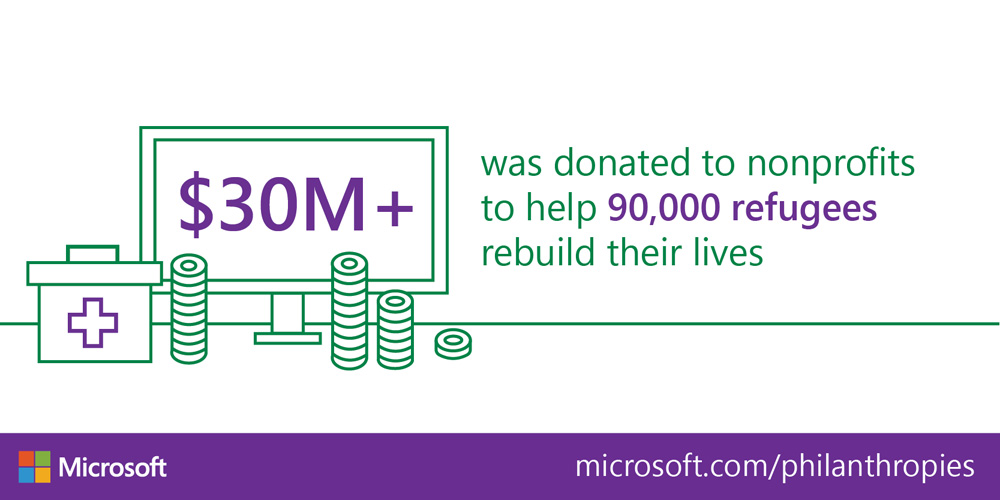
A year after the formation of Microsoft Philanthropies, Microsoft Corp. and its employees have donated more than $650 million in cash, cloud services and software to nonprofits around the world. In a letter published today, Mary Snapp, corporate vice president at Microsoft Philanthropies, detailed the organization’s 2016 contributions. Highlights include $465 million in cloud services donated to more than 71,000 organizations to benefit the public good. In addition, Microsoft employees raised $142 million for 19,000 nonprofits, helping reach an important milestone: The company’s giving program has now raised $1.5 billion since 1983.
Snapp also reports significant progress is areas such as aiding organizations that respond to human and manmade disasters and providing computer science education to those who otherwise would not have access.
“Technology has the power to uplift, to connect, and perhaps most important, to save lives,” Snapp said. “Together with our grantees, partners and employees around the world, Microsoft Philanthropies is using the power of technology to help those impacted by some of the world’s biggest challenges, including economic disruption, inequality, disasters, war, and famine.”
Helping organizations use the cloud to have an even greater impact
In January 2016, Microsoft CEO Satya Nadella announced the company would donate $1 billion in cloud services to nonprofit organizations and researchers working on the world’s most urgent needs, from health care to education to the environment. While the commitment was originally envisioned as a three-year initiative, Microsoft Philanthropies is nearly at the halfway point of the goal, with $465 million donated in a year to 71,000 organizations.
For example, CONIN, a nonprofit in Argentina, now uses Microsoft cloud technology to identify and analyze causes of childhood malnutrition. CONIN is now able, along with local governments, to better direct resources to families in urgent need and even pinpoint interventions that can be taken before a crisis occurs.
“CONIN works to prevent childhood malnutrition, and we attend to more than 400 children a week in Salta province alone,” said Teresa Cornejo, president of a CONIN network in the city of Salta, Argentina. “We used to work with paper records, which makes it very difficult to have a clear picture. Technology makes us much faster and enables us to have every child in the system.”
In Sri Lanka many NGOs have taken advantage of the software donations program and over USD 5 million of software has been donated to local NGOs. A recent partnership with Sarvodaya Fusion has directly trained 5,000 disadvantaged youth in computer science. Through the YouthSpark cash grant program Microsoft has donated cash grants totaling to USD 4.5 million in Sri Lanka. YouthSpark Live brings together Microsoft employees, partners and NGOs in an effort to inspire the youth and show them the myriad opportunities available in the technology field.
Additional 2016 results reported by Microsoft Philanthropies include these:
Entering its second year, Microsoft Philanthropies will grow its work with nonprofits to prepare people for jobs that require skills from basic digital literacy to advanced computer science, as well as increase support for humanitarian responders.
Video Story