- With effect from today, the service fee charged from merchants on all LankaQR transactions up to Rs. 5,000 has been completely removed
- Through the new system, person-to-person (P2P) transactions can be carried out easily at any time and from any location
President Anura Kumara Dissanayake pointed out that digitalisation is a key government priority and that through the digitalisation of all forms of transactions, a transparent, efficient, reliable and secure system can be established, while also enabling the gradual integration of the informal sector of the country’s economy into the formal economy.
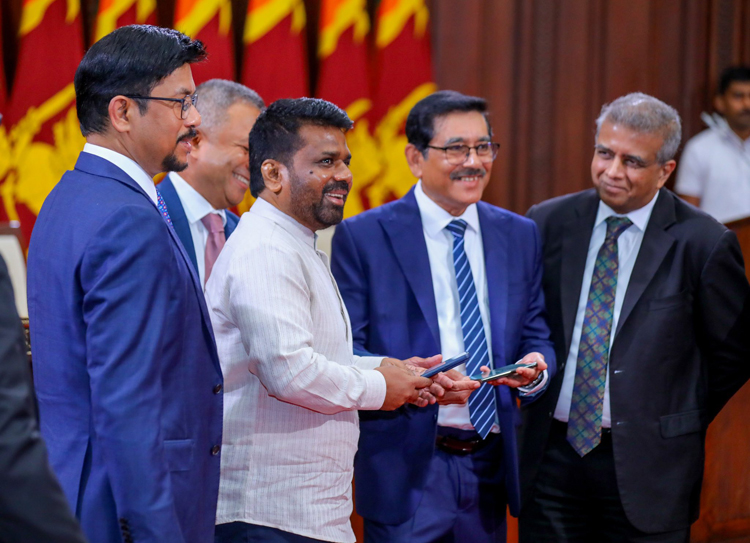
President Dissanayake made these remarks this morning (06) at the Presidential Secretariat during the official launch of the “National QR Payment Adoption Programme”.
Marking a new milestone in Sri Lanka’s digital economy, the programme has been initiated with the primary objective of steering the country towards a cash-lite economy with reduced reliance on coins and currency notes. Accordingly, financial institutions have taken steps to completely remove the service fee (Merchant Discount Rate) charged from merchants on all LankaQR transactions up to Rs. 5,000, with effect from today.
The programme is being implemented with the support of the Ministry of Digital Economy, the Central Bank of Sri Lanka, GovTech institution, LankaPay and financial institutions and is based on four key pillars: removing barriers to transactions, encouraging the public through incentives and benefits, introducing new technologies and conducting nationwide awareness programmes.
The President further stated that although Sri Lankan society has a culture closely associated with transactions, the country has still not been able to transform that connection from traditional paper-based systems to modern digital platforms.
He therefore invited all banks and financial institutions to support the achievement of the government’s expected targets by introducing this new programme as a more convenient and efficient method for the public.
President Dissanayake further stated;
“There is a point at which we are constrained in both our economy and our society. That is our inability to systematically and transparently collect data on our transactions, economic activities and social indicators. We have a clear state policy that subsidies should be provided to targeted communities. However, we face the challenge of how to identify those targeted groups.
For instance, with the Middle East crisis, fuel prices increased significantly. We examined this from two perspectives. We must assess both the impact of rising fuel prices on the national economy, as well as the impact on institutions involved in the fuel sector, including the Ceylon Petroleum Corporation. A sharp increase in prices can, in turn, contract our economy. On the other hand, failing to adjust prices appropriately can create a crisis in sustaining our institutional framework. Therefore, we must strike a balance. In that context, the most appropriate approach is to provide a fuel subsidy to the targeted groups. However, we are faced with the question of how to collect the necessary data for that purpose.
Accordingly, after considering market price fluctuations, we have decided to provide a subsidy of up to Rs. 100 on diesel. But who benefits most from this subsidy? If a person in rural area purchases five litres of diesel, they receive a subsidy of Rs. 500. If a large vehicle is filled with 100 litres, that individual receives Rs. 10,000 as a government subsidy. Therefore, to resolve this issue, greater attention must be paid to data collection. In this regard, transactions become a critically important area. These transactions reflect the nature of an individual’s economic status. Accordingly, they can be used as a criterion when granting subsidies. At the same time, we must also consider how subsidies are provided and how they are utilised.
Therefore, we believe that in addressing this complex issue, we must move towards transactions carried out through digital systems. Only then will we be able to direct these subsidies to the intended beneficiaries.
For that reason, we must bring transactions across all sectors into this system. It will become a transparent, efficient, reliable and secure mechanism. In doing so, we can gradually integrate the informal economy into the formal economy. Accordingly, this digitalisation programme becomes one of our priority initiatives. We have a target of building a digital economy worth US$ 15 billion. Our plan is not merely to create a 15 billion dollar economy within the digital sector itself, but to generate significant economic growth through the efficiency created by integrating digitalisation into agriculture and small and medium-scale enterprises.
However, we have still not been able to promote this in a sufficiently structured and widespread manner. We have a society with a culture closely linked to transactions. Our people have developed a strong relationship with the banking system through transactions, deposits and similar activities. Yet, we have not been able to transform that relationship from the traditional paper-based passbook to a modern system. Nor have we been able to build it to the extent required. Therefore, our main objective is to introduce these new payment systems to a society that already has such a transactional culture. In doing so, extensive media publicity and wide-ranging public awareness programmes are essential. The Ministry of Digital Economy has already focused its attention on this.
Within our culture, there is a large volume of transactions. When a child goes to school, money is given into their hand. Similarly, money is given when offering betel during the New Year. The question is how these transactions can be aligned with this new digital system.
If this QR method is to become a cultural norm, it must represent all transactions associated with social relationships in our society. If it is confined only to a limited pattern of transactions, society will not embrace it. Therefore, it must be connected with the cultural practices of the people.
We need new tools and new models to bring these cultural transactions into this system and we must give this considerable attention. At the same time, there is a central point in all these transactions. If the banks and financial institutions, which serve as that centre, extend their support, this can be made successful. Through the steps we have initiated and through QR codes, all forms of transactions can be rapidly popularised. Therefore, banks and financial institutions bear a significant responsibility in this regard. I believe that if a promotional plan can be developed to convert New Year transactions into QR-based transactions, it would become an important turning point. It would not only fulfil your promotional objectives but also bring about a meaningful shift in behaviour.
Our society is ready to embrace new developments. However, if these innovations are not attractive and convenient, people will not adopt them. Therefore, we must provide the necessary impetus to drive this process forward, because society must adopt what is efficient. If the government, banks and financial institutions take the initial steps, this programme will begin to spread rapidly within society. Therefore, I expect your support and intervention in making this a success.”
Deputy Minister of Digital Economy, Eng. Eranga Weeraratne
“In our country, currency notes and coins amounting to Rs. 1.48 trillion are currently in circulation. What we intend to do is to digitalise an economy that is heavily dependent on physical cash. As of today, our banking system has already undergone a high level of digitalisation. Around 89% of the population above the age of 18 holds bank accounts. In addition, ATM machines are available across the country. The LankaQR system was introduced several years ago. However, the benefits it offers have not been widely accessible to the public and public awareness remains very low. Therefore, we are now moving forward to introduce the National QR Adoption Programme.
Although this QR technology exists in our country, its usage for payments remains very limited. Even today, 99% of retail transactions in our country are conducted using cash. In the final quarter of last year, only around 400,000 people used QR-based payments. Therefore, we aim to encourage the public to adopt this system. One question frequently raised by international organisations is why, despite the introduction of digital technology, people are not using it for transactions. To address this, both the economy and public behaviour need to change. That is what we are attempting to achieve.
Once individuals register using their bank accounts, they will be able to make payments using QR even for small purchases, such as buying a king coconut from a roadside vendor. To encourage and motivate the public, appropriate incentives must be introduced.
In this regard, we have reached an agreement with financial institutions not to charge any service fee on payments below Rs. 5,000. In addition, we are planning to introduce a lottery-based incentive scheme to quickly encourage both merchants and the public to adopt this system. We have also planned to implement a large-scale nationwide awareness campaign on this initiative.”
Governor of the Central Bank, Dr. Nandalal Weerasinghe
“Having examined the reasons why the QR system did not gain widespread adoption in the past, steps have been taken today to introduce two special measures accordingly. This could mark a significant leap forward. The first is the ability to carry out transactions without any cost for payments below Rs. 5,000. In this regard, I would like to express my appreciation to the Sri Lanka Banks’ Association and LankaPay for agreeing to bear a certain level of cost.
The second is person-to-person (P2P) transactions. In countries such as India, this has become more widespread largely because consumers are not required to visit a merchant to carry out transactions. A substantial proportion of transactions take place directly between individuals. This is the most important change being introduced on this occasion. By simply printing and carrying a QR code, individuals will be able to conduct transactions anytime and anywhere without using cash.”
Chief Advisor to the President on Digital Economy, Dr Hans Wijayasuriya, also expressed his views at the event.
The event was attended by the Secretary to the President Dr. Nandika Sanath Kumanayake, ministry secretaries and government officials, as well as chairpersons and chief executive officers of banks and financial institutions, among others.