


December, 24, 2025
Cyclone Storm Ditwah has caused widespread devastation across Sri Lanka, severely impacting agriculture, fisheries and rural livelihoods, according to the latest country brief issued by the FAO’s Global Information and Early Warning System (GIEWS) on Food and Agriculture.
The cyclone made landfall on 27 November 2025 and remained over the country for nearly three days, bringing exceptionally heavy rainfall that triggered severe flooding and numerous landslides. As of 16 December 2025, more than 2.2 million people—around 10 percent of the population—had been affected, with extensive damage reported to housing, bridges, roads and irrigation systems.
Flooding destroyed agricultural land, standing crops, livestock, fisheries assets and household food stocks. The disaster struck at a critical time, as farmers had just planted or were in the process of planting the 2026 Maha main season crop, which accounts for the bulk of Sri Lanka’s annual agricultural output.
Preliminary official estimates indicate that about 106,000 hectares of paddy—approximately 20 percent of total sowings for the 2026 Maha season—were partially damaged or entirely lost as of 15 December 2025. The highest losses were recorded in Puttalam, Kurunegala, Ampara, Anuradhapura, Batticaloa and Trincomalee districts. Significant damage was also reported to maize, vegetables, big onions and green gram crops. An estimated 227,000 farmers, mostly smallholder rice producers engaged in subsistence agriculture, were affected.
The livestock sector also sustained heavy losses, with around 475,000 birds and nearly 50,000 other animals, including cattle, buffaloes, goats and swine, reported lost. Meanwhile, the fisheries and aquaculture sectors suffered extensive damage to fishing equipment, boats, fishponds, shrimp farms and related infrastructure. Total losses in the fisheries sector are estimated at between LKR 20.5 billion and LKR 21.5 billion.
Despite the cyclone’s impact, Sri Lanka’s aggregate cereal production for 2025 is estimated at 5.4 million tonnes, about 10 percent above the five-year average. Paddy production is estimated at an above-average level of 5 million tonnes, while maize output is estimated at 420,000 tonnes, supported by favourable weather conditions earlier in the year.
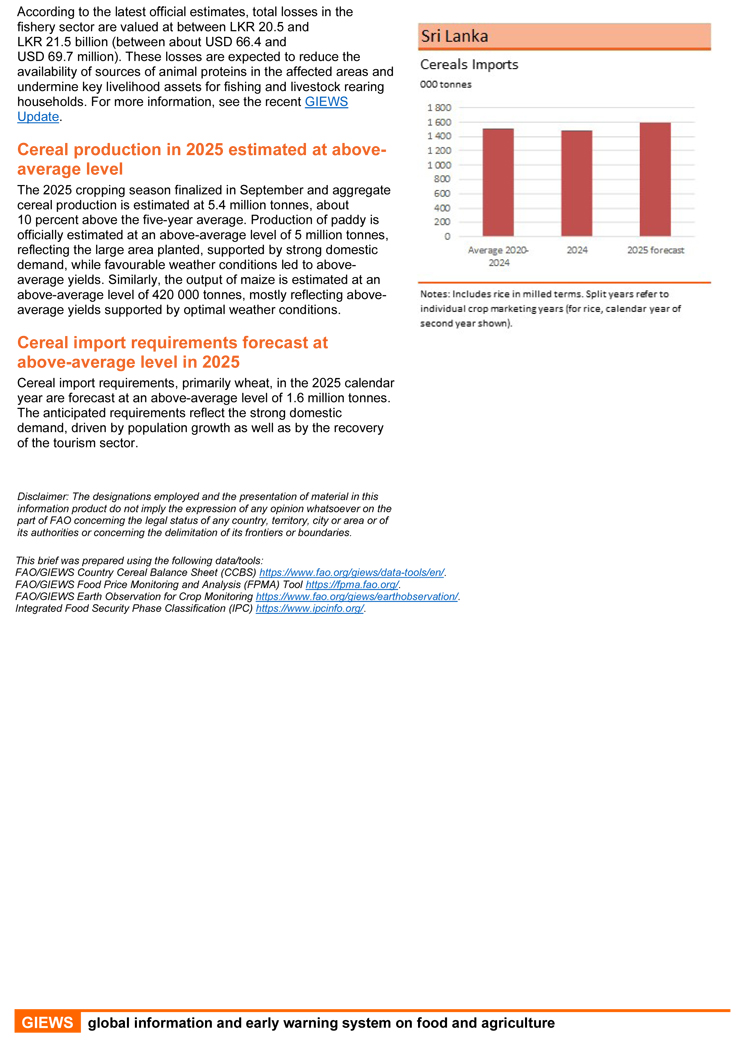
Cereal import requirements for 2025, mainly wheat, are forecast at an above-average level of 1.6 million tonnes, reflecting strong domestic demand driven by population growth and the recovery of the tourism sector.
Video Story