

August, 5, 2025
By Prof. Samitha Hettige
Former Minister Dr. Bandula Gunawardena recently published the Parliamentary debate on the Rubber Rice Pact (RRP) as a book. It is believed to be the 1st Sri Lankan Parliamentary debate to be published in Sinhala, English & Chinese. Dudley Senanayake was the Prime Minister when the RRP was signed. With the RRP, post independence shipping industry has also expanded as per port statistics. The Ceylon Shipping Corporation is seen as a byproduct & the ‘Freudenberg’ company had focused on shipping even before the RRP. It also was the agent for ‘Toyota’ vehicles in Sri Lanka. Those interested may refer the historic ‘Freudenberg’ record book (Ref. Late Jean De Silva). PM Dudley’s only brother Robert was a key person behind ‘Freudenberg’. ‘Elsa’ the lioness was his pet at his Kynsey Road bungalow. Some may fondly remember ‘Elsa’ causing conflicts with other animals at Robert’s residence. Owners of the Liberian flagged ship MSC ELSA - 3 which sank off the coast of Kerala (May 2025) agreeing to resolve conflicts by paying due damages to Sri Lanka for the environmental impact (Ref. Media) was a good news. This adds to the momentum of the recent ‘Express Pearl’ ruling. It’s indeed positive news for Sri Lankans whose ships were identified in ancient China as ships from the land of the Lion. 4th century Chinese records indicate Lion flagged Sri Lankan ships loaded with gems & jewels arriving in China & Chinese ships frequenting Sri Lanka popularizing Trincomalee as the ‘China Harbour’.
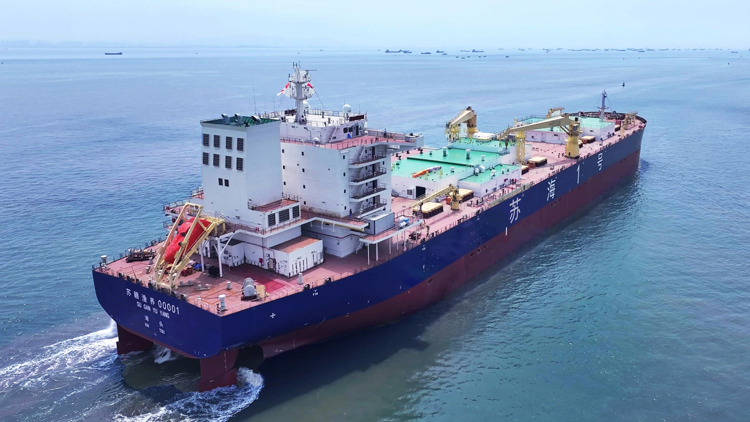
Salmon farming Chinese ship
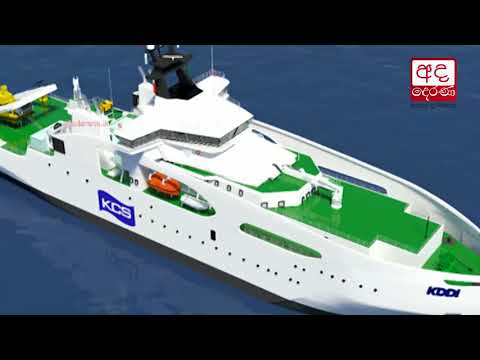
China last week delivered the world's 1st self propelled enclosed salmon aquaculture vessel ‘Suhai 1’in Guangzhou, Guangdong (South China). It’s a smart offshore aquaculture equipment integrating breeding, harvesting & on board processing of high value fish. It functions as a mobile offshore fish farm, a modern fishery processing plant & has a displacement of 132,000 tonnes (comparison to 2 med sized aircraft carriers). It also features 15 aquaculture cabins with a total water volume of 83,000 cubic meters (equal to 33 international standard swimming pools).
The ‘Suhai 1’ which is equipped with a centralized automated feeding system has the capacity to manage feed storage, transportation, hoisting, unpacking, conveying & distribution, all guided by intelligent feeding decisions. Different from traditional stationary net cage aquaculture in open seas, Suhai-1 can produce while cruising at a maximum speed of 18 KMPH & allows it to relocate fast to safer waters during adverse weather conditions enhancing operational safety & stability.
Zoological data indicates that deep sea salmon prefer colder waters & ‘Suhai-1’ is designed to navigate to the cold water mass in the Yellow Sea once operations starts ensuring salmon remaining within their optimal growth temperature (10 to 18 degrees Celsius). Simply this ship can "travel" with the fish to favorable environments & return with full holds of mature salmon (Ref. ‘Suhai 1’ stats). It may not be a surprise for the Chinese who grew vegetables in the mega ships of Admiral Zhen He to feed the20,000 strong crew in 14th century AD, but island nations may reap more from the blue economy with such new knowledge.
Ammonia fueled vessels
China’s first pure Ammonia fuel bunkering operation took place in Dalian, China last week. The Ammonia fueled vessel used for port operation is equipped with two full pressure Ammonia fuel tanks on sides of the main deck to ensure stable power support for the main engine reducing reliance on fossil fuels. The Ammonia needed is supplied from the world's largest Green Hydrogen & Ammonia project (Chifeng, Inner Mongolia Region) which employs an AI driven power system technology to achieve 100% green electricity. Ammonia has high energy density & its carbon free nature produces only water & nitrogen when fully combusted thus making it very suitable for de-carbonizing shipping (Ref. COSCO Shipping Ltd).
Opportunities for Sri Lanka
Similar to the trade expansions after signing the RRP, Sri Lankans can gain many opportunities by partnering with the Belt & Road Initiative of China (BRI) as shipping opportunities top the list. Historically it’s proven as the island was a partner of the ancient Silk Road. All Sri Lankan ports are becoming increasingly valuable in the coming years with the expansion of Indian & Chinese trade activities. Investors will be attracted to Sri Lanka only if it’s positive environment without unfair trade union actions etc. One might say that majority Sri Lankans took the first steps to eradicate such obstacles which dragged the country backwards. The momentum should be maintained.
Views Expressed are Personal (Photo source www: Suhai-1 floating Salmon farm)
Video Story