

August, 7, 2025
A $2.5 Billion Dice Roll Attracting the Subcontinent's Ultra-Rich to the Vegas of South Asia
By Jithendra Antonio
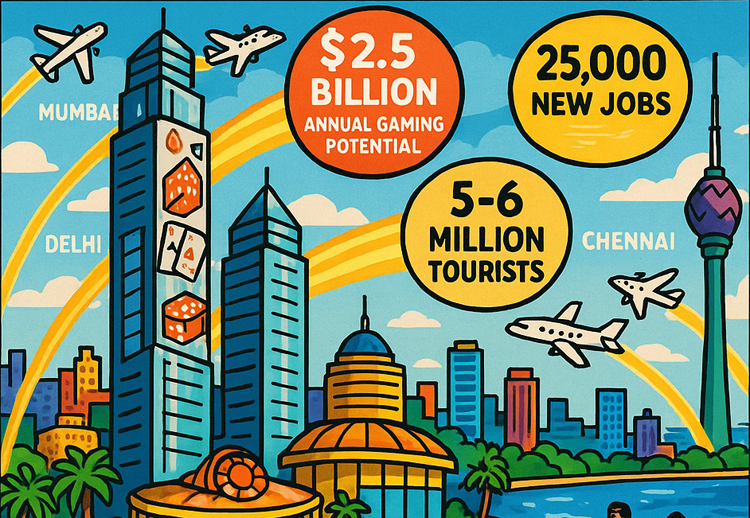
In a transformative declaration that reverberates through South Asia's economic corridors, gaming tycoon Lawrence Ho's recent bold proclamation at the August 2025 launch of the US $1.2 billion City of Dreams Sri Lanka has crystallized what many strategic analysts have long envisioned. According to Ho's statement at the City of Dreams launch in August 2025, Sri Lanka can be to India what Macau is to China, positioning the island nation for an unprecedented economic metamorphosis that industry experts project could realistically attract US $2.5 billion in annual gaming revenues within the next decade.
The Macau Model - A $28 Billion Blueprint for Colombo
The parallels between Sri Lanka's emerging strategy and Macau's spectacular transformation are striking, though the scale differs significantly. Gaming Inspection and Coordination Bureau data shows Macau generated 226.8 billion patacas or approximately US $28.3 billion in 2024, representing a 23.9% year-over-year surge from 2023. As Lawrence Ho emphasized to Gulf News in August 2025, Macau is by far the biggest gaming market in the world, and with Colombo being the closest destination to India, an integrated resort like this gives the city tremendous potential to capture a proportional windfall from India's explosive wealth creation.
Mathematics are compelling when adjusted to realistic market size. Knight Frank's Wealth Report showing India's ultra-high-net-worth individual population has grown by 11% annually over the past five years projects the country to mint 165 new millionaires daily by 2027. Melco executives revealed during their Q1 2024 earnings call that annual gaming revenues from the Sri Lankan market could reach up to US $250 million in the initial phase alone, with potential growth to US $500-750 million as the market matures over five years.
The $1.2 Billion Catalyst - City of Dreams Changes Everything
The inauguration of City of Dreams Sri Lanka represents more than just another luxury resort—it's a seismic shift in South Asia's entertainment landscape. John Keells Holdings Chairman Krishan Balendra's August 2025 statement according to reports highlighted that this project with an investment of US $1.2 billion is expected to generate a significant multiplier effect for the Sri Lankan economy, creating thousands of jobs in construction, retail, technology, hospitality, and attracting substantial FDI.
This flagship development, as reported by Gambling Insider in August 2025, marks Melco's first property in the region and operates under a 20-year gaming license following Sri Lanka's introduction of a formal regulatory framework initiated in 2023. The resort has already demonstrated its magnetic pull, with Balendra confirming to Gulf News in August 2025 that winter bookings at the group's hotels, including the new resort, are ahead of last year, signaling robust demand from affluent travelers across the region.
India's Billionaire Boom - The Economic Engine Driving Transformation
The timing couldn't be more fortuitous, as the Forbes Billionaires List 2024 reveals India's economic ascent has created an unprecedented concentration of wealth, with the country now home to 169 billionaires controlling combined assets exceeding US $675 billion. This wealth creation machinery shows no signs of slowing, with IMF projections indicating India's GDP will reach US $7 trillion by 2030, potentially creating thousands more millionaires and hundreds of new billionaires.
For Sri Lanka, this represents an extraordinary opportunity within realistic parameters. Unlike domestic gambling restrictions in India that have stifled the development of integrated resorts, Sri Lanka's regulatory clarity—as Asia Gaming Brief reported in August 2025 was established through its 2023 gaming legislation evolving —provides the perfect alternative for India's high-net-worth individuals seeking world-class gaming experiences without traveling to distant destinations like Singapore or Macau.
The Strategic Sectors Poised for Measured Growth
Beyond gaming, Sri Lanka's transformation into India's premium leisure destination will catalyze growth across multiple sectors:
The 2025-2045 Trajectory - Realistic Growth Projections
Looking ahead, Sri Lanka's evolution into India's gaming destination could be followed on a more measured but achievable trajectory based on regional market comparisons.
The Multiplier Effect - Beyond Gaming
The transformative impact extends far beyond gaming tables and slot machines, with realistic economic benefits across the economy. Sri Lanka's tourism revenue peaked at US $5.6 billion in 2018 according to Lanka Business data, before declining to US $1.26 billion in 2022 and recovering to US $3.17 billion in 2024. Gaming could add 15-20% to these figures within five years.
Melco Chairman Lawrence Ho articulated to media in August 2025 that this project is about more than creating a luxury resort—it's about helping to elevate Sri Lanka's global profile and contributing to its tourism economy, with a development of this scale having a cascading effect that drives demand for local products, services and supply.
The realistic economic benefits, according to various government and industry projections, includes below:
Navigating the Challenges - The Path Forward
Despite the significant potential, Sri Lanka must navigate several challenges to realize this vision. Political stability remains paramount, as does maintaining the delicate balance between attracting Chinese and Indian investments without alienating either power. The US State Department's Investment Climate Report 2024 warns that Sri Lanka's foreign investment policies are not consistent, with frequent policy changes, especially with changes of governments, causing uncertainty for investors.
The country must also ensure that gaming development doesn't exacerbate social issues. The Sigma World Report 2024 notes the Sri Lankan government in a move to establish a gaming regulatory authority responsible for overseeing tax collection, combating criminal activities, and alleviating the adverse societal effects stemming from gaming. The Gaming Regulatory Authority Bill approved by Cabinet in April 2025, according to a Cabinet decision announcement highlighting that the Cabinet approved the proposal made by the current President Anura Kumara Dissanayake in his capacity as the Minister of Finance, Planning, and Economic Development, represents crucial progress in establishing proper oversight.
Moreover, Sri Lanka needs to accelerate infrastructure development to support this transformation. World Bank's April 2025 Development Update shows Sri Lanka's economy grew 5% in 2024, surpassing the projected 4.4%, but growth is expected to moderate to 3.5% in 2025, reflecting structural impediments that must be addressed.
The Realistic Conclusion - A Measured but Transformative Opportunity
As Sri Lanka emerges from its economic crisis with renewed purpose and clarity, the transformation into India's gaming destination represents a realistic economic strategy that could significantly boost the nation's economy. JKH Chairman Krishan Balendra captured this sentiment in August 2025, declaring that today is not just a launch of a milestone project, it's a defining moment for Sri Lanka, representing the country's largest private sector investment and a declaration of belief in Sri Lanka's future.
The realistic numbers tell a compelling story, US $2-2.5 billion in potential annual gaming revenues by 2045, 25,000 new direct jobs, 5-6 million tourists, and significant contribution to GDP growth. For a nation of 22 million people with a GDP of approximately US $75 billion according to World Economics data for 2025, even these more modest projections represent transformative economic impact—potentially adding 3-4% to GDP through direct and indirect effects.
As the dice roll on South Asia's gaming future, Sri Lanka's measured approach positions it well for sustainable success. Melco CFO Geoff Davis identified during the Q1 2024 earnings call that India is definitely the most interesting feeder market with very significant potential there. With realistic expectations and proper execution, Sri Lanka's gaming gambit could indeed transform this island nation into South Asia's premier gaming destination, even if not quite reaching Macau's stratospheric heights.

(The writer, Jithendra Antonio is a Consultant specialized in Data Analytics with a special focus on Sri Lanka’s Future Direction, and in the fields of Sustainable Energy, ESG, Public Policy, Investments and Telecommunications. He can be reached at jithendra.antonio@gmail.com.)
Video Story