

January, 24, 2023
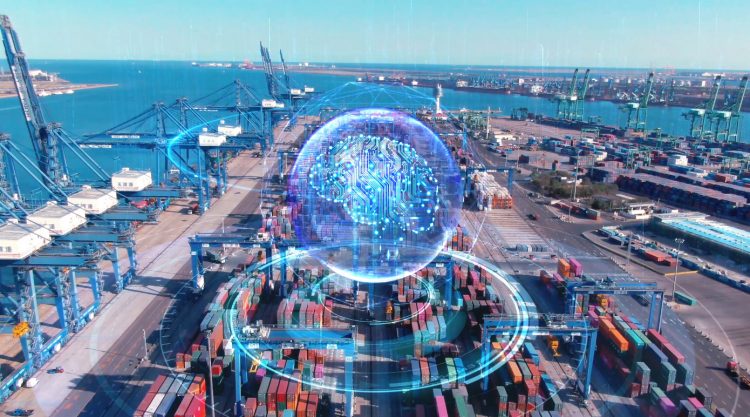
Tianjin Port Group and Huawei announced this week that the two companies will deepen cooperation to build a digital twin of the port, making it more automated and intelligent. Yang Jiemin, Vice President of Tianjin Port Group, explained that this plan consists of three parts: Construction of new automated terminals, upgrading of traditional terminals, and comprehensive digital transformation.
The Section C Terminal in the Beijiang Port Area of the Port of Tianjin was the world's first smart, zero-carbon port terminal. It entered large-scale commercial operations in October 2021, and has been stably operating ever since. 5G and L4 autonomous driving technologies are applied at this terminal to make it both safer and more efficient. At the terminal, container cranes operate automatically and intelligent robots of the horizontal transportation system frequently come and go. Remotely controlled quay cranes lift loaded containers from cargo ships and put them onto the intelligent robots for horizontal transportation. Supported by the BeiDou Navigation Satellite System, these robots are guided to automatic locking/unlocking stations to unlock containers and then to the container yard along optimal driving routes that are calculated in real time. The entire process runs smoothly.
Yang Jiemin explained how the new solution, which combines 5G and L4 autonomous driving technologies, has for the first time been put into large-scale commercial application in a partially public scenario at the Section C Terminal. This has provided a new model for upgrading and transforming existing traditional container terminals worldwide. "These innovations being used at the Port of Tianjin are having a huge impact on the port industry, creating new value for ports by improving operating environments, driving green and low-carbon development, and increasing operational efficiency. We believe that these practices will promote the intelligent development of the global port industry, "said Yang.
Yue Kun, CTO of Huawei's Smart Road, Waterway & Port BU, stated, "Ports are a vital link in maritime transportation, connecting trade and supply markets across the globe. Building more efficient smart ports is becoming an increasingly pressing requirement for the global supply chain. Section C Terminal of the Port of Tianjin has now been operating stably for over one year. This proves that 5G and L4 autonomous driving have already been successfully adopted by industries in China, and are creating true commercial and social value." Yue believes that this progress will benefit various industries, with next-generation digital technologies, such as 5G and AI, combined to solve industry problems, promote digital industry transformation and upgrading, and generate social value.
As a major modern port, the Port of Tianjin boasts 300,000-ton-class terminals with a channel depth of 22 m. It has 213 berths of various types. In 2022, its container throughput exceeded 21 million TEUs, ranking among the top 10 ports worldwide.
January, 16, 2023

Huawei has earned a top rank from CDP for its actions on climate change and transparency of disclosures. The international environmental non-profit organisation placed the company among its Climate change “A List”, the only firm from mainland China to get the accolade. CDP also granted Huawei an “Excellent Environmental Leadership Award”.
Huawei adheres to the concept of "Tech for a Better Planet", meaning to use technology to foster green development and combat climate change. ICT technologies, Huawei believes, are powerful tools for reducing carbon emissions, promoting renewable energy, contributing to a circular economy, and protecting nature.
In its own operations, Huawei strives to promote energy conservation and emission reduction, as well as to use more renewable energy. Meanwhile, our Digital Power business focuses on areas such as – clean power generation, electrification of transport, and green ICT infrastructure – to facilitate global energy transition. By the end of 2022, Huawei has helped its customers generate over 695.1 billion kWh of green power, and reduce customers’ power consumption by 19.5 billion kWh, equivalent to avoiding nearly 340 million tons of CO2 emissions. In addition, Huawei incorporates the concept of circular economy into its product life cycle management, from product design to end of service life. We are committed to using more eco-friendly materials and greener packaging, lowering carbon emissions in our processes, and producing more durable products that reduce waste. To complement our own efforts, we work with partners such as environmental protection organizations and scientific research institutions, to harness technology in innovative ways to protect forests, wetlands, oceans, and nature as a whole.
Tao Jingwen, Director of the Board and Director of the Corporate Sustainable Development Committee for Huawei, said: "Sustainable development is an important part of Huawei's overall strategy. To address the global challenge of climate change, we believe that technology is a key enabler of sustainable development, to create a more inclusive and environmentally-friendly world. Huawei hopes to work with global customers, suppliers, and partners to promote green and sustainable development in various industries and build a low-carbon society."
Dexter Galvin, Global Director of Corporations and Supply Chains at CDP, congratulated Huawei for its performance. He said: “Environmental transparency is the first vital step towards a net-zero and nature-positive future. In a year of ever-increasing environmental concerns around the world – from extreme weather to unprecedented losses to nature – the need for transformational, urgent and collaborative change is more critical than ever.”
Galvin continued: “As CDP continues to raise the bar on what qualifies as climate, forests and water leadership, we hope to see the ambitions and actions of companies on the A List – and those wanting a place on it – do the same.”
Image caption: Huawei included in the 2022 CDP Climate Change “A list”
December, 28, 2022

Huawei announced that it was named a Leader in the 2022 Gartner® Magic Quadrant™ for Enterprise Wired and Wireless LAN Infrastructure, the only non-North American vendor positioned in the Leaders Quadrant. Huawei takes it as a milestone and believes it is yet another testament to the global recognition of Huawei's full lineup of network offerings. Huawei’s wide range of solutions include the CloudCampus 3.0 Solution, CloudEngine series switches, AirEngine Wi-Fi Access Points (APs), and iMaster NCE automatic and intelligent network management platform.
As an excellent supplier in the global enterprise wired and wireless LAN infrastructure market, Huawei has a host of strengths, including the comprehensive product portfolio, Artificial Intelligence (AI) - and Machine Learning (ML)-enabled network management platform, wireless-first support, and industry-leading "Ability to Execute" and "Completeness of Vision".
Huawei has a holistic set of enterprise wired and wireless LAN infrastructure offerings. Featured products and solutions include the end-to-end CloudCampus Solution across LANs, WLANs, and WANs, feature-rich CloudEngine series switches, award-winning AirEngine Wi-Fi APs, and field-proven iMaster NCE automatic and intelligent network management platform. To date, these products and solutions have served millions of customers worldwide across industries, gaining high praise in the process.
Huawei remains committed to the global enterprise market, and constantly innovates to set the benchmark for enterprise networks in terms of simplified network architecture, best-in-class hardware design, agile software delivery, and flexible business models.
More specifically, Huawei simplifies the campus network architecture from three layers to two with its solution consisting of the central switch and Remote Units (RUs). Keeping hardware innovation in mind, Huawei has unveiled innovative third-generation Wi-Fi 6 smart antennas and a range of brand-new CloudEngine switches and AirEngine APs. With regard to software innovation, Huawei stands out with the powerful iMaster NCE automatic and intelligent network management platform that underpins the industry's first L3 autonomous driving network for campuses. When it comes to innovative business models, Huawei differentiates itself from other vendors by launching a leasable and salable cloud management platform model, as well as flexible deployment options, including on-premises, Huawei public cloud, and MSP-owned cloud.
To date, Huawei's campus network offerings have been widely used by customers in over 170 countries and regions across sectors such as public service, education, healthcare, manufacturing, finance, and energy, helping them build a solid digital bedrock for their digital transformation journey.
December, 19, 2022
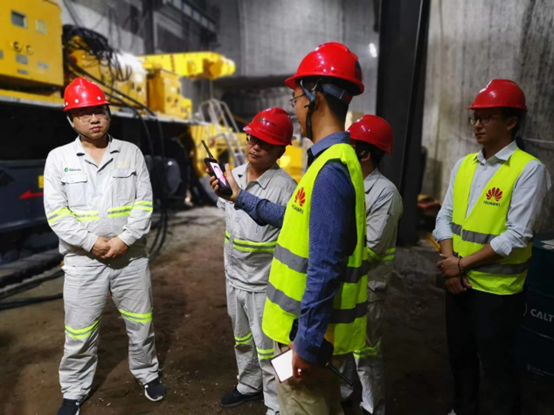
WeChat video call 300 meters underground, supporting real-time communication in emergencies
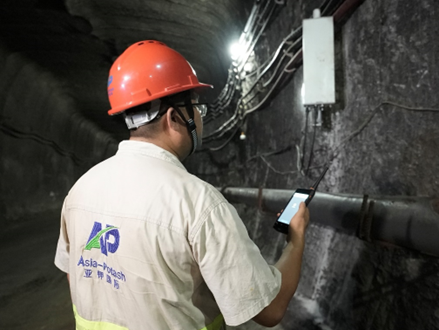
On December 15, the 4G industrial ring network that can be upgraded to 5G was officially launched in the smart mining area of Asia-Potash International Investment in Khammouane province, 350 km away from Vientiane, Laos' national capital. A miner made the first WeChat video call 300 meters underground, reporting real-time situation there to the headquarters 3,500 km away in Beijing.
Asia-Potash International Investment is one of the largest potassic fertilizer suppliers in Asia, with one million tons of output in 2022. Its mining area in Laos is the first smart mining showcase built by the company in Southeast Asia. It is also the first implementation of Huawei's Smart Mining Solution in Southeast Asia.
With the expansion of production capacity, the number of employees in the mining area in Laos has grown from hundreds to more than 3,000, greatly increasing the demand for automation and intelligence. Specifically, gaps need to be eliminated in communication above and below ground so that underground production safety can be monitored in real time. Workers need to be allowed to remotely control mining vehicles in operation rooms above the ground, reducing risks caused by underground operations in harsh environments such as high temperature and humidity. Intelligent methods need to be used to evaluate ore production quality in real time to improve operation efficiency. Last but least, the transportation system of underground mining vehicles needs to be flexibly scheduled. All these cannot be achieved without the powerful basic communication capability supported by a full-coverage industrial network in the mining area. This is also a rigid requirement for intelligent production in the future.
After over two months of construction, Huawei's Smart Mining Solution is implemented in the mining area, achieving full coverage of wireless private networks above and below the ground, and meeting the requirements of real-time communication between miners and smart inspection for incidents. This part of the solution is applicable to scenarios where wired networks are unreachable. On the other hand, wired private networks have also been built, meeting the communication requirements above the ground and the monitoring, operation, and security requirements of the underground production surface and important production facilities. This part of the solution is applicable to wired scenarios that require high bandwidth, low latency, and massive connections.
According to the head of the smart mine of Asia-Potash International Investment, based on full network coverage and 5G technologies, cloud-edge collaboration, smart mining applications, and underground services that require ultra-large bandwidth or ultra-low latency, such as remote control and autonomous driving, and cannot be implemented on the existing underground private network, will be implemented in the future, laying a solid foundation for building the industrial Internet architecture and people-centric smart mines.
Zhang Lu, a Huawei technical expert, said that fixed phones were mainly used before for communication below and above the ground. Now, the wireless industrial ring network supports mobile calls anytime and anywhere. In mobile working scenarios, every working unit is connected in real time in the mining area, greatly improving safety and efficiency. The application of Huawei's Smart Mining Solution fully considers the requirements of network advancement and practicability in mining areas. One network carries multiple services and supports fast provisioning as well as flexible upgrade to 5G in the future.
Over the past year, Huawei's newly established coal mine team has made great achievements in the field of coal mine intelligence. The MineHarmony operating system jointly developed by Huawei and China Energy has been deployed in more than 3,300 sets of equipment in 13 coal mines and one coal washing plant of Shendong Coal Group. The entire Wulanmulun mine applies the operating system. The transformation of connection, interaction, and data access has been implemented.
In addition, the 5G+AI video stitching technology has been used to implement remote control on some mines. For example, Sanyuan Coal Mine of Jinneng Holding Shanxi Coal Industry Co., Ltd. has implemented remote control on the comprehensive mining surface, and coal mining drivers have been transferred from underground to above the ground. The intelligent monitoring of the main transportation belt reduces the number of underground inspection personnel by 20%. Shenmu Hongliulin Coal Mine of Shaanxi Coal and Chemical Industry Group implements the digital twin of the entire mine. With the manageable and visualized human-machine ring as well as the construction of all-mine intelligence, the number of underground inspection personnel is reduced by 18% and the output of a single shift increases by 30%. Coal miners move from underground to above the ground, performing coal mining operations remotely in offices. This greatly improves the working environment, helping the industry achieve the vision of safe mining with fewer people and high efficiency.
With cutting-edge ICTs that are deeply interwoven with field practices, the Huawei Mine Team has created a mining Industrial Internet platform that runs on unified standards and unified frameworks, and is dedicated to a unified set of data specifications. By building a next-generation IoT with cloud platforms as the core, data as a key factor, and security as a safeguard, the Mine Team is focused on forging a new mode of applications that integrate next-generation information technologies into the mining sector to forge new modalities for mine companies, supply chain, and the industrial chain. In this process, the Team will work closely with the sector to unleash new value for the mining industry. This will help the industry to become safer and more efficient, while requiring fewer people for undesirable and dangerous assignments.
The digital transformation of industries brings both opportunities and challenges. Huawei looks forward to working with customers and partners in the spirit of openness, innovation, and collaboration. At the same time, Huawei encourages partners to work together to accelerate digitalization, unleash digital, and provide ever-more impetus for socioeconomic growth.
November, 21, 2022

Huawei Sri Lanka, together with Sri Lanka Inventors Commission, will host its annual "Huawei ICT competition 2022-2023" under the theme of "Connection-Glory-Future" to enhance the students' ICT knowledge as well as practical and application skills and, ultimately, inspire innovation which will be mandatory in the ICT industry. This is the country's most competitive ICT knowledge competition that gives Sri Lankan University students an opportunity to take part at a regional and global level conducted by the leading global ICT company.
The competition will be conducted in 2 Stages: The Learning competition and the Innovation competition. The registrations were opened on 8th November 2022 and will be closed on 25th November 2022. The competition will be conducted online for 90 minutes on 22nd December 2022, and the winners will get the opportunity to participate in the Regional final and eventually at the Global level. The competition will be conducted in 2 tracks: Network and Cloud. Only Sri Lankan undergraduates are eligible to participate in the contest. The winners will be awarded valuable Huawei products as gifts, such as Huawei Matebook X Pro, Matebook D 15, Huawei Nova 81, Huawei Watch GT 3 and Huawei Band 6.
Huawei ICT competition 2022-2023 is the second edition of the ultimate ICT challenge, following its successful first edition in 2021-2022. Twenty national winners among the Sri Lankan University talents excelled at the Huawei ICT Competition 2021-2022. The students won many valuable prizes at the Award ceremony.
"When I saw the flyer for last year's Huawei ICT competition, there were only a few hours left to register. As an agriculture undergraduate, I had no prior knowledge or experience in this area of study. The clock was ticking, and something inside my head told me, "why not give it a try?"
Even if I don't win the competition, I will not lose because learning never lets anyone lose. So, I registered, learnt and learnt and then faced the examination. And guess what? I won! 1st place! That happiness and pride I felt could be yours this year. Take the chance, and do your best. You sure will win." Anuruddhika Gunathilaka, Winner of Cloud Track of ICT Competition 2021-22 from the Rajarata University of Sri Lanka, said.
"The Huawei ICT competition greatly expanded my networking knowledge through the learning space content provided. Together with learning, the ability to win the competition with a fantastic prize is a wonderful dream come true. I am extremely delighted to be a part of this productive competition." Raveen Dassanayake, Winner of Network Track of ICT Competition 2021-22 from the University of Moratuwa, said.
This year, Huawei Sri Lanka has partnered up with Sri Lanka Inventors Commission and Innovation Foundry, Dialog Axiata, to promote the healthy development of the ICT talent ecosystem and support the integration of industry and education. Huawei invites universities with relevant majors to participate in the Huawei ICT Competition 2022-2023.
Register on or before 25th November 2022 via https://e.huawei.com/en/talent/news/#/details?consultationId=2661 to participate in the ultimate ICT challenge of the year and enhance your knowledge while winning unique gifts!
November, 9, 2022

IceWarp, a global messaging and collaboration solutions provider, is delighted to announce that its services are now available throughout Asia-Pacific (APAC) including Sri Lanka, Singapore, Thailand, Bangladesh, Indonesia, and Cambodia, using the technology of Huawei Cloud which allows to launch demanding cloud applications in minutes, using technologically advanced cloud infrastructure with strong local presence in the APAC region.
IceWarp earlier offered its services from data centers in Europe and America. With several successful implementations across Malaysia, as well as significant customers in Thailand, the demand for IceWarp in APAC has been steadily growing for years. The recently held Huawei APAC Digital Innovation Congress 2022, organized by Huawei and the ASEAN Foundation in Singapore, provided an excellent opportunity to align with business leaders as well as government representatives from Indonesia, Malaysia, Thailand, and Bangladesh. At the event, IceWarp was commended for its innovative collaboration tools integrated into a single all-in-one user interface that make it the ideal choice for both enterprise and government clients looking to replace outdated messaging platforms without creating further dependence on large international providers.
“Huawei Cloud opens up Huawei's expertise of over three decades in ICT and digitalization. We are looking forward to work with IceWarp to dive into digital and provide Everything as a Service, together building the cloud foundation for an intelligent world”, stated Tao Guangyao, CEO of Huawei Sri Lanka.
To capture the demand and provide organizations with a service that operates globally but stores data locally, IceWarp has partnered with Huawei Cloud to host the service for customers in the APAC. Huawei Cloud offers Everything as a Service, from computing nodes, containers, content delivery, networking, AI tools, storage, databases, and much more, available on-demand and infinitely scalable. Another advantage is that Huawei Cloud data centers are located directly in the APAC, in Beijing and Singapore, which provides for complete peace of mind when it comes to governance and data privacy. Huawei will continue to enable industries with Huawei Cloud through Infrastructure as a Service, Technology as a Service, and Expertise as a Service, to unleash digital.
IceWarp delivers email, calendaring, contacts, group chat, instant messaging, virtual conferencing, and document editing in a single easy-to-use interface. Built-in mobile synchronization enables an effective mobile workforce. Virtual conference rooms allow users to meet online with audio and video calls. Online document editing provides them the ability to work with Word, Excel, and PowerPoint files from within the browser, including collaborative editing, while having their files stored securely in a dedicated cloud storage. TeamChat binds all those features together into one powerful real-time collaboration tool, enabling the teams to work together in ways not possible before. IceWarp TeamChat has a significant edge over competing solutions by offering a unique mobile app that is compatible with Android Auto and Apple CarPlay for virtual conferences on the go. Users who prefer to work offline can take advantage of IceWarp's own Desktop Client which is able to entirely replace Microsoft Outlook with a uniform desktop experience for email, calendaring, contacts, and instant messaging bundled into an easy-to-use application available for both Windows and macOS.
“We made it our mission to replace Microsoft in the traditional European markets where data privacy and anti-trust sentiments work in our favor. We feel with much gratitude that our customers in Asian countries are themselves turning to us for solutions,” commented IceWarp’s CEO Adam Paclt. "We are honored to be regarded as the most innovative and cost-saving alternative to Exchange and 365 and will continue to expand our services beyond the Asia-Pacific region”, he added.
November, 8, 2022
At the 5.5G & Intelligent World 2030 media roundtable held during the Global Mobile Broadband Forum 2022 (MBBF2022), Alex Sinclair, CTO of GSMA, predicted that 5.5G would be put into commercial use in 2024, given the pace of 3GPP standardization. He emphasized that new generations of mobile communications networks emerge roughly every decade, and that upgrades of existing generations, like 2.5G, 3.5G, and 4.5G, are released roughly every five years. These enhanced versions come with much stronger performance and network management efficiency, as well as much less energy consumption, and 5.5G is no exception.
"5.5G is the result of the natural evolution of mobile communications technologies," said Walid Mathlouthi, Head of Future Networks & Spectrum Management Division at ITU, who believes that 5.5G will offer significant improvements in terms of uplink and downlink speeds, coverage, and latency — three major indicators for measuring the quality of mobile communications networks. He noted the importance of spectrum in the evolution from 5G to 5.5G. Allocation of ultra-high-bandwidth spectrum and utilization of uplink-only spectrum are common concerns within the global ICT industry. The whole industry needs to come together to explore and develop networks, ecosystems, and services, thereby promoting healthy and sustainable industry development.
This view was shared by John Gao, 5.5G General Manager of Huawei, who believes that wireless technologies will need to evolve beyond 5G to satisfy the needs for building an intelligent society for the next 5 to 10 years. 5.5G, as an upgraded version of 5G, will serve as the backbone of the digital economy, thanks to four iconic capabilities: 10 Gbps downlink, 1 Gbps uplink, 100 billion connections, and native intelligence. 10 Gbps downlink and millisecond-level latency will bridge the divide between real and virtual worlds, facilitating the large-scale development of the MR, XR, and metaverse industries. In addition, 5.5G's passive IoT technology will allow for battery-free mobile IoT devices, and unlock 100 billion connections. The Harmonized Communication and Sensing (HCS) will transcend connectivity and make it possible to innovate across a wider range of application scenarios. "To sum up, 5.5G provides across-the-board enhancement to 5G, for example, 10-fold improvements in network speed, new IoT connections, and higher sensing capabilities," said Gao.
"5.5G will have a significant impact on the industrial sector", said Michael Dowling, an academician of the German National Academy of Engineering and a founding member of Industry 4.0, who believes that the development of Industry 4.0 and the future of industry will be defined by new IoT iterations. In Germany, 5G-enabled factories tend to have better IoT, higher production efficiency, and can provide a wider range of better services to consumers. Some have even achieved sustainable production. It is believed that 5.5G will continue to drive this transformation.
"The development of metaverse requires significant improvements to communications networks. We look forward to the changes brought by 5.5G", said Moon Jerin, founder and CEO of Aeindri Protocol and former chairperson of IEEE Women in Engineering. She believes that greater immersion, lower latency, and anytime connections are the main elements of the metaverse, and that these pose higher requirements on networks. In particular, existing networks have a lot of room to improve in terms of satisfying users in scenarios like virtual social networking, metaverse gaming, and immersive collaborative offices.
As an upgrade to 5G, 5.5G features landmark capabilities like 10 Gbps downlink, 1 Gbps uplink, 100 billion connections, and native intelligence. These will power futuristic industries like V2X, IoT, and robotics, as well as new paradigms for manufacturing. 5.5G will serve as the backbone of the digital economy. Guests suggested that global partners throughout the value chain will continue to innovate standards, spectrum, products, ecosystems, and applications to prepare for these changes. An open, cooperative, and win-win approach is essential to building an industry ecosystem for tomorrow, ushering in a 5.5G era, and embracing an intelligent world.
The Global Mobile Broadband Forum 2022 is hosted by Huawei, together with its industry partners GSMA and GTI. This annual forum gathers mobile network carriers, vertical industry leaders, and ecosystem partners from around the world to discuss how to make 5G a commercial success, as well as other high-priority industry topics like green development, intelligence, and 5G evolution. For more information, please visit:
https://www.huawei.com/en/events/mbbf2022
November, 2, 2022
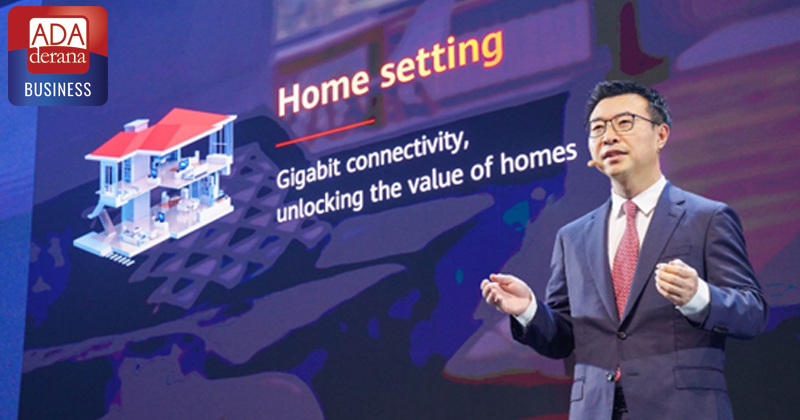
During UBBF 2022, Mr. Simon Lin, Senior Vice President of Huawei and President of Huawei Asia-Pacific Region, delivered a keynote speech entitled "Advanced Connectivity, Boost Growth". In the speech, he set out a roadmap for how operators can unleash the full value of connections in home and enterprise scenarios and how green networks can underpin the green development of various industries.
Home setting: A smart home entry is built for gigabit broadband connections to achieve business monetization in home connection scenarios.
The upgrade of home networks and emergence of new services such as live streaming at home pose new requirements on gigabit broadband. Coupled with gigabit broadband, new services can provide users with diversified experiences, create new home network business models for operators, and enable connection monetization. Simon Lin introduced three ways to monetize home network connections:
Enterprise setting: A connection entry is built for the digital transformation of enterprises to monetize their private lines and networks.
The digital transformation of traditional industries calls for connectivity upgrades. A variety of industries have different requirements for connectivity, driving operators to provide diverse enterprise network connection solutions. Currently, more and more enterprise services are migrating to the cloud, allowing operators to expand their business space. Simon Lin noted that operators can monetize enterprise-oriented connections in three ways:
Green solution: All-optical, simplified, and intelligent green networks enable the green development of various industries.
According to Simon Lin, Huawei is cooperating with operators to help the International Telecommunication Union-Telecommunication Standardization Sector (ITU-T) formulate standards and jointly define the network carbon intensity energy (NCIe) indicator system.
"A sculpture lies hidden within a marble block, but only the greatest artist can set it free," said Simon Lin, pointing out that operators have inherent network advantages in connectivity and will bring unlimited interconnection value to the world if their connectivity capabilities are fully unleashed. He also stated that Huawei will continue to explore connectivity technologies and solutions with customers and partners, and work with operators to promote business growth.
Image caption: Simon Lin, Senior Vice President of Huawei and President of Huawei Asia-Pacific Region
October, 31, 2022
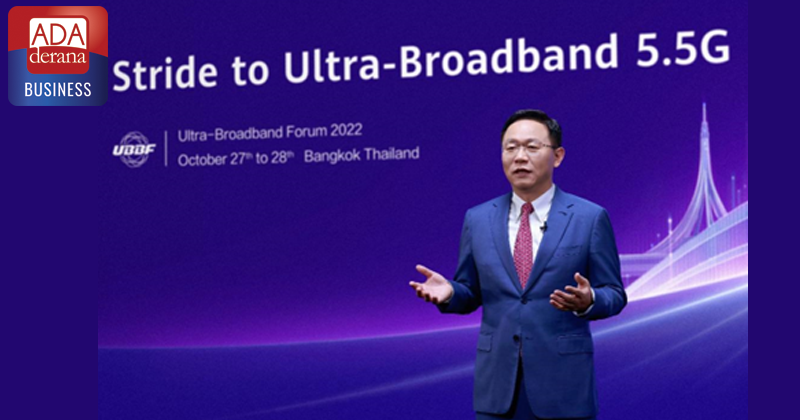
The Ultra-Broadband Forum 2022 raised its curtain today in Bangkok, with David Wang, Huawei's Executive Director of the Board and Chairman of the ICT Infrastructure Managing Board, delivering a keynote speech titled Stride to Ultra-
Broadband 5.5G. During this speech, Wang outlined the enormous changes that are set to take place in areas like smart homes, smart campuses, and industrial Internet by 2030. He also made it clear that ultra-broadband 5.5G will be a key milestone on the path to an intelligent world and recommended that the industry take four key steps to accelerate this
process. He went on to call on all industry players to work together and move faster towards ultra-broadband 5.5G.
As we approach the intelligent world of 2030, home broadband speeds will reach 10 Gbit/s, marking a huge improvement over today's 1 Gbit/s experience. Currently, homes have an average of 5 to 20 devices connected to their Wi-Fi networks. However, this is set to change as smart home devices see broad adoption, which will drive this number up to 150 to 200. It will therefore be essential that fiber can reach every room of every home.
By 2030, Wi-Fi networks will also be capable of delivering several 10 Gbit/s experiences form mid- and large-sized campuses, and will need to support intelligent operations and management. Micro and small enterprises will need Wi-Fi networks that can deliver large bandwidth, premium experiences, and one-stop intranet services. Industrial Internet will require a bandwidth higher than 10 Gbit/s and a latency lower than one millisecond. Enterprises will adopt a multi-cloud strategy that requires networks to dynamically adjust routing. Driven by green development and automation, we will see 10-fold increases in network capacity, energy efficiency, and O&M efficiency.
"Ultra-broadband 5.5G will be a key milestone on our path to this intelligent world. To hit this milestone, all industry players, including standards organizations, regulators, operators, and equipment vendors, will need to work together. I would like to call on you all to continue working together. Let's leverage ultra-broadband 5.5G technologies, build 5.5G
networks, and develop a 5.5G ecosystem. Together, we will move our industry forward andn stride to ultra-broadband 5.5G," stressed Wang. The four steps Wang stated the industry must take to reach ultra-broadband 5.5G include:
First, defining next-gen standards and reaching consensus across the industry.
ETSI started leading the standardization of F5G Advanced with their Release 3 standard. And the ETSI White Paper: Fixed 5th Generation Advanced and Beyond, which is designed specifically for the optical industry, was released in September 2022. By 2025, smart home use cases and optical fiber sensing will be addressed by standards.
In the IP industry, Huawei also published a Net5.5G white paper during this forum. They believe that Net5.5G will achieve even larger bandwidth and realize flexible, end-to-end SRv6 optimization by 2023. By 2025, IP networks are expected to sense computing power and applications, allowing them to deliver more deterministic network experiences and service guarantee for more industrial scenarios.
Second, jointly promoting the rapid adoption of standards across entire product lifecycles, from technological breakthroughs to product development, deployment, and operations.
In optical access, GPON, 10G PON, and 50G PON Combo will be compatible with operators' existing ODN networks and support their ongoing, smooth upgrade. The C-WAN architecture can be introduced on FTTR networks, supporting stable Gbit/s experiences throughout entire homes and cutting roaming handover times to less than 20 milliseconds.
In optical transmission, available spectrum for 400G WDM networks will increase from 8 THz to 12 THz. This will increase the number of available wavelengths by 50% and provide a single-fiber transmission capacity up to 100T. For metro WDM, new wavelength pooling WDM technology will be able to facilitate flexible sharing of metro wavelengths across multiple rings, greatly reducing TCO and supporting WDM deployment to access sites.
In terms of IP, Wi-Fi 7 will use technologies like CO-SR and CO-OFDMA to enhance collaboration between different access points and thus improve the network-wide experience. This will require the support of technologies like UL OFDMA and UL MU-MIMO, to improve Wi-Fi connection reliability. APN6 and SRv6 can also provide valuable support here by sensing computing power and application requirements and then dynamically configuring cloud resources so that companies can more quickly connect to clouds. Additionally, deterministic IP technologies can be used to reduce traffic microbursts and the
end-to-end jitter on IP networks to less than 20 microseconds.
Third, rolling out ultra-broadband 5.5G more quickly using policies and target networks.
New standards and technologies can only create value when they are applied to live networks. Governments and regulators will therefore need to adopt more effective policies, including national broadband strategies, fiber deployment policies, and construction standards, to accelerate the rollout of gigabit FTTH networks and help bring fiber to every room in every home.
Operators also have an important role to play. They will need to define target network architectures for 2025 and 2030. They must also accelerate the rollout of FTTH and FTTR networks, deployment of metro WDM to access sites, upgrade from IP networks to SRv6 networks, and deployment of 400G and 800G for both transmission and IP networks.
Fourth, exploring new applications and building a prosperous ecosystem.
Industry players and ecosystem partners need to work together to explore what ultra- broadband 5.5G will look like. Ultra-Broadband 5.5G will be able to support new, high- potential applications, and once 10 Gbit/s everywhere is realized, applications like MetaVerse games and real-time interactions will see wider adoption. In addition, exploration will continue for new campus scenarios such as immersive offices and robot- assisted offices, and for micro and small enterprise services like one-stop Wi-Fi networks. Huawei believes the telecom industry will need to cooperate with industrial Internet companies as they continue working on deterministic experience and flexible routing in support of industrial Internet. This will help incubate applications for automated industrial control and enterprise connectivity to multiple clouds.
Already, this ongoing standardization is continuing to drive change in the ultra-broadband industry. Over the past 10 years, the world has seen 790 million new FTTH users, while over the past five years, 100 million users have started using gigabit services. Over the past year, an additional one million users have begun using FTTR services.
There are also already about 50.000 high-quality OTN private lines being used by enterprises, 600,000 cloud private enterprise lines, and over 27 million Wi-Fi 6 hotspots now available worldwide. This is all in addition to the 130 400G WDM networks, more than 15,000 all-optical, cross-connect ROADMs, and over 100 SRv6-supported IP networks that have already been rolled out globally.
Image caption: David Wang delivering the keynote
October, 25, 2022

Around 300 students from 11 countries completed a three-day on-site Training Camp initiated by the International Collegiate Programming Contest University Commons (ICPCU) on Sunday. Co-hosted by the University of Wrolcaw and Huawei, the camp aims to provide top-notch programming training for college-aged enthusiasts of mathematical modeling, algorithms, programming and data structure.
Ready, steady, go!
From October 14th to 16th in Miłocin Park in Pierwoszów, near Wroclaw, teams of students and young programmers met to practice and improve their skills under the watchful eyes of supervisors, coaches and mathematical talents from around the world. For the first time in history of this global initiative, the 3-day educational program took place in Poland. More than 40 teams, some connected online while others joining on-site, were attracted to compete in algorithm programming during 3 training sessions led by experts. These courses allow the participants to practice and improve their skills before the next stage of the finals. It was an exciting opportunity to meet new people, learn from others and get to know the practices and theories taught in different countries (such as Romania, Czech Republic or Israel).
“Huawei will continue to support contests & boot camps, and provide professional coaching to the ICPC community. We would also like to share with all of you real-world industrial problems that need to be solved in order to enable a fully-connected & intelligent world. Together, we can learn & grow through ICPC, and drive technological progress!” Zhou Hong, President of the Institute of Strategic Research at Huawei said.
Huawei is committed to open research platform
One of the ongoing goals of Huawei is to actively support the local talent ecosystem. Huawei is committed to open research platforms that are oriented to the future of information terminals, computing, and connectivity. Huawei’s research and development in technologies and products is inevitably connected with mathematics, algorithms and software challenges, especially in the field of optics, wireless structures and mobile phones. Observations of similar Huawei-powered contests dedicated to young talents lead to the conclusion that students consider Huawei’s fields of work such as Cloud, social-app software and financial transactions as the best areas for practicing their skills in programming and mathematical modeling.
"The training camp is not only a meeting of minds, but also a platform for communications. Its value lies not only in the content, but also in the connections made through the training camps. Huawei has opened a window of opportunity for ICPC volunteers to participate in these activities without having to bear the financial burden.” ICPC Global Executive Director. Dr. William B. Poucher said.
“ICPC Foundation training initiatives are crucial for raising new talent, aspirations, bringing people together and building new systems and services that will serve our neighbors. ICPC is about finding solutions to problems. Huawei has been supporting this initiative for several years, which allowed it to successfully grow, and provide opportunities for many students and coaches in different regions of the world. Only together, with academia and industry, we can make this world a better place, establish opportunities for next generations of problem solvers and find smart solutions for global needs.” Veronika Soboleva, Director of ICPC Foundation Development said.
Equal education is the key to the digital inclusiveness
Huawei is committed to the eradication of inequality in the access to the new technologies – and therefore aims for a total inclusivity of the digital world. One of the most effective strategies that Huawei can introduce in this regard is to give the opportunity to educate the youngsters from across the world. The company’s flagship educational program Seeds for the Future, which starts in just a few weeks, is one of its many initiatives providing the students with exposure on AI, Cloud or alternative energy resources. In just 2021, Huawei had cooperated globally with more than 300 universities and more than 900 research institutions. Huawei will also launch over 10 Tech Arena competitions in dozens of European countries.
“As an unswerving pioneer in digitalization, Huawei believes digitalization will be the key to unlocking a brighter future. This progress will become much easier if we involved the top talents in discipline design, school-enterprise joint training, science and technology competitions and other all-round and multi-level top talent discovery and cultivation initiatives. This is why just in 2021, Huawei invested RMB 2.7 billion in university cooperation, cooperating with more than 300 universities and more than 900 research institutions around the world,” said Guo Shuaisheng, head of Huawei’s Warsaw Research Center.
In Poland, Huawei has recently signed an agreement with WSB University in Dąbrowa Górnicza to give students access to more practical courses, interesting conferences and more up-to-date study plans. It is just one of many collaborations that Huawei has conducted with Polish universities. The company has had talent cultivation programs such as co-developed deep learning courses for Warsaw university, algorithm research program in University of Jagiellonian, and other upcoming training program in Wroclaw University, Warsaw University of Technology, the Poznań University of Technology or Koźmiński University.

Director of ICPC Foundation Development Veronika Soboleva speaks at the opening ceremony on Oct 14th

One student speaks during the Training Camp on Oct 16th at Miłocin Park in Pierwoszów

University students participate the 2022 ICPC Europe Training Camp on Oct 15 th at Miłocin Park in Pierwoszów
Image caption : 2022 ICPC Europe Training Camp powered by Huawei held in Poland
Video Story