

November, 12, 2022
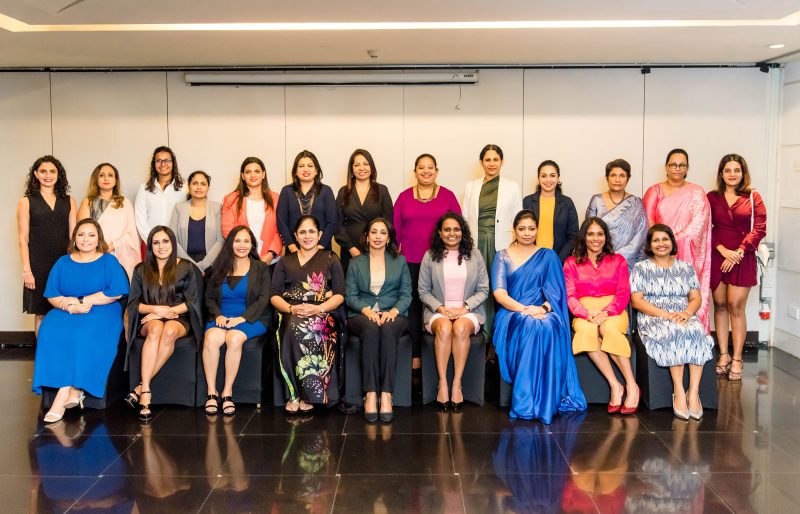
The Women’s International Shipping & Trading Association - WISTA Sri Lanka 8th AGM was held on 4th November at the Cinnamon Grand Hotel, followed by Cocktails.
This event was graced by her excellency Julie J Chung, US Ambassador to Sri Lanka, distinguished invitees and WISTA Members.
Addressing the gathering, her excellency Julie J Chung shared her experiences in breaking glass ceilings and overcoming gender disparities inspiring the gathering of WISTA members. She also stated that globally women representation in Shipping and Logistics is a mere 2% and urged females in the country, who are more than just over half of the population, to join forces in re-building the economy, advance good governance and further market reforms, and be a positive force in the labor market. She took time off her busy schedule to meet WISTA members over networking and cocktails.
Ms. Diruni Chanmugam – Director/ CEO of Shermans Logistics was elected as the President of WISTA Sri Lanka during the event. Diruni brings in a wealth of knowledge and experience in the Shipping and Freight Forwarding Industries to lead and achieve the objectives of WISTA Sri Lanka. Chamila Bandara – Director of Advantis Express, IML Delivery Systems and Member of the General Management Committee of Hayley’s Advantis, was elected as the Vice President. Kalani Dassanayake – Assistant Manager Commercial & Marketing of South Asia Gateway Terminals was elected as the Secretary, Sharmala Fernando – Manager Key Account Management of Mac Supply Chain was elected as the Assistant Secretary, Shiyamalee Karunanayake – General Manager Shared Services of Hayley’s Advantis was elected as Treasurer, Ruwini Perera – Assistant Manager Customer Solutions and Business Development Support of Hellman Worldwide Logistics was elected as the Assistant Treasurer.
The newly elected Executive Committee for the year 2022/23 consists of Nilu Mediwake Wickremasinghe – Director of SALOTA International, Swabha Wickramasinghe – Director Marketing of World Link Shipping, Anoma.V Ranasinghe – Consultant Shipping and HR Services of McLarens Shipping, Debbie Jones – Assistant General Manager P&I Division of GAC Shipping, Amali Mudunkotuwa – General Manager Operations of Regency Teas, Surangi Gunasekera – General Manager NVOCC of Prudential Shipping Lines, Enoka Wickremasinghe - Assistant General Manager Marketing of Shipping and Cargo Logistics, Anuka Pathirana - Assistant General Manager HR of GAC Shipping, Therani Kalyanapriye - LCL Execution Lead of Maersk Lanka, Udara Cumaratunga - Senior Manager Commercial and Marketing of South Asia Gateway Terminals, Madhu Welikala - Assistant General Manager Business Development of SALOTA International, Aparna Thilakaratne - Chief Law Officer of Sri Lanka Ports Authority, Aruni Wijepala - Deputy General Manager of Hayley’s Energy Services, Anjalika Perera - Manager Commercial of GAC Shipping, Dilky Bartholomeusz - Assistant Manager Customer Service of GFS Lanka and Deepika Wijesuriya – Director of Penguin Shipping . The Executive Committee will work towards implementing many initiatives in accordance with the WISTA Sri Lanka mandate on improving gender parity and women empowerment in the industry.
Addressing the gathering the newly elected President Diruni Chanmugam expressed her confidence in leading WISTA Sri Lanka to be a strong force in the industry and outlined priorities that she intends to focus on during the year. Diruni stated that there now is a trend where more women are taking up career development initiatives focusing on higher studies in the industry which is a welcome change and it is her utmost intention to encourage more women to be equipped with leadership skills to prepare them for future leadership positions in their respective Companies. She also stated that Maritime and Logistics Sector need to embrace innovation, digitization, better cross border mobility, creating neutral platforms to collaborate and share experiences in addressing some of the challenges faced in the Industry. Diruni invited all members to join committees and collaborate by working together on projects to promote diversity and inclusion in the maritime and Logistics Sector.
Key highlight of the event was recognizing WISTA Personality of the year which was awarded to Dr . Sulochana Segera, founder and Chairperson of Women in Management (WIM). This recognition was bestowed on Sulochana for the immense contribution made to uplift the standards, promote gender parity in Sri Lanka and the region. She was able to stamp her mark in many overseas markets taking WIM representation to the region and to be recognized internationally by winning several awards. She also dedicates time and resources, joining hands with the Corporate community to uplift the standards of living and wellbeing of the underprivileged community needing support with several unique initiatives.
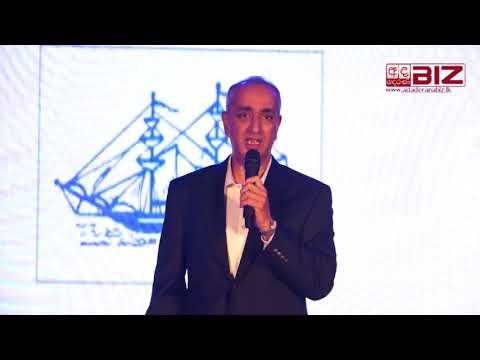
Founder President of WISTA, Shehara De Silva – Group Managing Director of McLarens Holdings addressing the gathering spoke about the journey of WISTA and its success story of promoting gender diversity in a male dominant Shipping and Logistics Industry over the years. She also stated that WISTA has made many strides to promote female representation in the Industry.
Hayley’s Advantis Limited was the Official AGM Sponsor for the event and South Asia Gateway Terminals continue to power WISTA Sri Lanka as the Corporate Partner. SAGT will continue to partner and support WISTA for yet another year. WISTA Team is confident of yet another great year ahead of promoting and strengthening gender diversity and women empowerment in Shipping and Logistics industry In Sri Lanka.
November, 1, 2022
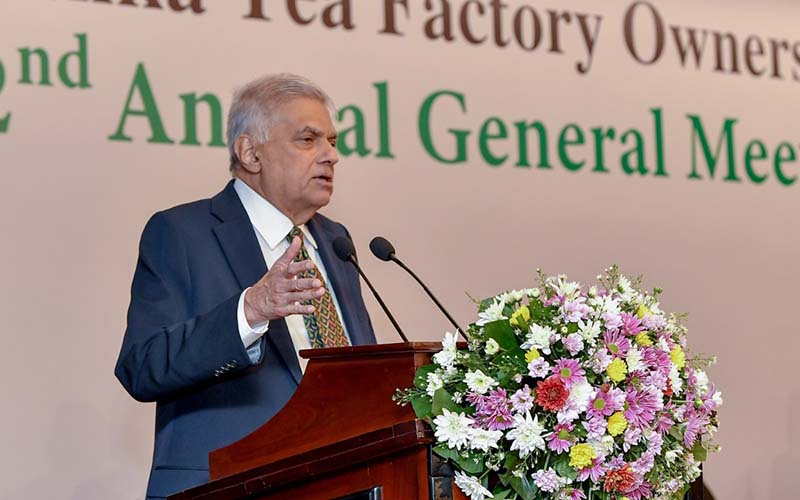
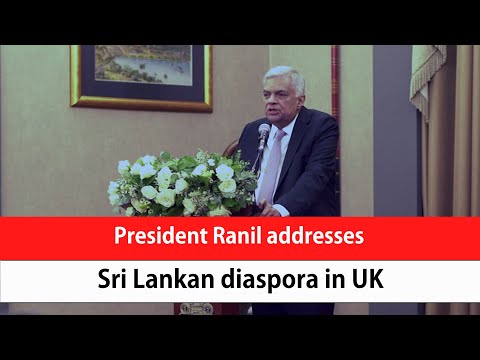
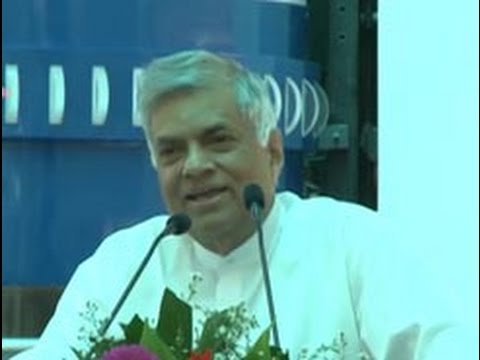
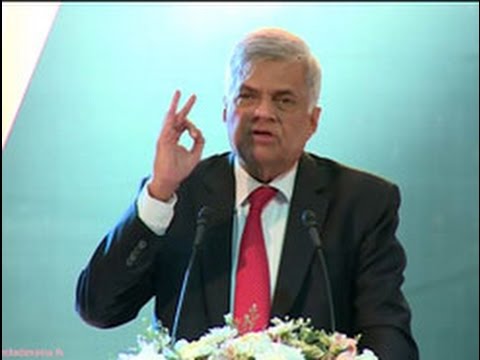
President Ranil Wickremesinghe noted that the government is aiming at an agriculture modernization programme in which tea will have a prominent place. He said that the country has a very competitive tea industry that needs to be developed.
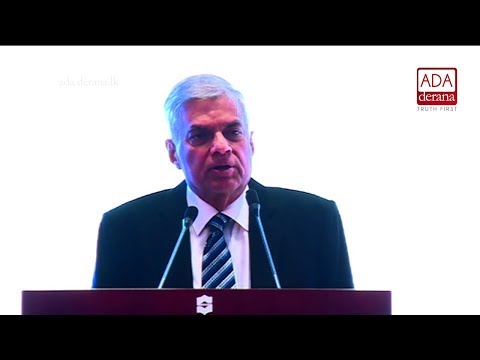
Addressing the 32nd Annual General Meeting of the Sri Lanka Tea Factory Owners Association at the Water’s Edge Hotel in Battaramulla yesterday (30), he said that the main focus should be on producing quality tea be high-grown or mid-grown.
“It is useless for us to try to compete with those who are not having the quality. We have an opportunity. Let’s go for it and develop the industry, modernize our factories, look at renewable energy, the biomass, all that is there,” the President emphasized.
Following is the full speech made by the President;
“I was listening to the report by your president about a survey of the tea industry today. He came out with a tale of woes. That is understandable looking at what we have gone through this year. Now, it is my chance to come out with my tale of woes because I have taken over the titanic after it hit the iceberg. So you can just imagine where I have to start. Everything was down.
We have declared ourselves bankrupt. What have we got to do? First is to ensure that people can live and there is enough food to eat, whatever the other difficulties. With the bankruptcy that we have declared, our economy has virtually come to a halt. The inflation, the bankruptcy, and everything else that is happening have brought our economy to a grinding halt.
How do we restart it? That is what we are engaged in. In addition, I thought I’d explain to you the process. Primarily, we have to conserve whatever foreign exchange we have and limit imports so that we could get fuel, fertilizer and medicine.
It has not worked fully initially, but now it’s working much better. Therefore, that is how we started. Then as the revenue dried up, we faced the difficulty of paying our bills or meeting our commitments. We had to keep two things in mind, one is to pay the salaries of government servants, about 1.7 million people and service our debts. Therefore, we have had to work within this scope.
Now that we have declared ourselves bankrupt, the first issue was to ensure that the world would now accept that we have taken sufficient steps to wipe out the label of bankruptcy, which meant that we have to go to the IMF and discuss with them. Every country and organization wanted us to meet with the IMF and devise a plan.
We did have a plan until 2019 when we cancelled the last year. Therefore, we had to start original discussions with the IMF. We had no other option. Our growth rate this year is going to be -8%. Last year too we recorded minus growth. This year is also -8%, and next year it is forecast that it would be -3%.
However, there’s one other factor which worries me. When that forecast was made, everyone thought the global economy will do well. Now, all the indications are that the global economy will fair badly. How will it impact, because the rising inflation in European and other countries will mean that the cost of living will rise? This in turn can somehow affect exports such as less clothing, maybe less tea, and less coffee. We have to understand that.
Therefore, we have to get through this year and then go into next year. Hence, we have to somehow manage two years. Our revenue reduced from 15% to 8.5% and we are expected to get the revenue back to 15%, which I think we have to do.
The timeframe is 2026. I went in for a four-year program.
I didn’t think we could bear the burden if we tried to do it in two years and it may not have been possible. I’m happy that we went for four years because 2023 looks to be a bad year globally, not only for Sri Lanka.
So we had to first come to an arrangement which meant raising money. To raise that money, we had to tax everything, which also meant agriculture.
As someone once said, if it moves tax it. We had to come to that level and we had no way out. I wish we could have done it gradually but couldn’t because we needed the money. If you look at the taxes, those who paid taxes up to 2019 got a reduction 2019. Therefore, that’s a loss of revenue. Now what we are trying to do is bring it back first to the 2019 level and add a little bit more. So if you look at up to 2019, your taxation then and today is one figure. However, if you look at 2020 the gap seems much bigger. The fact is that we are suffering, it’s not only tax, but our rupee has also depreciated and interest rates have gone up.
Therefore, it is in this context that we have to operate. Ordinary people are finding it very difficult to live. I mean it’s in that condition that we have to come back. So the first issue is to ensure that we can restructure bankruptcy. We have to start talks with our creditors. I first went to the Paris Club where all the creditors were from the West and Japan.
However, we are in a unique position today where out of our three main creditors, only one belongs to the Paris Club. Japan. The other two are not in the Paris Club. They are India and China. I mean China only started dealing with bankruptcy in Zambia. I think India has it for the first time with Sri Lanka. I have already started discussions with Japan and now with India and China. We get down to a common platform of how we can resolve it while we also have discussions on bilateral issues that affect each other’s countries.
Now, this is the process, we had to move. If we can move and come to an agreement by December, which means coming to an agreement by mid-November, and going up to the IMF Board in mid-December, we will gain a big advantage. However, I don’t know whether we can do it for the simple reason that in China, the focus has started now after the party conference. However, we must aim to have it by January.
Therefore, this is what we are aiming at, and it means that we have to show that we have the revenue and we can go ahead. We start from there. Then how do we go ahead to ensure next year is better? In the meantime, we have started receiving assistance from many organizations and countries. Some countries have helped us through different organizations.
So thanks to the World Bank, ADB and others, we are having FAO, and we are having enough fertilizer. Even countries like the US have assisted us. So the fertilizer issue is solved. No one will give us money for fuel. Hence, we have to use the savings on fertilizer with local foreign exchange to buy fuel.
The next issue though, is that the price of fuel has dropped now and everyone expects the price of fuel to increase in December/January due to the Ukraine war and winter. Hence, that’s the next issue that we have to face. But since we have received fertilizer, the first thing was to revive agriculture, starting with Paddy and then getting on to tea and other crops.
Therefore, this is one part where if we get a good Maha crop by March/April next year, that will help to stabilize the economy. Meanwhile, once we get the agreement, the countries will come to help us. However, it takes time to get loans from bilateral loans again. Meanwhile, the World Bank and the ADB are willing to come up with bridging finance and the whole process will start.
Therefore, we have to thirdly go all out to improve our tourism. I think if we can aim for good tourist numbers by December next year as it grows progressively, then it will start working. Finally, we need foreign exchange reserves. There is no way in which you can raise it now. The only way in which we can raise foreign exchange reserves is by selling off some of our enterprises for dollars so that we can at least put $ 3-4 billion into the reserve, strengthening the rupee further. It will make life that much more affordable if you are moving to a complete market economy and a high-growth economy. This is the only step that we can take because so far having a vast state sector did not enable the economy to grow that fast.
I know the problems you have and I know many of you in the tea sector. Factory owners as much as in the rubber, coconut sector construction sector and the hotel sector are having problems with your banks, servicing your loans etc. So that’s why we are hoping first to bring the rate of interest down gradually.
The Governor of the Central Bank has informed us that our inflation is peaking. So by about February or March, we can see the reduction of interest rates, if not earlier. If we take all these measures by mid-year, we’ll be able to give relief on the interest rates. It’s difficult when the rupee has depreciated and the interest rates rise. But you have to remember that in two years we printed Rs 2.5 trillion worth of notes. So it has to run through the system.
There is no shortcut and the only way is by getting production up again. So here it’s a question about how we could help you in the tea industry. We have got the fertilizer. I know there are deficiencies in other areas. One of the main things that I asked is that we pay the fertilizer suppliers. We have decided to pay them, but the money hasn’t gone yet.
I hope that with the new taxes and the collection that is coming in November-December we will be able to pay them off. We also have to pay the contractors. The whole industry has come down. So there’s a long list of people with debts which the government has to honour. So that’s the process. But we want the tea industry to develop. And I must assure you, the honourable minister and the State Minister have been spending a lot of their time looking at how to help you in this circumstance.
Because helping the tea industry helps us bring in foreign exchange and save rubber and additional agriculture production. Next year we have to come through with agriculture production. That is what we have to do as we add the rupee stabilizes. Certainly, people will start sending back the exchange, the foreign employment and the money will come up. But also we can’t run on this economic model anymore.
We have to pay our debts. We have to take some more debt. We are to work completely on an export-oriented economy, and that’s what we are working on. We’ll come back to you, but you have a lot of things to do too. We know you need fertilizer. Most of the major issues are that we need replanting. We are suffering because we have not replanted. As a result, our crop per hectare is coming down. Vietnam is overtaking us. Whoever thought that Vietnam will be growing tea. That’s the position. So we are looking at an agriculture modernization programme in which tea will have a big place.
We have a very competitive tea industry that we have to develop. And I think we have to go for quality tea, whether it be high-grown or mid-grown. It is useless for us to keep competing with those who are not having the quality.
We have an opportunity. Let’s go for it and develop the industry, modernize our factories, and look at renewable energy, biomass, and all that is there. So we need a modern industry and certainly, I think it’s good that you have got Price Waterhouse and Cooper. Because you can utilize their report together with the ADB report on the regional plantation companies. Some of you are doing quite well. Others are a disgrace. So let’s see how we can restructure, how we can get your help and go ahead. I thought I described this to you. I haven’t got the best picture possible, but at least I am trying to take the Titanic off the iceberg and once we do that, we’ll go ahead. Thank you very much for inviting me”.
Plantation Industries Minister Ramesh Pathirana, Chief Executive Officer of A. Baur and Company (Pvt) ltd Rolf Blazer and President of Sri Lanka Tea Factory Owners’ Association Lionel Herath also addressed at the occasion.
State Minister Lohan Rathwatte, UNP leader and Parliamentarian Wajira Abeywardena, Plantation Ministry Secretary B. L. A. J. Amarakeerthi, Sri Lanka Tea Board Chairman Niraj de Mel and office bearers and the members of the Sri Lanka Tea Factory Owners’ Association participated in the event.
October, 24, 2022
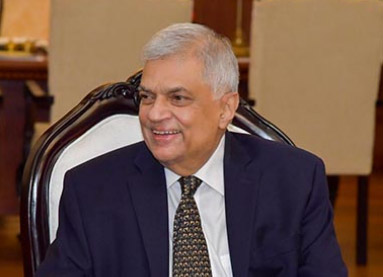
President Ranil Wickremesinghe said that he aims to make Sri Lanka a developed country by 2048 and that the youth of this country have been allowed to contribute towards this goal.
The President said this during the discussion held on the 22nd of this month through Zoom technology with the youth of the “2048 Youth Platform on the Journey towards a Developed State” program.
The youth were given an opportunity to question the President about the social, economic and political issues of the country as well as the problems faced by today’s youth.
Accordingly, the following are the questions that were posed by the youth and President Wickremesinghe’s responses:
Question:
Mr President, you always say that for the country to move forward, opportunities must be provided to the youth. Back in 1977, Mr J.R. Jayewardene allowed you to come forward as a young leader to contribute to the development of the country. You aim to make Sri Lanka a developed country by 2048. Have you commenced the process of training youth leaders for it?
Response:
First, we are working towards creating a situation where our country can move forward. When I took over the country, the country’s economy had completely collapsed. If we are unable to recover from this predicament, we will have no future.
During the agitations in the country recently, I took over this government and initiated measures to resurrect the bankrupt economy. The youth of the country have the opportunity to take part in it. One of the steps that I have proposed is to appoint five young people to every parliamentary oversight committee. The selection of members and chairpersons of the oversight committees has not been completed yet.
Similarly, we intend to legalize the youth parliament. There is an opportunity for new youth to come forward through the proposed Jana Sabha. In addition, we have invited the groups that joined the struggle but did not resort to violence, to participate in this process. I hope this move will produce the new leadership we need. I would like to assure you that we are now paving the way for it.
Question:
One of the main factors that will contribute to making our country a developed state is to guide the youth towards entrepreneurship. I would like to know what your vision is to bring young people forward as entrepreneurs.
Response:
Entrepreneurs began to emerge following the open economy in 1977. While these measures were initiated during the British era, entrepreneurs emerged in the 19th and early 20th centuries. However, after 1960, the number of entrepreneurs decreased because of the government’s tight economic control. In 1977, we were in a very competitive economic environment in Asia. However, today our economy is not competitive. From 1977 to date, we have not been able to join this program. A good example is the oil tank farm in Trincomalee. For 15-20 years, these tanks were not utilized. If not for LIOC, we would not even have this concession.
Many businesses in the country have gone bankrupt today. Our banking system has been safeguarded with the greatest difficulty. Our priority should be to strengthen our banking system. We should also make our economy competitive. The export economy should be strengthened. Young entrepreneurs can take over these bankrupt businesses and uplift them.
We need to look at how we could provide loans to young entrepreneurs. In a situation like this, if we are to forge ahead, our banking system needs to be strengthened.
If our rules and regulations for receiving foreign investments are further relaxed, the investment opportunities in this country will expand further. Everything needed for the garment industry was outsourced, the only advantage we had was labour. Today we have been able to produce these things locally. We send them abroad. This is how the value increase has been systematically done. It is in this process that youth should look for opportunities.
Question:
Is there a special plan to engage the youth of this country for the country’s development, if so, we are eager to hear it?
Response:
Why are you waiting to be invited to join the country’s development? There are ample opportunities for it. What the youth should do is utilize this opportunity and contribute towards the country’s development without waiting to be invited to do so.
Question:
Former President J.R. Jayewardene also faced the same issue you are facing today. Having been influenced by him, what do you think of the country’s future? Will you follow in his footsteps and continue with the same foreign policy?
Response:
Challenges must be faced. No one can escape from these challenges. The biggest challenge facing our country in this century is how to move forward with post-war modernization. We were not prepared for it back then. Even after the war, we held on to that same mentality. That world has now completely collapsed. The reason is that we cannot forge ahead burdened by debt.
We need to act diligently. We have been living in a dream world. Ne must step out of that dream world. Mr J.R. Jayewardene came to power in 1977 and initiated the open economy. Countries such as China, India and Vietnam had an even tighter controlled economy. Back then, China was poorer than India. However, China went ahead with the open economy. India is also heading towards that development.
Vietnam is a country that was destroyed after the war. However, today it is a developed nation. The war in our country ended in 2009. Even when we were in the government in 2019, the people were still not ready for this modernization. As a result of the tax policies implemented in 2019, the country’s economy has completely collapsed. Now the youth of this country are facing its negative effects. Some young people are leaving the country claiming that there is no future.
Another group is waiting to build their future. We must accept that challenge. That is what we have to learn from J.R. Jayewardene and other leaders.
Question:
Mr President, we would like to know about the government’s program on food security and what the agriculture policy for the coming year is.
Response:
We have already started a program on food security. In addition, the program of providing fertilizer for agriculture has also been implemented. We have received the dollars required to purchase fertilizer. As we have received money from the World Bank, Asian Development Bank and other countries, we can now purchase fertilizer.
The fertilizer needed for the Maha season is currently available in the country. It will be distributed shortly. If there are any shortcomings, I have advised the authorities to look into them.
We have also taken steps to provide the required fuel for agricultural purposes. We also expect to receive the second batch of fertilizer after the 15th of November.
We plan to commence food production completely within the first three to four months of next year. Currently, there is no problem with paddy production. However, maize cultivation needs to be expanded.
Question:
We would like to suggest that a fortnight of agricultural promotion should be designated to discuss issues that could arise about the Maha Season cultivation while a program should be implemented to attract youth to agriculture.
Response:
Our agriculture has to be modernized. There are agrarian service centres and several officers are working at the village level but they have not been deployed to duties systematically. Thus, when agriculture is modernized, we have a lot of work to be done.
Question:
The brain drain has become one of the most serious issues in the country. Although the country receives foreign exchange through it, the loss of human resources is a problem. We would like to know the action you intend to take to prevent brain drain.
Response:
The high rate of brain drain commenced last year. It has increased rapidly this year with the economic crisis. Future uncertainty is the cause of it. I would like to raise two matters in this regard. The first issue is if it is just to leave the country have received free education and get a good job. This situation will last until the middle of next year. Government revenue has dropped to 8.5 per cent of the Gross Domestic Product which should be raised to 14 per cent. The non-taxation in the past is the root cause of this issue. Now, we have got to move forward with the new tax systems.
Question:
You have mentioned that you would focus on foreign investments rather than on foreign loans. We would like to know what stance you maintain on foreign investments and your proposals to get the contribution of the youth in this regard.
Response:
The countries develop themselves with foreign investments and not with borrowings. China developed with foreign investments and it is ahead of India as the latter was slow to attract foreign investments. Vietnam is also another country that has advanced itself with foreign investments. A country cannot go forward without foreign investments.
Foreign investment creates new business opportunities and increases production. It is the only way we can move forward. Following the war, it attempted to develop the country by taking foreign loans, which proved a failure. In 2015, although I had the opportunity to bring about a solution, the program was not continued and that is the cause of the predicament we are in today.
We have to create a conducive environment for foreign investment and we are working on it. If we impose restrictions and take two to three years to reach decisions, our country will not get investments. Therefore, we have to make drastic changes in the existing system to move the country forward.
Question:
Mr President, our attention has been focused on Russia with the issue of crude oil. Discussions are in progress with them to get crude oil on a long-term basis. What is your position in that regard?
Response:
Mostly we get crude oil from Middle Eastern countries and there would not be a change in it. However, with the contemporary crisis, Russia has also suggested obtaining credit facilities. Several problems have arisen in that regard. Some restrictions have been imposed on getting fuel from Russia and they are not lifted yet.
Question:
Mr President, winter is approaching in Europe. They too are facing the crude oil problem. Under such a situation, people from European countries are awaiting to travel to Eastern countries. I would like to know if Sri Lanka has proposed any tourism promotion program targeting them.
Response:
We have a program to promote tourism this year and the result is expected by next year. Europeans have already decided which countries they would travel to and I hope, we can achieve these goals by next year.
Question:
Mr President, there were different youth groups in the struggle. There were groups with ulterior motives. There was a group of youth who were devoted to the future of the country. Would not you like to make this an opportunity to invite those youth?
Response:
I have already extended my invitation to them. We are always ready to discuss with those groups at any time. In addition, we would like to say that we are ready to discuss with the youth who were misled in the struggle.
We would like to discuss this with both the devoted group and those who were misled by the struggle. The groups who tried to gain their political intentions by way of violent activities in the guise of the struggle too have the opportunity to make a confession and join hands with us if necessary. We should not neglect them, as they must acknowledge that they had caused harm to the country.
Naturally, various measures are being taken by the people of a country when the economy faces a crisis. However, violence in the guise of them should be paid attention to. If there were a group who realized that they resorted to violence and it was wrong, we would discuss it with them as well.
Question:
Mr President, have you got the chance to watch a movie or read a book recently?
Response:
All my books were burnt so I am unable to read them. Since the 09th of June, I am watching a movie about the country comprising several sequels. Even the first sequel is not completed yet.
October, 21, 2022
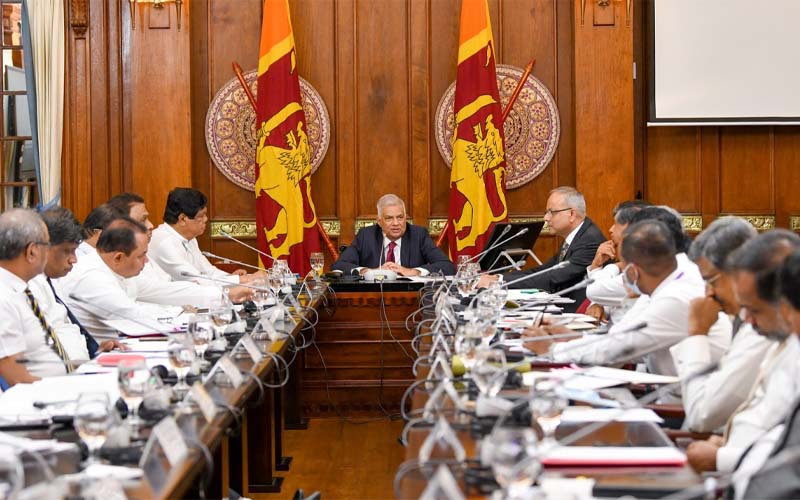
A discussion on the challenges faced by the construction sector and proposed plans to address these issues were held at the Presidential Secretariat under the patronage of President Ranil Wickremesinghe yesterday (20) afternoon.
The problems faced by the construction sector under the current economic situation were discussed at length and special attention was paid to the delays in the construction of middle-income housing projects as well as road construction projects.
During the discussions, attention was also paid to the issues that have arisen about the contractors, banks and other financial institutions.
The President drew the attention of the officials to the program to be followed for the maintenance of the construction sector and job security in the sector while proposing the appointment of a committee to discuss the matter further and make recommendations.
Those engaged in the construction sector also requested the President to establish a special task force for the upliftment of the construction sector.
Minister Bandula Gunawardena, State Minister Lasantha Alagiyawanna, Senior Presidential Adviser on National Security and Chief of Presidential Staff Sagala Ratnayake, President’s Secretary Saman Ekanayake, Senior Economic Advisor to the President R. H. S. Samarathunga and heads of institutions related to the construction sector were present at this discussion.
October, 21, 2022
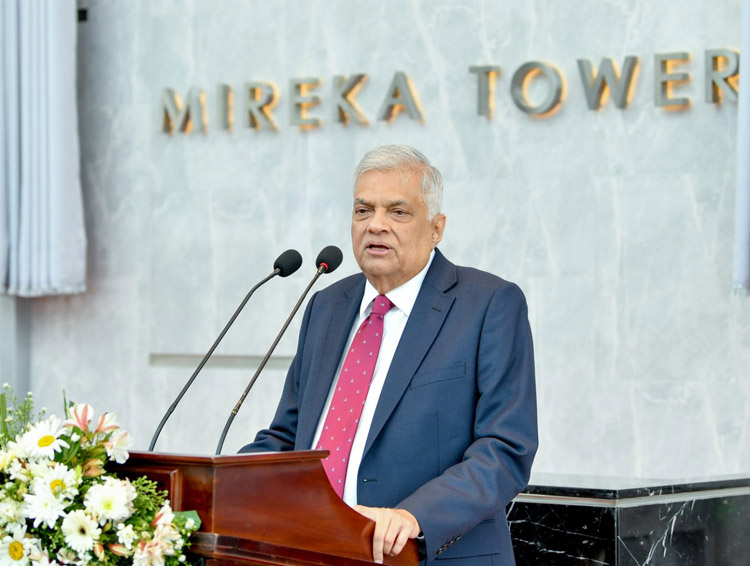
President Ranil Wickremesinghe emphasized that immediate measures are being taken to create an investment-friendly environment in Sri Lanka and create economic stability.
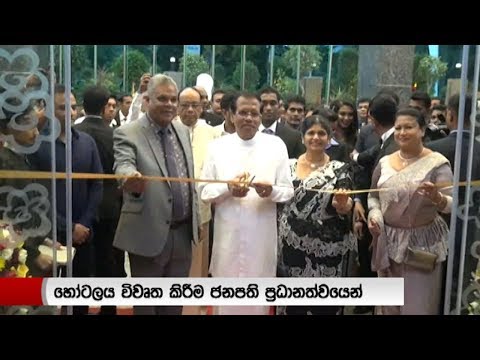
The President said this addressing the gathering at the Mireka Tower Opening Ceremony at Havelock City in Wellawatte Thursday (20), where he was the Chief Guest.
The President also said that laws that had been introduced under the Greater Colombo Economic Commission (GCEC) will be re-enacted to introduce an efficient system replacing the existing slow process, to encourage foreign investment.
The President further said that he had already appointed a committee to bring the Board of Investment (BOI), the Export Development Board (EDB) and the Sri Lanka Export Credit Insurance Corporation (SLECIC) together onto one platform and establish one investment promotion agency to encourage foreign investment in Sri Lanka.
He further added that Sri Lanka needs to be made an investor-friendly country to attract foreign revenue and get out of the vicious cycle of foreign borrowing.
The statement made by President Ranil Wickremesinghe is as follows;
“This complex, Havelock City is a tribute to Mr S. P. Tao and his commitment to Sri Lanka. I told Mildred, now you are virtually a Sri Lankan citizen. So let’s think of where the next investment is going to be. I first got to know Mr Tao in 1994 as I became the Prime Minister. He had started at the World Trade Center and after President Premadasa passed away, the late Sirisena Cooray brought him along to meet me. That’s how our first contact started. I met him many times, and not only the late Mr S. P. Tao but also Mildred Tao. Then I must say, the commitment is such that during the attacks, a lot of people wanted to pull out.
Instead, when I asked Mr Tao, he said, ‘no, I’m going to stay here. So first, thank you for that confidence in Sri Lanka’s future. When you crossed over and I was Prime Minister in 2003, again, I met S.P. Tao and he has been meeting me on and off, and he wanted to start a new project.
The new project came along and they were looking at the Havelock town, Wellawatte Spinning and Weaving Mill land that was abandoned. So some people asked why we wanted to give it. We can have some industrial business there. But I said Havelock town started as a residential area. So let’s look at this. This will be the start of the Havelock city development.
I had known this place earlier when I was young and the Wellawatte Spinning and Weaving Mills were operational. I used to come here when Mr Solly Captain’s father was in charge of the mills. We used to have lunch there and also we were taken along to see the mills. Then in 1975 when I entered politics, President J. R. Jayawardena was the MP for Colombo South and he asked me to take over Wellawatte North. At the time this area was known as Wellawatte North Ward.
I used to come here and one of our meeting places was the old worker’s residence at the other end of the complex. So, I told Mr S. P. Tao, that whatever he does, to ensure that the workers who lived there were looked after, which he did. So I was more than happy. Here was the area that I had known when I was first in charge and I thought why not. I took over Biyagama next and started zones there.
So, I thought, why not have one zone in Havelock town and no better person than SP Tao to start it off? So it is this venture’s results which we see today. Many people were involved in it. I see Rohini Nanayakkara, who was involved in this project from the very beginning.
She doesn’t want me to reveal her age. Okay, I will not reveal your age, I am only saying that you were involved. There’s Ajith Jayaratne and many others who were involved in the project. So I must again say thank you. I am saddened that Mr S. P. Tao is not here. After all, he had lived to 105. Nevertheless, this is a tribute to Mr S. P. Tao.
So I look forward to another investment, as I said, from the company. That will have to be Mildred’s investment. This is Mr S. P. Tao’s investment. So now you got to make one for Mildred. However, I must say that we have to now seriously look at foreign investment, replacing foreign loans, as our main source of income.
We have to become an export-oriented economy, and we have to keep increasing our foreign investments. Now, if we are to keep increasing our foreign investment, we must have an outward-looking economy. We can’t have an inward-looking economy. So, now as the economic stabilization is taking place, and the discussions are on between Japan, China and India, about the main creditors, on how to restructure the debt, we are also looking at how we can now revive growth.
One of the biggest issues we have is the number of government agencies that investors have to pass through. You go through BOI, Tourist Board, or some other ministry, then you go to Port City and then you come back to where you started. Then you do a second round. After about ten years, you can get the investment through. This just won’t work.
When we came in 1977, we started the Greater Colombo Economic Commission (GCEC). There, the decisions were taken quickly and really in ten years, we got four zones going that is Katunayake, Biyagama, Koggala and Seethawaka. Then there was Pallekele which Mr Wijethunga wanted. Thereafter, what are the big investment zones that we have started?
The whole system has broken down. The Tourist Board is where people go around for various fairs and come back after they have had a good holiday. Therefore, I appointed a committee which is now looking at the whole structure and the investment authorities. What this committee is recommending and working on is that the BOI the EDB and Sri Lanka Export Credit Insurance Corporation (SLECIC) are brought together as one investment promotion agency.
Secondly, the industrial estates and investment zones will be broken off. I think Katunayake and Biyagama are the best zones in South Asia. We are now looking at thousand-acre zones and initiating them from Bingiriya, then Hambantota and Trincomalee. A separate corporation will handle these.
Then we have to look at the laws. We have to cut through these laws and go back to the GCEC system. When the investment is made, the organization has two weeks to make their remarks and the thereafter-final decision is taken. That is the only way. Next is to develop the quality of human resources, and manpower available and look at the infrastructure.
If these steps are in place, we won’t need 40-year tax holidays. We should have an efficient bureaucracy and efficient infrastructure to ensure that investment can take off. Therefore we would be focusing mainly on zones, whether it be for manufacturing, IT or even tourism, rather than have people located everywhere they want. We could expedite matters earlier under the GCEC because we had an efficient system.
So this is the new system, we are looking at. How do we open up? There will be many laws that will be changed and there will be some who will object and say that we are betraying the country. So remember that propaganda will go on. But we must have fast growth. We have gone down. It doesn’t mean we have to stay down.
Sri Lanka can be like a football. You hit it, send it down and then it bounces back up again. So that’s what we have to be and we must go all out. We have several people leaving the country. That’s okay. We can’t stop that. We must train more people. We are modernizing the education system. So that’s what we are working on while we are looking at stabilization measures which we are working on with the IMF.
Certainly, we are also looking at modernizing the economy, looking at the industry and how we can go ahead. Another area of interest is going to be modernized agriculture. There’s so much land available. I thought I’d share with you what we are now working on because by the end of the year will be able to announce many of the measures that will be implemented by early next year to get the legislation enacted. Therefore, many measures are needed to be taken.
However, this is all to make Sri Lanka an investor-friendly country. And when investors come in, we will certainly have more employment, and higher income and we will be able to get off this vicious cycle of foreign borrowing. We can’t do this a second time. So let’s make up our minds. Let us commit ourselves to moving forward to promote greater foreign investment.
Before I conclude, I would like to say that Mr S. P. Tao, had a lot of faith in Sri Lanka. He looked at the locations and said, this is a good point. Even better than China or India. I too share the same view. So let’s hope it succeeds.
Thank you.”
October, 5, 2022
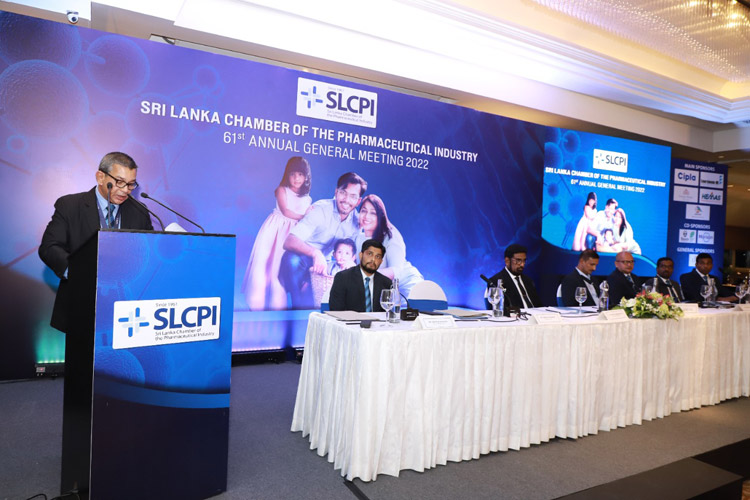
The Sri Lanka Chamber of the Pharmaceutical Industry (SLCPI) held its 61st Annual General Meeting at the ‘Samudra Ballroom’, Hotel Taj Samudra on the 23rd of September 2022. The prestigious Pharmaceutical Chamber has an unblemished history of serving as a representative of over 60 members who account for more than 80% of the island’s private pharmaceutical market comprising of Importers, Manufacturers, Liaison Offices, Distributors, and Retailers.
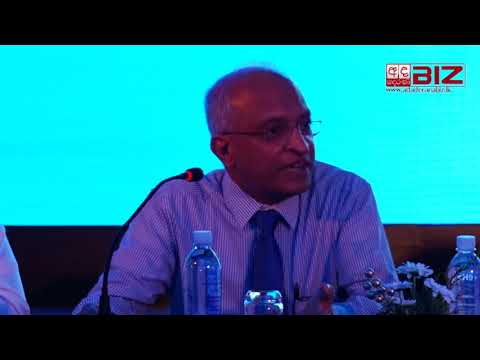
The Chamber unanimously elected Mr. Sanjiva Wijesekera as the President for the year 2022/2023. Mr. Wijesekera, the Executive Director of George Steuart Health (Pvt) Ltd., will head the Pharmaceutical Chamber for the second consecutive year along with the Office Bearers and Membership of the SLCPI, keeping the Chamber’s vision at heart, which is to improve the quality of life and life expectancy of the Sri Lankan people through strong partnerships and strengthened bonds with all stakeholders.
In his keynote address, Mr. Wijesekera highlighted that the past year has been the most challenging year for the industry, especially in terms of value chain disruptions, rupee depreciation and cost escalation of direct overheads, given the pandemic and the prevailing economic crisis of the country. He went on to emphasize that, despite challenges the Pharmaceutical Industry has been resilient, continuously ensuring the availability of medicines and medical devices for the general public across the island. He also thanked the government for the price adjustments granted on pharmaceuticals that helped to mitigate exchange losses to a greater extent in the past year, aiding the industry to cope with adversity.
The Chief Guest at the AGM, Hon. Dr. Keheliya Rambukwella, opened his speech by affirming that the state and the pharmaceutical industry are two faces of the same coin that work towards the ultimate goal of providing the best service for the ailing patients in the country.
“Prudence is necessary to impose certain controls and guidelines in order to ensure that there is no exploitation of people or the industry. Such controls should never be to the detriment of the industry itself which provides an essential service”, stated the Minister.
He stressed the importance of working towards ensuring further effectiveness and efficiency of the industry together with the National Medicines Regulatory Authority (NMRA), which is the regulatory body of the island’s Pharmaceuticals & Medical Devices.
The Minister also lauded the efforts of the industry during the past year for staying resilient amidst distress and extended continuous support of the government to the Pharmaceutical Industry.
The Office Bearers of the SLCPI for the year 2022/2023 are; President – Sanjiva Wijesekera (Executive Director, George Steuart Health (Pvt) Ltd), Immediate Past President – Kasturi Chellaraja Wilson (Director/ Group CEO, Hemas Holdings PLC), Senior Vice President - M.Prathaban (Deputy Chairman/CEO, Emerchemie NB (Ceylon) Ltd), Vice President - Azam Jaward (Managing Director and CEO, Cipla Limited), Hon. Secretary - Shantha Bandara (CEO, Sunshine Healthcare Lanka Ltd) and Treasurer- Dinesh Athapaththu (Managing Director, Morison Limited).
The SLCPI is determined to further synergize the strengths of all Importers, Manufacturers, Liaisons Offices, Distributors and Retailers of pharmaceuticals of 1239 molecules in 7723 stock keeping units currently available in Sri Lanka from 438 manufacturers across the world and to make them available to all ailing patients at affordable prices in Sri Lanka.
Image Captions: Sanjiva Wijesekera (SLCPI President) addressing the gathering at the 61st Annual General Meeting of SLCPI
Video Story