

September, 19, 2025
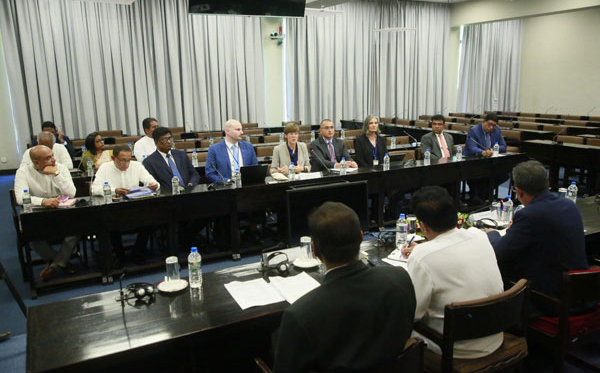
Sri Lanka’s ongoing electricity sector reforms having highlighted the urgent need to align financial viability, sustainability, and consumer protection, a recent discussion on tariff methodology was held together with policymakers and experts underscoring that both cost recovery and cost reflectiveness are vital principles for a strong and transparent electricity sector.
These views were expressed at a discussion held in line with the IMF – Extended Fund Facility (EEF) programme, to review the electricity tariff methodology in consultation with the IMF staff. As it had been prescribed as a prior action to completed by the end of November – 2025, a team led by Ms. Delphine Prady (Senior Economist, FAD) held a joint meeting with the Committee on Public Finance, the Committee on Public Enterprises and the Sectoral Oversight Committee on Infrastructure and Strategic Development, other Hon. Members of Parliament, officials representing the respective ministries and other stakeholders.
This technical discussion was held on 12.09.2025, at the Parliament premises with the participation of the Hon. Leader of the Opposition Sajith Premadasa, (Dr.) Harsha de Silva, Hon. Chair of the Committee on Public Finance, Kabir Hashim, Hon. Chair of the Committee on Public Accounts, Hon. Members of Parliament Rauff Hakeem, Attorney at Law, Ravi Karunanayake, Harshana Rajakaruna, (Dr). Kaushalya Ariyarathne, Nimal Palihena, Chithral Fernando, Attorney at Law, Ajith P. Perera, Attorney at Law, Thilina Samarakoon, Dilith Jayaweera, Chandima Hettiarachchi, officials representing the Ministry of Energy, Ministry of Finance, Ceylon Electricity Board (CEB), Public Utilities Commission (PUCSL) and other respective stakeholders.
During the discussions held, it was noted that cost recovery ensures the sector as a whole covers its total expenditure, thereby preventing inefficiencies and attracting the investment and credit needed to modernize. Cost reflectiveness, meanwhile, ensures consumers pay based on the actual cost of serving their demand, reducing unfair cross-subsidies. It was stressed during the discussions that without recovering costs, inefficiencies multiply and there is no way to attract new investment.
The country’s renewable energy target of 70% by 2030 was a central focus. Experts emphasized that to achieve this, Sri Lanka must establish the right infrastructure, financing, and incentive structures. Expanding solar, hydro, and wind energy, coupled with investments in storage and emerging technologies such as green hydrogen, will be essential. While thermal power continues to play a role, it was described as “super expensive” and highly volatile, exposing the sector to global price shocks. Renewables, by contrast, were recognized as increasingly competitive but requiring upfront investment.
It was also cautioned during the discussions that the volatility of generation costs poses risks to both financial stability and consumers. The need for accurate forecasting and careful planning to avoid passing sudden cost spikes onto households and businesses was underlined. It was discussed that tariff methodology must therefore provide not only cost recovery but also predictability, while steering investment towards least-cost and environmentally friendly generation.
Members of Parliament present highlighted the importance of safeguarding vulnerable households through targeted subsidies, protecting workers affected by restructuring, and ensuring efficiency gains translate into fair outcomes for end-users.
Concerns were also raised over data integrity and transparency, with gaps in Power Purchase Agreements (PPAs), incomplete cost breakdowns, and weak information systems. During discussions, it was stressed that without stronger governance and regulatory independence, a modern and effective tariff methodology cannot be applied successfully.
During the discussions held, it was agreed that tariff reform cannot be treated as a purely technical exercise. It must be grounded in policy objectives that deliver a financially viable power sector, ensure a sustainable shift to 70% renewables by 2030, protect vulnerable communities, and strengthen transparency and accountability across the industry.
Video Story