

September, 29, 2025
The International Monetary Fund (IMF) has cautioned Sri Lanka that while its landmark debt restructuring is nearing completion, the hard-won gains will remain fragile unless fiscal discipline and strong institutions are entrenched.
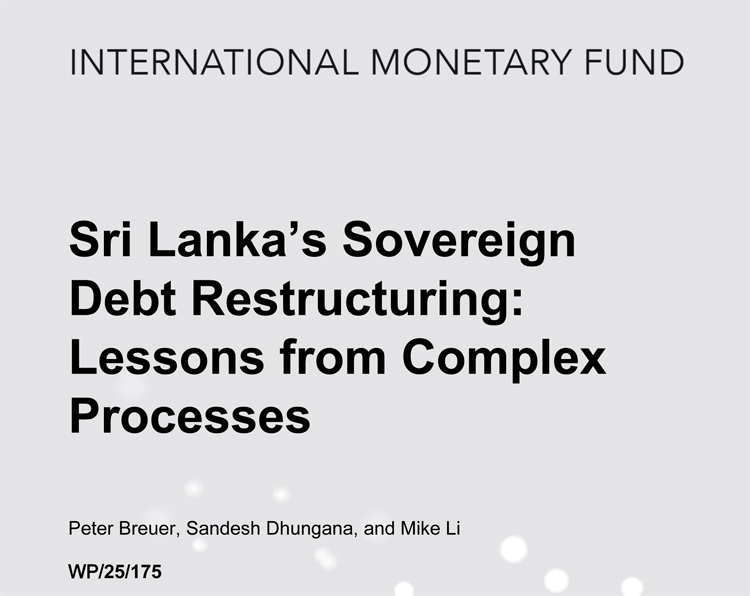
A new IMF Working Paper, Sri Lanka’s Sovereign Debt Restructuring: Lessons from Complex Processes (WP/25/175), released in September 2025, notes that the country’s unprecedented default in April 2022 and the complex negotiations that followed provide lessons not only for Sri Lanka but also for other emerging economies facing debt distress.
The IMF paper acknowledges that Sri Lanka has made significant progress since defaulting for the first time in its history. Domestic debt operations in 2023, followed by agreements with official creditors and private bondholders in 2024, helped reduce debt vulnerabilities. Bond spreads narrowed, credit ratings improved, and the government began lengthening the maturity profile of its borrowing.
However, the IMF warns that debt relief alone is not sufficient to secure long-term stability. “Restructuring alone will not guarantee durable recovery,” the paper stresses. “Sustained prudent macroeconomic policies and stronger institutions are essential to prevent a recurrence of crisis.”
The working paper traces Sri Lanka’s collapse to years of fiscal mismanagement and vulnerability to shocks. Government revenue, already among the lowest in the world, fell sharply after tax cuts in 2019. At the same time, state-owned enterprises such as the Ceylon Petroleum Corporation and the Ceylon Electricity Board accumulated large losses, adding hidden liabilities.
When the COVID-19 pandemic struck, tourism revenues collapsed, while reserves were drained to service maturing bonds. By April 2022, the country was forced to suspend external debt payments, with public debt climbing to 126 percent of GDP.
Under the IMF’s four-year Extended Fund Facility, Sri Lanka’s debt restructuring was designed to restore sustainability using the new Sovereign Risk and Debt Sustainability Framework. The framework set strict quantitative targets:
Reduce public debt below 95 percent of GDP by 2032.
Limit gross financing needs to around 13 percent of GDP annually.
Cap external debt service at 4.5 percent of GDP in the post-program years.
Meeting these targets required both domestic and external debt operations, complemented by policy reforms and international financial support. According to the IMF paper, the restructuring delivered an estimated 41 percent net present value reduction in debt obligations.
Despite these achievements, the IMF emphasizes that Sri Lanka’s recovery remains vulnerable. Fiscal slippage, weak debt management, or backtracking on reforms could quickly undermine progress. “There is no room for complacency,” the report notes, adding that strong institutions are needed to guide borrowing decisions, improve transparency, and maintain discipline.
The IMF also underlines the importance of building reserves and managing risks from state-owned enterprises, which remain a potential drag on public finances.
The paper concludes that Sri Lanka’s experience underscores the importance of acting early in crises, coordinating effectively among diverse creditors, and maintaining transparency. Above all, it warns that debt relief provides only breathing space. Without credible fiscal consolidation and institutional strengthening, the country risks repeating the cycle of instability that led to its 2022 default.
Video Story