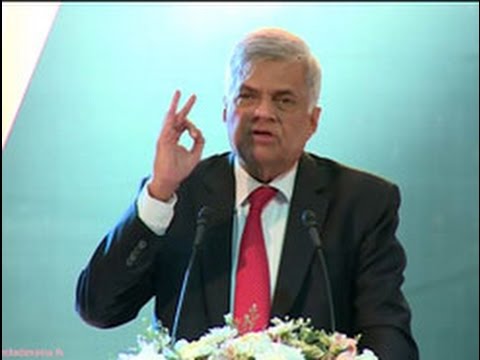


January, 12, 2023
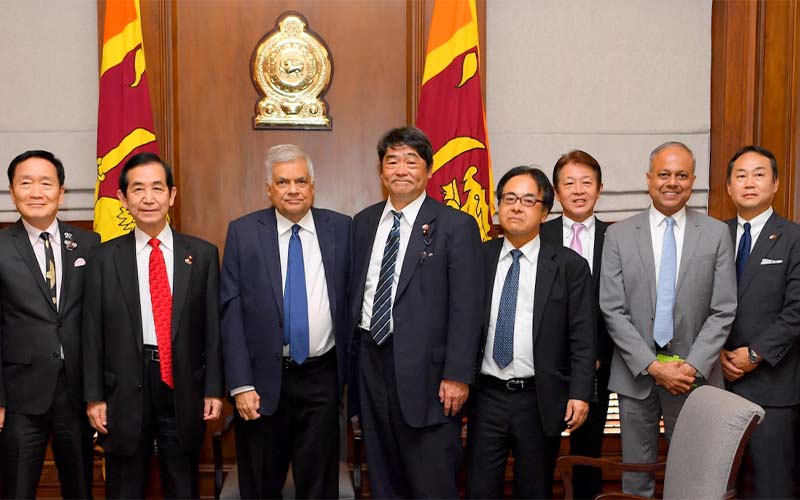
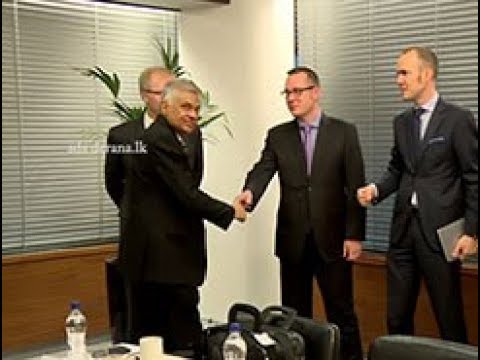
President Ranil Wickremesinghe met with the Japanese State Minister of the Cabinet Office, Hon. Satoshi Fujimaru, Wednesday (11) at the Presidential Secretariat.
The State Minister was accompanied by a Japanese business delegation. Discussions focussed on the investment opportunities available in Sri Lanka, including in hospitality and tourism, mining and training of Sri Lanka’s workforce.
The President explained that under the Government’s economic plans, emphasis was being placed on training Sri Lanka’s youth to ensure the country was geared to adapt to new and emerging industries.
The President was accompanied by his Chief-of-Staff and Senior Advisor on National Security Mr Sagala Ratnayake and Director of International Affairs, Mr Dinouk Colombage.
January, 2, 2023
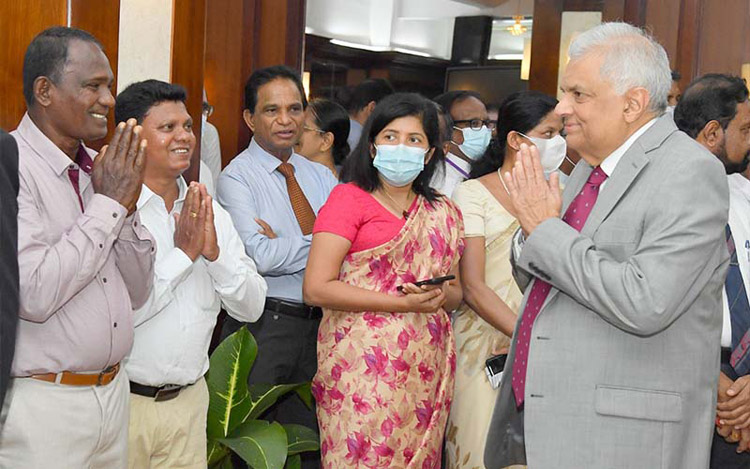
President invites all government employees during the commencement of duties for the new year
President Ranil Wickremesinghe said that no one can shirk their responsibilities for the country in the year 2023, which is a crucial year for the Sri Lankan economy, and invited all public servants to dedicate themselves towards making Sri Lanka a prosperous nation in the New Year.
He extended this invitation to the Presidential Secretariat staff during the oath-taking ceremony for the New Year 2023 before commencing their duties this morning (02).
President Wickremesinghe hoisted the National Flag marking the commencement of duties in the New Year, and all staff members of the
Presidential Secretariat took the public service pledge together.
Thereafter, the President joined the staff members for a tea party.
The President also extended his best wishes to the staff for the New Year.
President Ranil Wickremesinghe further said, “I wish you all a happy and prosperous New Year.
Five and a half months ago, we took over a historic task at this office. During those five and a half months, we took steps to establish normalcy in the country at a time when the government had collapsed and the economy had also collapsed. However, not all our economic problems are over yet. Nevertheless, today we have the ability to provide fuel, gas, foodstuff and fertilizer as required.
I must first extend my gratitude to all those who assisted us during these five and a half months. However, our task is not over yet. The most crucial year is 2023. We have to move forward by implementing the debt-restructuring program and freeing our country from the debt burden.
Moreover, we have to build an economy that can compete with the new world. The opinion of the majority is that there is a need for a change in the political system of this country. We have to fulfil both these things.
We also need to come up with a new method that can solve the problems of today’s political system. We need greater unity among us than last year.
We look at this government as a sort of mechanism. This is not divided into several programs by ministries. All work as sub-parts of the same mechanism. Therefore, there can be no competition or tug of war between anyone and no one can put a limit to their responsibilities.
All of you should be bound to implement the basic policies of the country. The core of the program is the President’s Office, as well as the Cabinet Office and the Prime Minister’s Office. It is from these institutions that these activities will be carried out.
Each person’s duties cannot be limited to 08 hours a day and 05 days a week. Let’s all work with commitment. By the end of 2023, I hope to take this country forward with the support of all of you and restore normalcy.”
Member of Parliament Vajira Abeywardena, President’s Senior Adviser on National Security and Chief of Presidential Staff Sagala Ratnayake, President’s Secretary Saman Ekanayake and senior officers of the Presidential Secretariat and all staff members were also present on this occasion.
December, 28, 2022
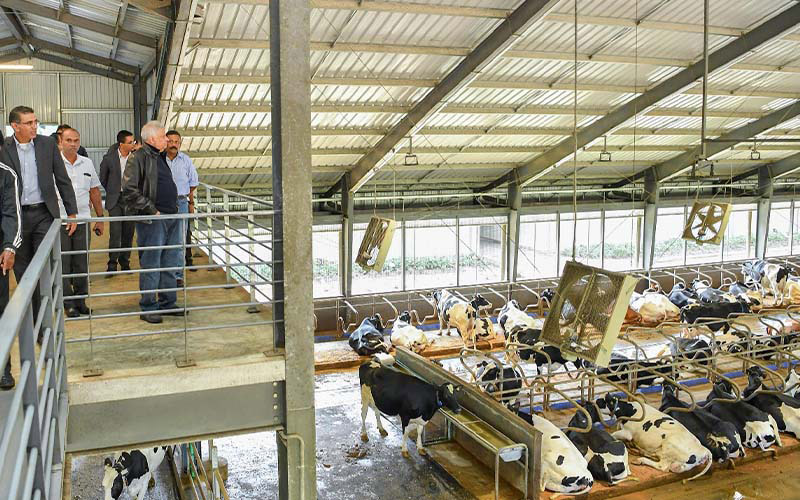
President Ranil Wickremesinghe instructed the Nuwara Eliya District Secretary and Commissioner to immediately provide 30 acres of abandoned land adjacent to the Ambewela Farm to them and provide the necessary facilities to develop it as grazing land to meet the food requirement of the dairy cows.
President Ranil Wickremesinghe issued these instructions yesterday (27) during an observation tour of the United Dairies Lanka (Pvt.) Ltd, which belongs to the Ambewela Farm Group.
The President commended the systematic growth achieved by the Ambewela Farm in the dairy production industry adding that it has set an example for other dairy farms as well. The President also instructed to open this farm for research activities for university students in the country to gain experience in the dairy farming field.
General Manager of the Ambewela Farm Group Sarath Bandara said that the Ambewela Farm is the main centre in Sri Lanka as well as in South Asia which can boast of the highest technical application in dairy production and farming technology.
Presently, there are about 1,000 dairy cows at the Ambewela Farm. All activities such as maintaining the dairy cows, providing necessary fodder, weighing, diagnosing diseases and separating them from others are done through an automated system. The cows are milked thrice a day and 40,000 litres of liquid milk is supplied to the market daily.
Around 4,500 cows are currently being fed within the entire Ambewela Farm network. While this institution was under the government before the establishment of the Ambewala Group in 2001, the daily milk production stood at a mere 1,500 litres.
The Ambewela Farm system has been working for the last 15 years to create the best dairy cows for Sri Lanka. Accordingly, none of these dairy cows is imported and only a very few male animals are imported once every few years.
Additionally, around one thousand indirect jobs have been created in the process of providing fodder for the animals on this farm. A mechanism is already in place to get the whole maize plant to the Ambewela Farm from the farmers after harvesting the crop. Accordingly, the Ambewela Farm has facilities to amass around 25,000 metric tons of maize plants annually and store them.
President Ranil Wickremesinghe also inspected the 30 acres of abandoned land in the vicinity of the Ambewela Farm which has been identified as suitable land for the cultivation of grass.
December, 21, 2022

President Ranil Wickremesinghe said that an environment will be created for small and medium-scale industrialists to become successful using modern technology and the government is ready to empower the industrialists as the main stakeholders in earning foreign exchange for Sri Lanka.
President Wickremesinghe made these remarks at the 21st ‘Achiever Awards 2022’ which was organized by the Ceylon National Chamber of Industries (CNCI) in collaboration with the Ministry of Industry, held at Hotel Galadari, Colombo, yesterday (20).
The President pointed out that instead of looking at the fallen economy and regretting it, everyone should work together to create an environment that can enable us to have a prosperous future. He also said that Japan and Germany, which were destroyed by the World War, provide us with an example of how to rebuild the country and the economy.
President Wickremesinghe also added that the industrialists have a great responsibility in rebuilding the fallen economy of Sri Lanka. Industrialists are a group of people who contributed immensely to the country’s economy.
“We have no option but to increase the taxes, but I am confident that we can pull through and we will pull through. We have gone through this earlier. You ran through wars. We have gone through the worst of what has happened this year. We have to pull through and that is where we have to look at all of you. Because we have to preserve what is left. We still have issues. Nevertheless, the government’s aim is to revive and help as many businesses as possible. Many businesses as possible must survive,” the President added.
The government focuses on Small and Medium enterprises with economic difficulties, as without the Small and Medium enterprises no one can survive. The government is going through a whole series of exercises in correcting the economy and uplifting small and medium-scale enterprises. Modern technology can be used for that. We should look at the development of small and medium-scale industries in other countries of the world and use the modern technology they have used it for the development of these industries. We are ready to provide all the support we can provide as a government for that.
The President asked the industrialists whether they would like to strengthen the economy with new innovations to win the international market or to remain with the same old methods. He further said that with new technology and new innovations, the industrialists have a good chance of becoming economically stronger to conquer the world. For that, we need to make a change in attitude, he said.
At present the country needs foreign exchange, with increasing foreign exchange, the economy will be strengthened. This enables the government to provide solutions to allocate more financial assistance to the education and health sectors and to solve the problems that have arisen in the field of education and health.
The President presented awards to the top 10 achievers.
The Vice Chancellor of the Jayawardenepura University, Prof. Sudanta Liyanage, Secretary to the Ministry of Industries Thilaka Jayasundara, CNCI Chairman Canisius Fernando and several others participated in this event
December, 19, 2022
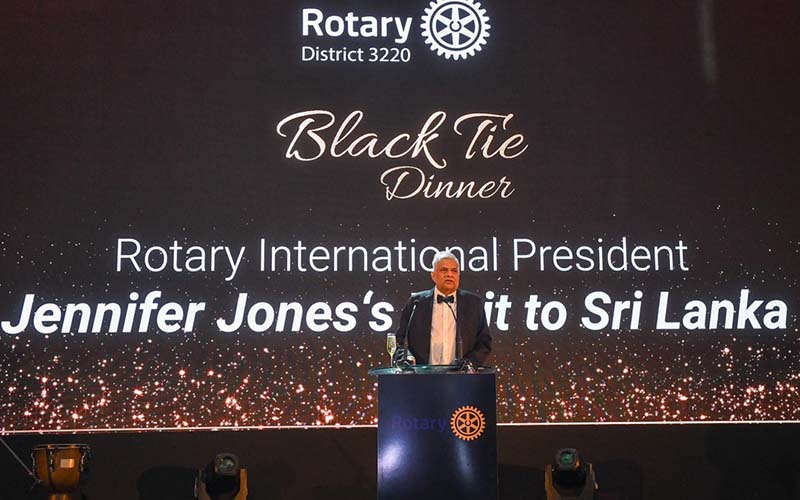
President Ranil Wickremesinghe invited the Rotary Club to join Sri Lanka’s National Food Security programme to ensure a self-sufficient country by next year. He said that Sri Lanka has established a combined mechanism which is working together with the government and the private sector to organize growing of food for the supply chain, storing and delivering of food into the cities. It is also concerned with malnutrition, people without food and how to feed them.
He also acknowledged the Rotary, for the effort that was taken at a time when Sri Lanka was in difficulty, and how the Rotary came along to provide medicine to Sri Lanka.
President Ranil Wickremesinghe made these remarks while addressing the gathering to mark the Rotary International President Jennifer Jones’s visit to Sri Lanka organized by the Rotary District 3220 at the Shangri La Hotel Colombo, yesterday evening (14).
The President also said, “I have seen your campaign to plant a million trees, well next year is also going to be the year when we go full out on mitigating climate change. A number of laws will be passed but we want to start urban forests and many other projects. I am sure you in the Rotary, will be taking part in some of the projects. So this is another area in which I feel I have to ask the Rotary to help me.”
He further said that a government has to be innovative in a crisis situation. The government has to restore the economy as well as be bold to see how it can also get the country on the top of the world, which he said is not a difficult and impossible task. He also pointed out that the government needs the commitment of the public for the next 25 years to make this country, a good beautiful country and a strong country.
Rotary International President Mrs. Jennifer Jones, presented a memento, a painting, ‘Imagine one’s Dream’ especially designed and painted for President Wickremesinghe.
Prof. Maithree Wickramasinghe, Minister of Health Keheliya Rambukkwella, District Governor Pubudu De Zoysa, College of Governors Ajith Weerasinghe, Krish Rajendran, and other officials also participated in this occasion.
Following is the full speech made by the President;
I am here to repay a debt. When things were pretty bad when I became the Prime Minister and I was under fire, one of the biggest issues was the shortage of medicine. So Keheliya came along to me and said kindly find me some money to buy medicines. At that time we were dead broke. What do I do? I thought it best to turn to Ravi and the Rotary. So they came along and they started this lifeline. And as he said, work with FAO we got to get everyone together and we got the medicine too. So thank you Rotary, thank you, Ravi.
Now, why don’t you join us in the next programme, the National Food Security programme? To ensure we are self-sufficient next year, despite not having fertilizer and the consequences of the Ukrainian war. We have already taken over, we started the campaign to ensure that we have sufficient food in our country, indeed ourselves and we have got a combined mechanism which is working together with the government sector and the private sector. At the basic level of the Divisional Secretary’s Division, we are handing it over to people to give leadership.
Work with the Divisional Secretary’s combined mechanism, we are bringing together all the government departments, and provincial institutions in the divisions and we want them to work with the local organizations. There are different people who have come and taken over divisions, some have been members of Parliament, and some are government servants in that region. Many in the social service organizations and many in the private sector have also joined.
So I would like you all to take over a few divisions and organize the growing of food for the supply chain, storing of food and how we get the food here into the cities. On the other hand, we have other area divisions like in Colombo, we are just looking at malnutrition, people without food and how we can feed them.
Throughout the country, we are growing food, identifying the people without food, looking at malnutrition, and trying to certainly help them to get along. Community kitchens have been started and there are many more to be done.
If there are some of you who are willing I must say, this is the time and I have no doubt that you will all get together and join us in the food security campaign. We have to ensure that no one goes hungry.
Some of the people are going through a very tough time and if all of us get together I think we have sufficient resources to look after them.
So this is my request now, thank you for the lifeline, keep the lifeline going and then get into this campaign.
The Rotary is a force for the good. The Rotary brings together the humane aspects of society in a world whether it be political, social or economic, marked by divisions and more so by hate. The level of hate in the world is increasing. It is alarming. Nevertheless, there have to be forces of good and that is what the Rotary has turned out to be. You spread across the world, from Chicago now you are covering virtually every country other than North Korea. There may be some secret Rotarians there too. But you brought together people who are committed to helping in their society in their own community. People who are helping anonymously, as a community, as a group. Now, this is what we admire. One of the most successful campaigns has been the eradication of polio. I remembered the effort that Ravi and others took back in the days when the war was on and we went into the territory, which was under the control of LTTE. That was a difficult task. Firstly, you could have been attacked by the LTTE, secondly, you could have been attacked by those in the South who didn’t want anyone to go to the controlled areas, but the job was done. That was part of the greater programme of the Rotary to eradicate polio.
As seen in your campaign to plant a million trees, well next year is also going to be the year when we go full out on mitigating climate change. A number of laws will be passed but we want to start urban forests and many other projects. I am sure you in the Rotary, will be taking part in some of the projects. So this is another area in which I feel I have to ask Rotary to help me.
Because you asked me how I keep this ticking, I don’t know if you want to put some sticking plaster. It’s holding so far, and from time to time I reach out to people and organizations and say help us to keep this together. In a crisis, we have to be innovative. Which is what my friends from the other school have not learned. Nevertheless, we know the duty we have. We not only have to restore our economy, but we got to be bold and see how we can also get to the top of the world. It is not difficult. It is not impossible. Just commit ourselves for the next 25 years. Some of us won’t be there. The rest of you will be. But let us commit ourselves to making this country, a good country, a beautiful country and a strong country.
To do so, we need all your commitment and that is the spirit of the Rotary. I wish many other parts of our community would have that spirit. A sense of commitment, that sense of commitment has to be spread. A country in peril like Sri Lanka requires that and this is the work that you have to spread throughout the world. We have here Rotarians not only from Sri Lanka, from India, Maldives, and Canada, you forget your differences and get together. There is one goal and that is the goal which all of us have to achieve if this world is to be a better place. That is our commitment to humanity. Jennifer made her own personal commitment leaving aside the media business, I have been at both ends of the media, the hitting end and the receiving end. But, you made your commitment to the Rotary. You made your commitment to the community. And you come up and you are here as the first female President of the Rotary. And then you have the female District Governor in Sri Lanka. This is what my wife calls a Dream Team, all headed by women. Why not, after all 52% of Sri Lanka is women and you may say there are not enough females in the Rotary. So one of their jobs is to increase the number. In any case, I am happy that she came here and I am happy that she was able to spend two days here. But we hope Jennifer will have time to come here and spend a longer time in Sri Lanka working among the most disadvantaged in our country. So I must say thank you to the Rotary. Thank you for what you are doing throughout the world. So let me raise a toast both to the Rotary International and to its first female President Jennifer Jones. Cheers.
December, 16, 2022
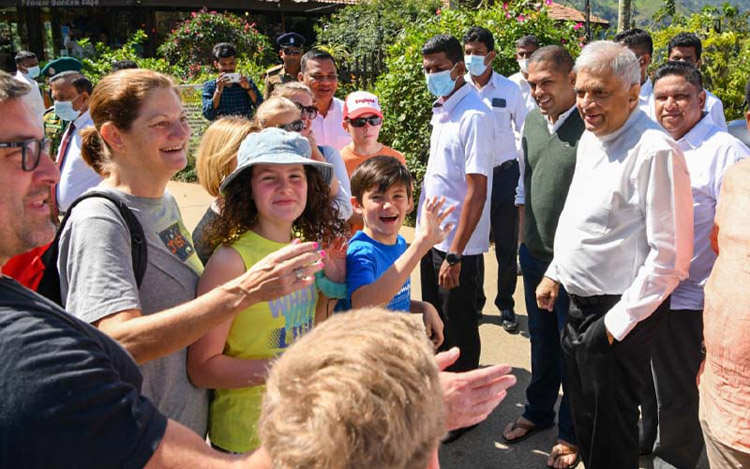
President Ranil Wickremesinghe instructed the officials to take immediate steps to develop the Ella tourist area according to a grand comprehensive plan.
The President also informed the officials to prepare the relevant development plan within 4 months together with the Ministry of Tourism, the Ministry of Urban Development and the Ministry of Environment and submit it to him.
The President issued these instructions during the discussion held with the Ella Businessmen’s Association today (16)
The President pointed out the need to plan the Ella tourism zone formally and according to a proper plan and also pointed out the importance of carrying out its construction activities in an environmentally friendly manner to avoid disturbing the tourist attraction.
The President pointed out the need to plan the Ella tourism zone formally and according to a proper plan and also pointed out the importance of carrying out its construction activities in an environmentally friendly manner to avoid disturbing the tourist attraction.
The President pointed out the need to plan the Ella tourism zone formally and according to a proper plan and also pointed out the importance of carrying out its construction activities in an environmentally friendly manner without obstructing the tourist attractions.
President Ranil Wickremesinghe further stated that under the first phase, the Ella tourism zone will be developed through a formal plan, and then steps will be taken to make the entire Uva Province a preferred destination for tourists.
Expressing his views, President Ranil Wickremesinghe said,
Ella is a tourist area created by the people of this area. It now contributes widely to Sri Lanka’s economy. We hope to develop this tourist zone according to a new comprehensive development plan. I have instructed the officials to take steps to provide short-term solutions to the problems that have arisen in this area.
Today, tourists visiting the Maldives spend about $500 a day. However, tourists who come to the Ella area spend twenty dollars a day. We must change this situation.
Trained workers are needed for the promotion of the tourism industry. Experienced tourism workers left the country during the last Covid epidemic. They were very experienced workers.
Tourists, who spend $500, come expecting good service. We need trained employees to provide such a service.
Steps should be taken to create a good tourism service under this massive development program. Those tourists who arrive in the Uva Province should spend at least 07 days there. We need to make new plans with that objective in mind.
We have to arrange to attract the tourists visiting the Eastern Province to Ella thereafter. This new development plan should include a program to develop the Mattala Airport and bring tourists directly from Mattala to Ella. These plans would be effective for the country’s development both in the short term and in the long term.
We must work to maintain the banking sector in the country without letting it collapse while developing the tourism sector. If the banking system collapses, tourists will not come to our country. Therefore, the government has a program to protect both the tourism and banking sectors. As we would implement it, I request you all support it.
President Ranil Wickremesinghe solved many of the issues raised by the Ella Businessmen during the meeting with them and the prompt action taken by the President to address their issues was highly appreciated by the Ella business community.
Ministers Nimal Siripala de Silva, Harin Fernando, State Ministers Chamara Sampath Dasanayake, Governor of the Uva Province A.J.M. Musammil, Chief of Presidential Staff and President’s Senior Adviser on National Security Sagala Ratnayake, Badulla District Secretary Damayanthi Paranagama and several others were present at the event.
December, 8, 2022

Asian Development Bank (ADB) Vice-President Shixin Chen met with Sri Lanka President Ranil Wickremesinghe on 5 December. Mr. Chen noted the measures that are being taken to contain the crisis and address its underlying causes, and supported the steps taken to seek international assistance.
Mr. Chen briefed the President on ADB’s emergency response to the crisis, especially in addressing immediate needs such as essential medical supplies, materials for water treatment, fertilizer, and working capital for small and medium-sized enterprises by repurposing from ongoing ADB-funded projects.
In response to the food situation in the country, ADB supported the poor and vulnerable of Sri Lanka with direct financial support while boosting livelihood development activities and agricultural production and enhancing social protection systems. In addition, through the Trade and Supply Chain Finance Program, ADB has provided guarantees to help critical international trade to continue.
“ADB is deeply concerned about the effects of the ongoing economic crisis on the poor and vulnerable sections, including women, of Sri Lankan society, particularly its long-term impact to people’s lives,” said Mr. Chen. “ADB is a trusted development partner of Sri Lanka, and we are working closely with authorities as well as other development partners to address immediate needs and plan future assistance.
Mr. Chen highlighted the need and called for deep, meaningful, and sustained structural reforms to address long-standing macroeconomic vulnerabilities, promote private sector development and to support renewable energy development. Mr. Chen underscored the importance of strengthening macroeconomic management, improving governance, addressing structural constraints, and enhancing social protection system for sustained and inclusive recovery.
During his visit, Mr. Chen also met with Prime Minister Dinesh Gunawardena, Secretary to the Treasury Mahinda Siriwardana, and Governor of the Central Bank of Sri Lanka Nandalal Weerasinghe.
At the invitation of Mr. Wickremesinghe, Mr. Chen participated at the high-level round table discussion on structural reform for economic recovery and sustainable growth along with representatives from the Asian Infrastructure Investment Bank, the International Monetary Fund, and the World Bank. The government’s reform agenda was discussed along with proposed policy directions, reform priorities, other interventions, and future collaboration and support from international partners.
Mr. Chen will also witness the unloading of a 42,000 metric ton Muirate of Potash (MOP) fertilizer shipment at the Colombo port, which is part of ADB’s emergency assistance to Sri Lanka. The fertilizer will be distributed to paddy farmers throughout the country to support agriculture production and address food insecurity.
ADB is committed to achieving a prosperous, inclusive, resilient, and sustainable Asia and the Pacific, while sustaining its efforts to eradicate extreme poverty. Established in 1966, it is owned by 68 members—49 from the region.
December, 6, 2022
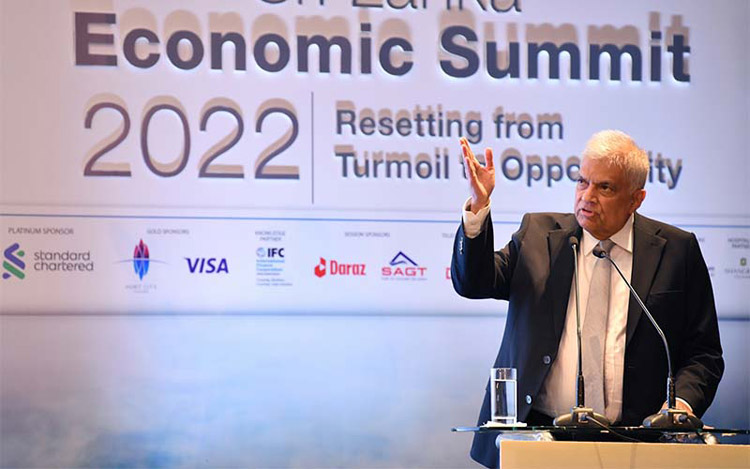
President Ranil Wickremesinghe stated that steps would be taken to introduce a strong new economic system that can face 2050 without implementing economic reforms that offer no solutions to the current economic crisis.
Pointing out that the country’s economy cannot be recovered through outdated economic systems, the President said that the first, second and third thing needed to build the Sri Lankan economy is foreign exchange.
He made these remarks while inaugurating the Sri Lanka Economic Summit 2022, the foremost and most anticipated annual economic event in Sri Lanka, under the theme ‘Resetting from Turmoil to Opportunity’ at the Shangri-La Hotel, Colombo yesterday (05).
The President also pointed out that in order to recover from the economic crisis Sri Lanka is currently facing, the debt must be restructured and a correct economic system should be introduced.
Accordingly, President Wickremesinghe also expressed confidence that it will be possible to get the assistance from the International Monetary Fund to overcome this situation and he said that the government has reached a staff level agreement with the IMF.
President Ranil Wickremesinghe said that Rs. 300 billion will be spent on the power sector alone next year, and that alternatives should be sought to cover that cost.
The President said that measures should be taken to introduce new alternative energies to the power sector, and the government is ready for that and plans to focus on green hydrogen energy instead of renewable energy.
Regional Vice President of the World Bank for South Asia, Mr. Martin Raiser, Chairman Ceylon Chamber of Commerce Vish Govindasamy, Parameswaran Iyer, CEO of NITI Aayog India also spoke on this occasion.
MP Eran Wickramaratne, MP Harsha De Silva and the Central Bank Governor Dr. Nandalal Weerasinghe were also present at this occasion.
Following is the full text delivered by President Ranil Wickremesinghe:
“Martin Raiser the Vice President of the World Bank, president of the Chamber of Commerce, distinguished guests and friends.
In the opening remarks, our Compare said this year has been like no other year, which is correct. Just to think back, not a single year in the 20th century or the 19th century, I would say was like this.
What we have is not a civil war. We had civil wars around this region earlier, what we had it not terrorism. What we have is not world war. We’ve gone through all this. We’ve gone through uprisings, we’ve gone through riots. This was just a collapse of the economy. It was an economy waiting to collapse.
In the 4.5 years the prime minister, it was an effort to try and take the economy out in a different direction.
We were able to get a surplus on the primary budget, but it was warfare. Politicians wanted to protect their power, businessman wanted to protect their profits and many others wanted to see what the country would give them, provide for them free of charge, without having rendered any services. So in the long term, this formula can’t hold. When Sri Lanka became a commercial economy, a modern commercial economy, after the Colebrook–Cameron reforms and opening up the abolition of Rajakariya, the British came in, but not only the British the Sri Lankan’s also came. They had no banks, they had no means finding money, and there was no World Bank to give them assistance on a concessionary term. But what did they do? They build up a big business empire. While the British planted tea, we planted coconut, we exploited our graphite. And then in 1948 after the war was over, we stood second to Japan.
But we started destroying it from the sixties and the seventies. We started rebuilding an economy, which was affected by a war, and thereafter the way we went, is best not described here. So it is not surprising that this economy collapsed in the two years of Covid, reduction of revenue and the policy measures that were taken. So from the turmoil, we have to get out. We are still working our way through.
We’ve been able to stabilize with our own effort. The last a few months from July onwards, from August onwards, we had to do it on our own, of course, with the help that the multilateral gave us. We’ve got into a staff level agreement with the IMF, I thought Harsha will get up and say can you table the copy now.
We are now discussing with our creditors, bilateral creditors, not the Paris Club, but with India and we had very successful talks and we have started talks with China and they’ve asked us to talk with the Exim Bank and the talks are going on. The talks with China started later because they had to start after the party conference. They wanted it. So we started the talks. Haven’t seen a major issue that has come up so far. We hope we can conclude it fast, but that doesn’t mean that we are out of the woods. We start next year with a big hole of about 3 to 400 billion rupees. That’s what the CEB is going to cost us.
We start from there. How do we handle it? If you want the government to fund it, then we have to get the printing presses going.
I mean, we are paying not only for the increase in price of coal and fuel, but also for bad management.
Now, this is the first issue we have?
Are we to adjust the prices and face the consequences? Or, we to do nothing and hope someone will help us? Now the first question that all of us have to answer.
If you have to go ahead, there is only one thing you can do. There are no options, and I presume I’ll get blagarded again for that. Second, we have to look at our banks. We have to save our banks. Easier said than done.
I need not talk to you about the position in the bank, you all know it better than me, but it’s two fold. One is, all of you want to know what’s going to happen to the interest rates? I wish I know. The governor has told me that the inflation has peaked. It’s coming down. You all understandably want some relief with the interest rates to carry business on.
I understand that and appreciate the viewpoint. It’s not easy to carry business on with such high interest rates. On the other hand, the Central Bank also has to handle the economy. So maybe sometimes early next year we will have a meeting of minds of both these propositions. One strengthening the economy. Secondly, seeing what relief we can give the private sector. But that also means to understand that the bad debt that is being carried by the banks is mainly from the private sector or the government sector. Keep the government sector aside. We’re dealing with it. How do you handle it? Look, one of our major areas of are the small and medium industries. You can’t allow them to collapse, but they’re in a bad way.
So you’ve got to find a solution there. I think the state and the private sector, the big players, medium players all have to see how can we save our small and medium enterprises?
There are the larger ones, too, but these are the ones that can get wiped out. Can we go on without them? The success of the open economy was that a large number of small and medium enterprises came along. People made their way. They came up to the middle class they went beyond that. Some became billionaires. But that’s how the system works. Now what I am going to do with it? So these are two major issues that we have to resolve as we go along.
What do we do after stabilization? What is the plan for reform? Frankly, I have no plan for reform.
I don’t know in the crisis, if reforms can work. to reform, we must have an economy.
What do we face in the future? Whatever relief we get from our debtors, multilateral debtors, creditors and also from the private creditors we have to pay this money back longer term. Then remember, for the next few years we have to borrow money.
Our trade balance is not in our favour. So are we going to rebuild the same structure and come down again much faster? Therefore, I thought it’s not worth reforming it. So I personally have no plans for reform and the government will not have plans for reforms. We want to build a new economy an economy that will face 2050. Is the private sector ready for it?
That’s the only question I have to ask you. Are we ready for it? Are we going to take up the challenge?
Shall we take the pain that comes with it? Or are we going to hide again?
The Ostrich cannot put its neck under the carpet all the time and sometimes it has to come out. What have you got? We have to earn Foreign exchange, Foreign exchange, foreign exchange.
Why can’t we have a balance of trade? Why can’t it be in a surplus?
Can you put into a surplus?
If not, we can’t survive.
If you want to survive and you have to compete with the world, then we have to be competitive, not competitive. We’ve got to be highly competitive.
We’ve got to join the rest of Asia. You’ve got to compete with China. We’ve got to compete with Japan. You’ve got to compete with Korea. You’ve got to compete with India. Can we build that?
Can we create sectors which are competitive?
Are you ready to take that challenge?
Are we ready to go to 2050 or do you want to go back to 1950? These are the two options that are available for us.
Then we’ve got to build a highly competitive social market economy. But it must benefit all not only a few. All of us are going through these troubled times. Some were finding it very, very difficult.
And are we ready to do those reforms? If you already there are many opportunities. We talk our renewable energy. I won’t talk to renewable energy. I will talk of green hydrogen. That’s where the potential lies. We seem to be having immense surplus of renewable energy which can be turned into green hydrogen.
Why don’t we develop and become a logistics center? When I last tried to develop the Colombo Harbour and tried to give out the East Terminal, there was a big debate, as to I am trying to sell the country. Now we have given the West terminal out. Very good, but if you really want to get going, you have to give the East terminal out. We’ve given the first choice to Japan. If they don’t, we’ll ask the others to come. Colombo port must be the busiest port in South Asia. The small port won’t do so when you get full. We are now thinking of expanding the Colombo port all the way to Ja-Ela.
A logistic center, already about 30 acres have been cleared in Colombo North 20 or 30 acres to start on part of it. There will be more land becoming available to connect it.
Look at Hambantota and Trincomalee, you have the three best ports available in the region. Think of logistics think of green hydrogen, and then modernize our agriculture. Small holding agriculture may be modernized the agriculture and get ready for exports. It can be done, but it requires high technology and more than that, the willingness to go ahead.
Land must be used to the maximum benefit of the economy and the people.
Now, this is where the chamber is one day going to come to me and say, Why are you doing this? They have had a contract and they must have the right to use the land. And my answer to that is you have not used it to the fullest benefit of the economy. So therefore we’ll have to give it to someone else. There has to be more changes in the land law, and especially to give land to the smallholders. Otherwise, they will not put the money in. They won’t put their effort in. So these are some of the changes you have to make. You have a highly competitive manufacturing industry. Very highly skilled, semi-automated may be automated. All these are necessary. You’ve got to think out of the box. You have to look at what we have, what you can do to all this we require education.
Higher education, school education. We have to become educational hub, and I must thank all parties in Parliament who agreed. Let’s open the higher education sector to the private sector and to universities. Let’s have that. Now this means Are we ready to think how there’s much more to be done. Are we ready to think out of the box? Are we ready to take the challenge? Are we ready to go forward? And everyone has to think private sectors to think Trade unions, others. So we’ll all have to get together. And that’s what’s called the social contract, what do we build and how do we all benefit? So this is the challenge that is there.
As far as the government is concerned, yes, we have an idea of what the long term plan should be. We’ll put it out for discussions. We prepared well. Ask all the political parties and the different players in the economy to give their views but are you ready to go? If you have against it, come up with a viable alternative? That’s all that I’m asking. It is not for me, it’s for you all. It’s for all the young people are looking for a better future. Anyone who can go out there basically voting with their feet. They are saying you have not succeeded to all of us. Him and me all. Not to the government, to the government and the opposition and to the Parliament as a whole. Not only the parliament for all of you as an establishment.
Instead of pointing fingers at each other, the younger people have decided to work with their feet and they’re getting out in thousands and hundreds of thousands. You may not have any more, so we have to realize that we have to make amends that we have to go ahead. We may all not be here by 2050, but for those who are there and the younger people, a better future. So our program for the future will be called next 25 years. What will we be when you’re 100? Thank you.”
December, 5, 2022
President Ranil Wickremesinghe and Prime Minister Dinesh Gunawardena have applauded the role the Malays have played and continue to perform in the country as part of their congratulatory messages in the ‘Malays of Sri Lanka’.
The ‘Malays of Sri Lanka’ coffee table book, which was launched on November 29, 2022 at the Shangri-La Hotel, Colombo, contained laudatory messages from the President and Prime Minister of Sri Lanka, acclaiming the role of the small Malay community.
“The Sri Lankan Malays are an important segment of this country’s social fabric and have played a vital role in both the history and culture of Sri Lanka,” wrote President Wickremesinghe in his message.
“Despite being one of the smallest communities in Sri Lanka, the Malays have contributed towards the nation building of Sri Lanka as an equal partner in the multi-ethnic mosaic of the country,” President Wickremesinghe noted.
Prime Minister Gunawardena recalled: “Sri Lankan Malays have from pre-colonial to post-colonial times made a colossal impact on the fabric of Sri Lankan society through their invaluable services and sacrifices in the Armed Forces and Police.”
The Prime Minister acknowledged the role statesman and visionary Dr. T.B. Jayah – one of the many prominent Malays highlighted in the 224-page book – had played in the Independence of the island nation from British colonialism.
“Dr. T.B. Jayah is acknowledged as a leader who put his country before community, and I urge the leaders of the Malay community to continue to enrich the noble traditions of Malays through enduring harmony as Sri Lankans,” Prime Minister Gunawardena added.
The book which marked the 150th Anniversary of the Colombo Malay Cricket Club and the 100th Anniversary of the Sri Lanka Malay Association, both in 2022, was written with the aim to tell the story of the Malays to the wider community as well as to serve as an inspiration to the younger generation of Malays.
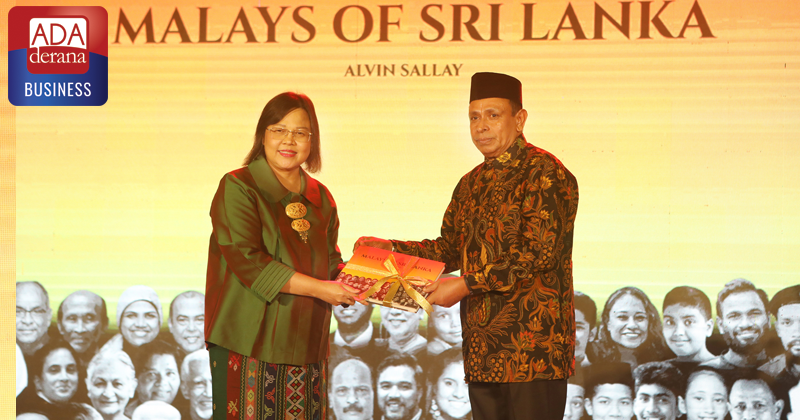
The first copy was handed over to Chief Guest, Her Excellency Dewi Gustina Tobing. The Ambassador of the Republic of Indonesia to Sri Lanka by Deshabandu M.R. Latiff, Senior DIG (retired), Chair of the Book Committee of the Colombo Malay Cricket Club.
In her address, the Indonesian Ambassador said: “When I first heard of this project, soon after I arrived to take up my post in December, last year, my first thought was how appropriate that a book of this nature should be written on the 70th anniversary of diplomatic relations between our two countries, Indonesia and Sri Lanka, in 2022.
“The Malays, though a small community, continue to play a key role in all facets of life in this beautiful island-nation of Sri Lanka. Over the centuries they have integrated into the dynamic fabric of this nation and underlined their status as respected members of the public,” she added.
Invited guests at the launch were treated to a colourful and warm traditional ceremony comprising Malay dances and songs from a number of leading Malay artistes including Umara Sinhawansa, Naushad Rassool of Flame, and international disc jockey DJ Mass of the famous hit Pem Kekula. This event was supported by a number of sponsors with Cargills Ceylon PLC being the Platinum Sponsor.
The book is priced at Rs. 10,000 and can be ordered via email to: malaysofsrilanka@gmail.com or WhatsApp +94 77 737 9995.
All proceeds from this sale will be utilized for the maintenance of the Colombo Malay Cricket Club (CMCC) clubhouse and grounds.
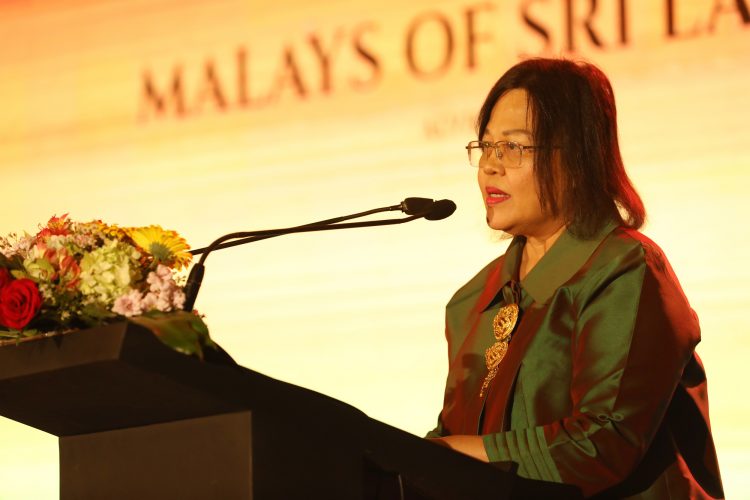
Her Excellency Dewi Gustina Tobing, The Ambassador of the Republic of Indonesia to Sri Lanka addressing the gathering

Popular Malay songstress Umara Sinhawansa
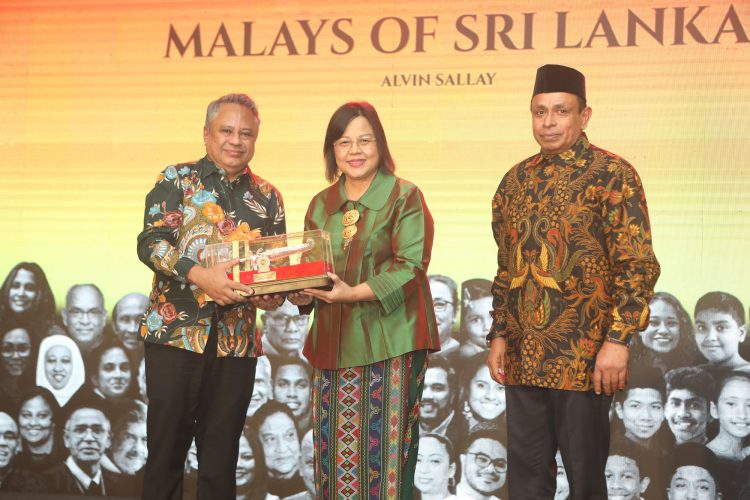
A special recognition to author Alvin Sallay
Image Caption : First copy of the book presented to Her Excellency Dewi Gustina Tobing, The Ambassador of the Republic of Indonesia to Sri Lanka by Deshabandu M.R. Latiff, Senior DIG (retired), Chair of the Book Committee of the Colombo Malay Cricket Club.
December, 5, 2022
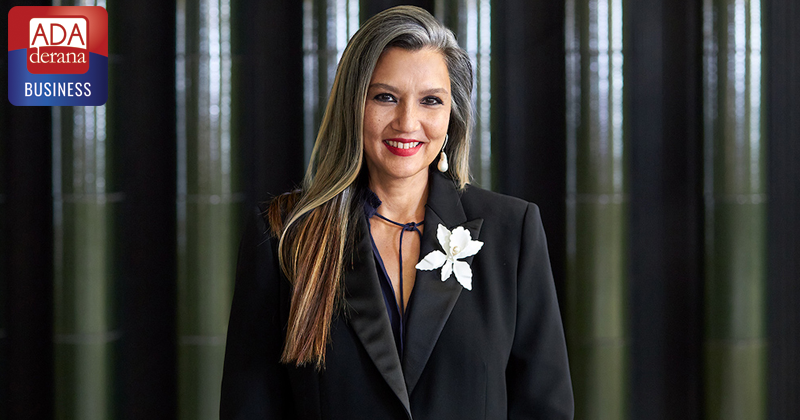
Suhanya Raffel, Director of M+, has been appointed as the President of the International Committee for Museums and Collections of Modern Art (CIMAM) for 2023–2025. Raffel has led the M+, a visual art museum in Hong Kong, since 2019. She is also a founding Committee Member of the Museum of Modern and Contemporary Art Sri Lanka (MMCA Sri Lanka).
Acknowledging her appointment, Raffel noted that "To serve as the next President of CIMAM is an honour, and I am excited to work together with my fellow board members to contribute to our modern and contemporary art museum community as we face a complex and challenging world.”
She added, “The past three years have seen much tumult and division, with the global Covid-19 pandemic adding a further degree of separation within our societies. In this context, the roles our museums play in bringing people together, with the work of artists providing necessary insight, vision, and perspective has become ever more urgent.”
Video Story