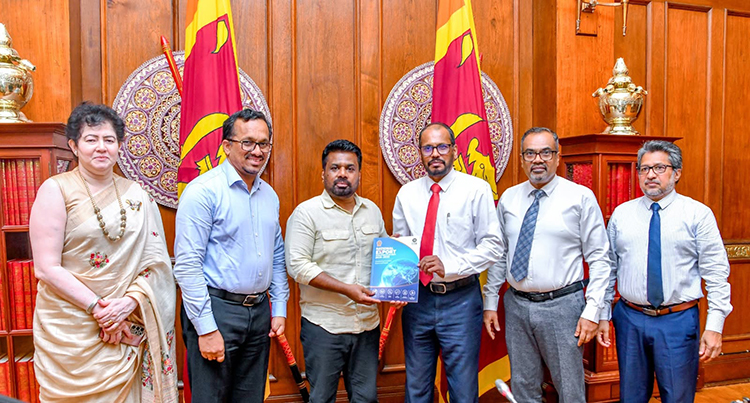
Marking an important milestone in Sri Lanka’s economic development, the National Export Development Plan (NEDP) for the period 2026–2030 was presented to President Anura Kumara Dissanayake this morning (16) at the Presidential Secretariat.
The 2026–2030 National Export Development Plan (NEDP) is a key national programme formulated in line with the Government’s policy direction under the 2025 Budget. It aims to strengthen the country’s export sector and achieve export-led sustainable economic growth.
The strategic plan has been developed under the guidance of the Ministry of Industry and Entrepreneurship Development and the leadership of the Sri Lanka Export Development Board (EDB), with technical assistance provided through the Asian Development Bank’s (ADB) Policy-Based Lending (PBL) programme. It is the result of an extensive consultative process carried out in close collaboration with key government institutions, private sector stakeholders, and development partners.
The proposal submitted by the Minister of Industry and Entrepreneurship Development to recognise the “Sri Lanka National Export Development Plan 2026–2030” as the official strategic framework for export development and promotion in Sri Lanka was approved by the Cabinet of Ministers on 4 May 2026. The Plan reflects a broad consensus among government institutions, private sector experts, and international development partners.
In line with the national vision of “A Thriving Nation – A Beautiful Life”, the Plan has been formulated to enhance Sri Lanka’s export competitiveness and achieve an export revenue target of USD 36 billion by 2030.
The core vision of the Plan is to transform Sri Lanka into a competitive logistics and knowledge-based export hub serving regional and global markets. The strategy is based on two key interconnected pillars: “horizontals” and “verticals”, which together provide the foundation for strengthening export competitiveness, diversification, and sustainable growth.
The horizontal enablers, which support the growth and expansion of all priority sectors, include logistics and integrated hub operations, trade facilitation, trade finance and reforms in the business and investment environment, trade promotion and market linkages, quality management, standards, environmental, social and governance (ESG) capacity development, as well as entrepreneurship and innovation.
The Plan also identifies eight priority export sectors to enhance export diversification and value addition, and to position Sri Lanka more competitively in global markets. These include automotive components, mineral-based industries, rubber-based industries, maritime industries (including boat and shipbuilding), spices and concentrates, digital products and services, electrical and electronic equipment, and processed food and beverages.
The preparation of the Plan involved contributions from over 300 stakeholders, including government institutions, the private sector, civil society organisations and international development partners. Broad consensus was achieved through consultations held from October to December 2025 and workshops conducted in January 2026.
The Government expects that, with implementation supported by strong governance and monitoring framework, the Plan will elevate local products to international standards and ensure long-term economic stability and growth. It is further anticipated that the National Export Development Plan will serve as a key driver of Sri Lanka’s economic progress in the years ahead.
Minister of Labour and Deputy Minister of Finance and Planning Dr. Anil Jayantha Fernando, Minister of Industry and Entrepreneurship Development Sunil Handunnetti, Senior Additional Secretary to the President and Secretary to the Ministry of Energy Russell Aponso, Secretary to the Ministry of Industry and Entrepreneurship Development Thilaka Jayasundara, and Chairman of the Sri Lanka Export Development Board Mangala Wijesinghe were also present at the event.