

August, 28, 2026
As part of Forward Faster Now | APAC 2026, the UN Global Compact Network Sri Lanka convened the SDG Investment Forum, a high-level Technical Deep Dive and Leadership Roundtable dedicated to advancing sustainable and transition finance across Asia-Pacific emerging markets. Delivered in collaboration with the United Nations Environment Programme Finance Initiative (UNEP FI), the Principles for Responsible Investment (PRI) and the Board of Investment of Sri Lanka (BOI), the Forum brought together senior leaders from the financial sector, institutional investors, impact investors, corporates, development finance institutions, regulators, sustainability practitioners and development partners to explore how finance can accelerate progress towards the Sustainable Development Goals (SDGs).
The SDG Investment Forum was supported by Principal Corporate Partners Sampath Bank, Hatton National Bank (HNB) and Hayleys PLC, alongside Supporting Corporate Partners Amana Bank and Dialog Axiata PLC, demonstrating strong private sector leadership and commitment to advancing Sri Lanka's sustainable finance agenda.
The invitation-only forum explored one of the defining questions facing the region today: Can emerging markets better position themselves and bridge the intermediation gap to attract the capital needed to accelerate sustainable development and deliver on the SDGs?
The Forum highlighted that achieving the SDGs requires more than ambition—it demands stronger collaboration between capital providers and businesses, alongside credible transition strategies, transparent governance and investable pipelines capable of unlocking private finance at scale.
The Forum opened with addresses by the Hon. Prime Minister of the Democratic Socialist Republic of Sri Lanka Dr. Harini Amarasuriya and the Assistant Secretary-General of the United Nations Global Compact Sanda Ojiambo, who highlighted the importance of transition finance as a critical enabler of resilient, inclusive economic growth across the region and reinforced the role of responsible business in accelerating sustainable development. Discussions also emphasized the importance of regional cooperation, blended finance, and strengthening investor confidence to mobilize greater levels of sustainable investment into emerging markets.
Keynote addresses from Nathan Fabian, Chief Sustainable Systems Officer at PRI, and Nirnita Talukdar, Asia Pacific Lead at UNEP FI, provided valuable insights into how investors assess transition opportunities and how financial institutions are embedding sustainability into investment and financing decisions. The speakers explored the importance of transparency, robust disclosure, fiduciary responsibility, and innovative financing mechanisms in scaling capital towards climate-resilient and inclusive economies.
The programme then transitioned into a series of four technical deep dives, deliberately sequenced to build on one another rather than stand alone. Rebecca Kwee, Associate Director at LeapFrog Investments, opened with a case study on how impact-oriented capital is deployed across emerging Asia and what portfolio companies and local partners must demonstrate to attract it. Yixi (Wilson) Wei, Investment Manager Assistant and Chief Analyst of ESG at E Fund Management, followed with an additional case study from the investor's perspective. Esther An, Chief Sustainability Officer at City Developments Limited (CDL), then presented a case study on CDL's trajectory in securing transition finance. The International Finance Corporation (IFC) and WindForce PLC closed the segment with a live, closed transaction on local-currency renewable financing in Sri Lanka, presented from both the investor and corporate sides by Prajakta Ajit Chitre, Senior Infrastructure Finance Specialist at IFC, and Rusiri Cooray, CFO of WindForce PLC. Taken together, the four case studies offered participants practical insights into what investors screen for, what domestic institutions must build to be selected, and how a bankable transition finance deal is structured and closed.
A facilitated Leadership Roundtable followed, bringing together investors, financial institutions, corporates and sustainability leaders to candidly discuss the barriers preventing greater capital mobilization across emerging markets. Participants identified priority actions to strengthen collaboration, improve access to transition finance, and accelerate the development of investable projects across the Asia-Pacific region. The session concluded with participants submitting individual organizational commitments to advance sustainable finance within their institutions, with progress to be tracked through follow-up engagements over the coming year.
Throughout the discussions, participants explored several priority themes shaping the future of sustainable finance, including transition finance instruments, blended finance, sustainable disclosure frameworks, internal carbon pricing and strategies for communicating sustainability in an evolving global investment landscape. These conversations reinforced that mobilizing capital at the scale required will depend on stronger partnerships between investors, businesses, policymakers, and development institutions.
The Forum also marked the launch of a one-year Sustainable Finance Implementation Workplan, unveiled by the Assistant Secretary-General of the United Nations Global Compact. The Workplan will translate dialogue into action through continued technical engagement, capacity building and collaboration between financial institutions, investors and businesses, supporting organizations in strengthening sustainable finance capabilities, improving access to transition finance and embedding internationally aligned sustainable finance practices.
The SDG Investment Forum forms part of Forward Faster Now | APAC 2026, hosted by the UN Global Compact Network Sri Lanka in partnership with the UN Global Compact Asia & Oceania Regional Team and Country Networks across the region. Together, these platforms reaffirm the UN Global Compact's commitment to equipping businesses with the knowledge, partnerships, and practical solutions needed to accelerate progress towards the SDGs.
By convening leaders from across the investment ecosystem, the SDG Investment Forum demonstrated that sustainable finance is not only essential to addressing today's environmental and social challenges, but also a strategic driver of long-term resilience, competitiveness and inclusive economic growth. Through continued collaboration under the one-year Sustainable Finance Implementation Workplan, the partnerships established through the Forum will help accelerate the flow of capital needed to deliver a more sustainable and prosperous future for Asia-Pacific.

From right to left: Dilhan C. Fernando, Chairman & CEO, Dilmah; Sanda Ojiambo, Assistant Secretary-General & CEO, UN Global Compact; Prajakta Ajit Chitre, Senior Infrastructure Finance Specialist, World Bank; Nirnita Talukdar, Asia Pacific Lead, UNEP FI; and Rathika de Silva, Executive Director, UN Global Compact Network Sri Lanka
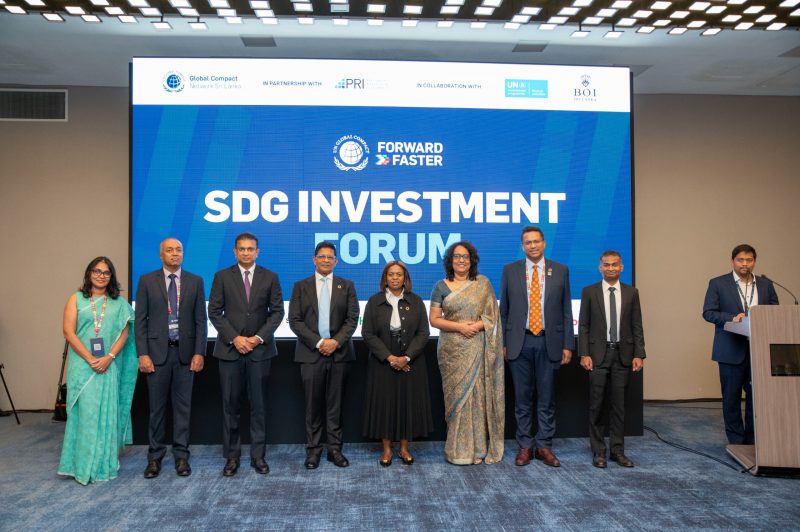
Image Caption : From right to left: Kaif Azoor Sally, Lead – Partnerships and Innovation, UN Global Compact Network Sri Lanka; Tharindu Abeywardana, Chief Economist/Head of Research, Sampath Bank; Dilhan C. Fernando, Chairman & CEO, Dilmah; Hon. Prime Minister Dr. Harini Amarasuriya; Sanda Ojiambo, Assistant Secretary-General & CEO, UN Global Compact; Rathika de Silva, Executive Director, UN Global Compact Network Sri Lanka; Supun Weerasinghe, Director & Group CEO, Dialog Axiata PLC; Dr. Lalith Weragoda, Chief Transformation Officer; and Priyanka Wijayaratne, Senior Vice President / Chief Sustainability Officer
Video Story