

September, 29, 2026
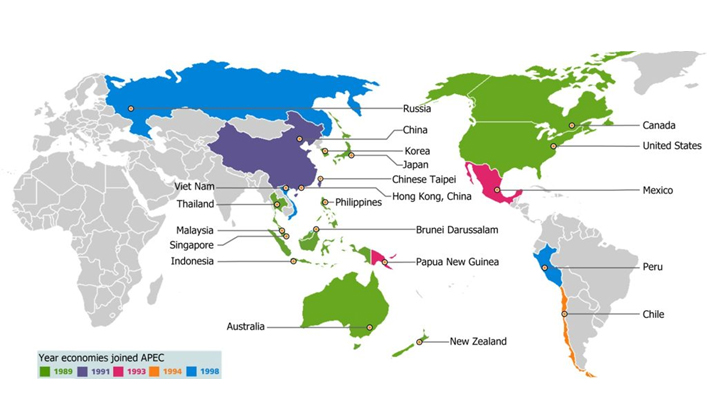
The Asia Pacific Economic Corporation (APEC) is a regional economic forum founded in November 1989 to boost free trade, investment, and sustainable growth across the Pacific Rim (Ref. APEC). USA, Canada, Mexico, China, Japan, South Korea, Singapore, Indonesia, Malaysia, Philippines, Vietnam, Brunei, Australia, New Zealand, Russia and Thailand etc. are members of APEC. Though not in the Pacific Rim, Thailand had benefits much from the APEC. 2026 is APEC China year and it’s the 3rd time China is hosting APEC. China which connects the Far East with Europe via train approx with 11 train trips daily hosted the 12th APEC Transportation Ministers meeting on 22nd September in Beijing.
Giving yet another example of China’s historic non violent win-win cooperation policy, China has organized year long events including above for the benefit of members and non members. APEC member USA is expected work with global community after President Xi Jinping met President Trump on September 24th moving away from the win-lose policy especially in the Middle East. Historically Iran has been a tool in US domestic politics dating back to the ‘Iran Contra’ during Regan days etc. One might see similarities with India using Sri Lanka for domestic politics. India being active in BRICS, focused more on economic growth is also expected to change that approach. If so it will be a win-win and Sri Lanka should work with India and China to repay the loans starting 2028. Sri Lankans should remember that Maldives is also developing a port eyeing the opportunities of China’s Belt and Road Initiative (Ref. Thilafushi).
Seeing the ‘New Era’.
In 2027, 70 years of Sino Lanka diplomatic relations and 75th anniversary of the signing of the Rubber Rice Pact (RRP) between Socialist China and Ceylon will be commemorated. RRP was the first international trade agreement socialist China entered after its founding in 1949. That was an era when most didn’t trust China and weren’t ready to work with it. However, since China had historically saved Sri Lanka whenever it was pushed to the wall, Sri Lankans embraced Socialist China. Under the Chinese Communist Party, China progressed rapidly since 1949 becoming a global factor in the new era.
Malaysia and Indonesia which initiated economic restructuring with support from Admiral Zheng He during the ancient maritime Silk Road (14th century AD) are now APEC economic powers. India which traded with Admiral Zheng He at the Calicut port is a co founder of BRICS. China Malaysia bilateral trade was approx 80.5 billion USD in the first half of 2026 (Ref. Edge). China Indonesia bilateral trade was approx. 67 billion USD in 2025. Indo China bilateral trade was approx 151 billion USD in 2025. Sri Lanka which established its strongest economy before colonization with support from Admiral Zheng He played a key role to ease tensions during Indo China conflict in 1962.
Prime Minister Sirima Bandaranaike won the respect of both parties and as a result Sri Lanka received the BMICH as a gift from China. At a recent APEC event, writer met a Chinese national who is in his late sixties. He respectfully said that Sirima Bandaranaike was the first ever foreigner he saw in life. Sri Lankans shouldn’t miss the opportunity to see the new era working along the Belt and Road Initiative.
Views Expressed are Personal.
Writer is an Academic and the Executive Director of the Zheng He Center in Colombo.
Photo Source WWW
Video Story