

September, 29, 2026
Sri Lanka has spent the past several years restoring economic stability. The question now is what the country does with it.
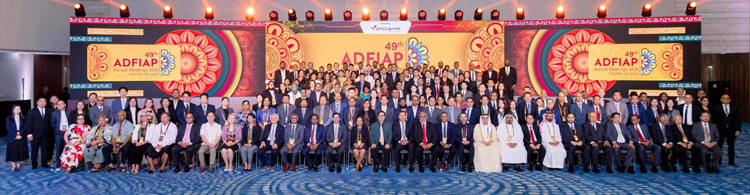
That question ran through the 49th Annual Meetings of the Association of Development Financing Institutions in Asia and the Pacific (ADFIAP), hosted by DFCC Bank from 23 to 25 September 2026 at Cinnamon Life at City of Dreams, Colombo.
Held under the theme “Partnerships for Prosperity: Unlocking Regional Potential,” the meeting brought development finance institutions, policymakers, bankers and private-sector leaders together to consider the next phase of regional growth.
The discussion moved beyond economic recovery. It examined how countries can attract productive investment, mobilise private capital and finance businesses and infrastructure whose value may take years to emerge.
From stability to investment
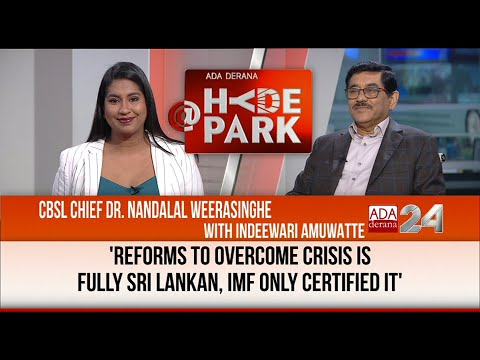
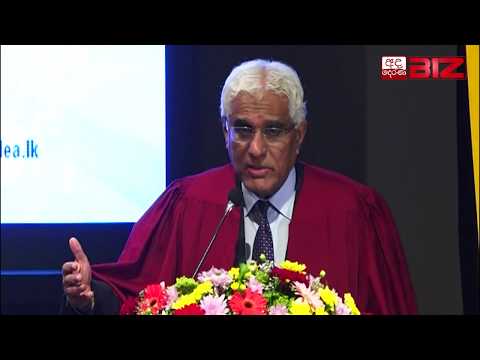
In his keynote address, Dr Nandalal Weerasinghe, Governor of the Central Bank of Sri Lanka, said Sri Lanka’s recent sovereign ratings upgrade reflected the progress made in macroeconomic stabilisation and reform.
Stability, however, is the starting point. The next task is to convert it into investment, greater productivity and sustained economic growth.
That will require development finance institutions to do more than lend from their own balance sheets. They can help make projects investible, absorb or share risks that conventional lenders cannot carry alone, and bring public, private and multilateral capital together.
The Governor’s remarks gave the conference theme a practical meaning. Partnership, in this context, is not simply institutional cooperation. It is a way of widening the pool of capital available for development and directing it towards areas capable of creating lasting economic value.
When debt is not enough
The opening Special Interest Session, “Sri Lanka’s Financial Landscape: Transforming Challenges into Regional Opportunities,” carried this discussion further.
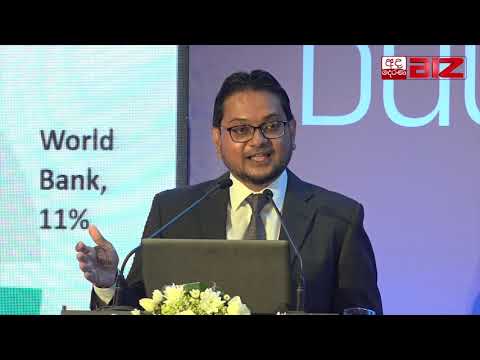
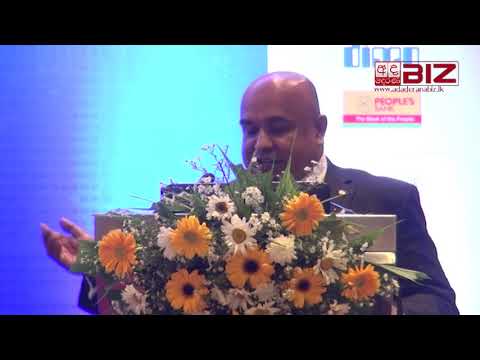
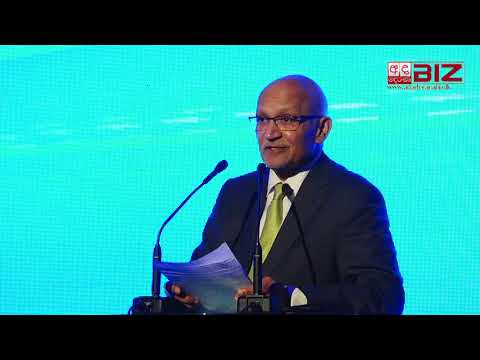
Speaking during the session, Thimal Perera, Director and Chief Executive Officer of DFCC Bank, argued that conventional bank lending cannot meet every development need.
“Debt alone does not solve every problem,” he observed.
Some businesses need time before they can generate the cash flows required to service debt. Others require capital to expand, adopt technology or enter new markets. Loading such businesses with conventional loans too early can weaken them before they have had an opportunity to grow.
Patient capital, minority equity, quasi-equity and appropriate risk-sharing structures can offer a better fit. In some instances, development financiers may also contribute through board participation, strengthening governance and financial discipline while a business becomes established.
This is familiar ground for DFCC Bank. Established as Sri Lanka’s pioneer development finance institution, its original model extended beyond long-term lending to equity participation and active engagement with the businesses it financed. As DFCC Bank evolved into a commercial bank, that history continued to inform its understanding of how capital can support productive enterprise.
The argument was not for a return to the past in its original form. It was for the recovery of an important idea: development finance should be designed around the needs of the enterprise and the economic outcome being pursued, rather than around a single financial instrument.
Mobilising capital instead of replacing it
A development finance institution creates the greatest value when its participation brings other capital into an opportunity.
That may involve blended finance, guarantees, co-lending arrangements, first-loss structures or technical assistance that helps a project reach the standard required by commercial investors. The objective is not to compete with private capital, but to help it move into areas where risk, scale or long development periods might otherwise keep it away.
The conference discussion also recognised the limits of a financial system that depends heavily on commercial bank lending. Banks are designed to manage depositors’ money and must operate within clear limits on risk and maturity. Emerging businesses, major infrastructure and new climate technologies often need a different kind of capital.
Sri Lanka therefore faces a broader financing question. How can the country create deeper routes for investment into promising enterprises, particularly when the funding required is too large for informal investors but too early or uncertain for conventional lenders?
The answer will require several parts of the financial system to work together: banks, development finance institutions, pension and insurance funds, capital markets, private equity, government and international partners.
Regional cooperation with practical outcomes
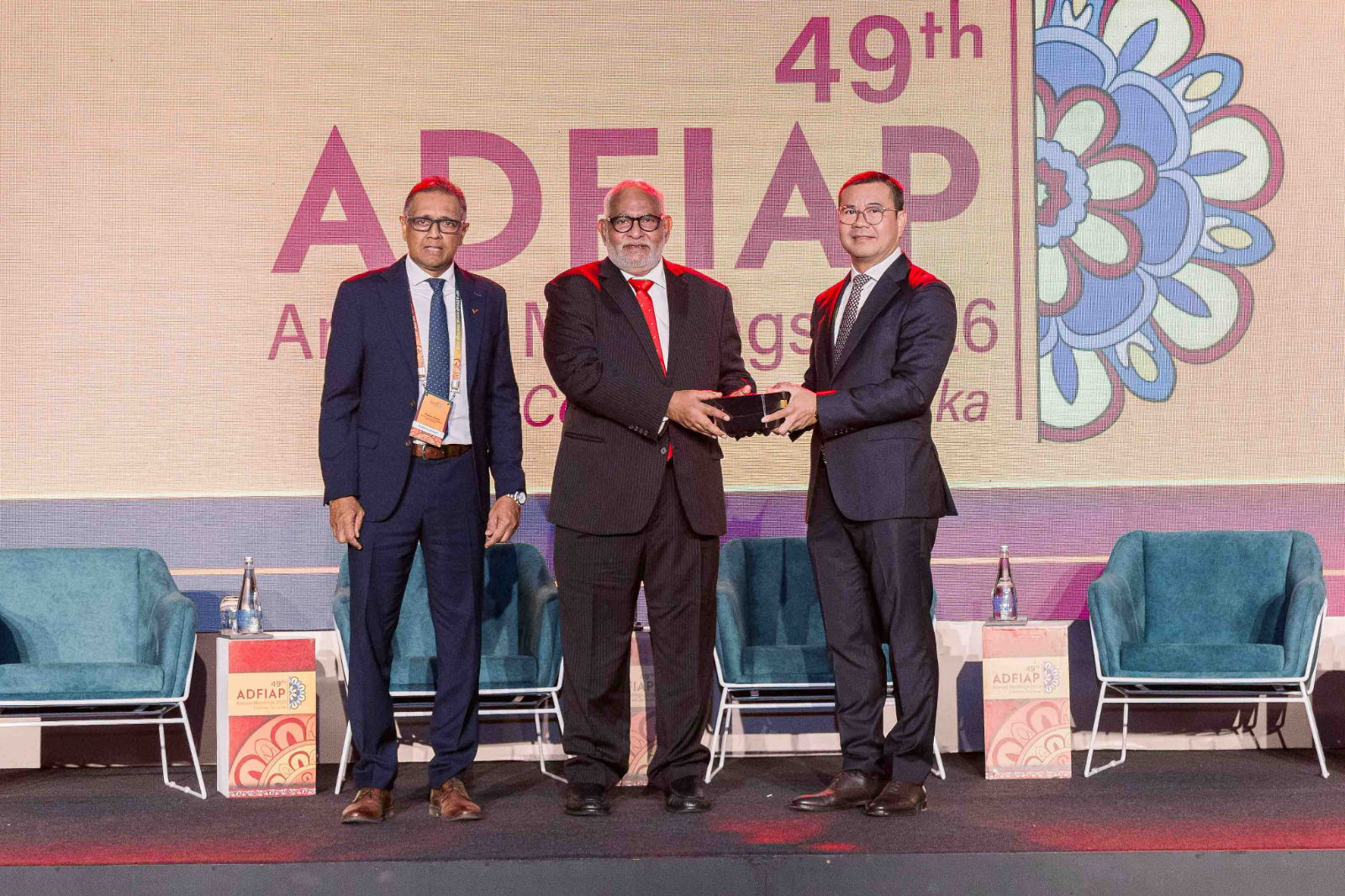
The 49th Annual Meetings gave this thinking practical expression through the ceremonial recognition of six partnership agreements connected to ADFIAP and its regional development agenda.
The agreements covered green infrastructure, sustainable finance, agricultural technology, digital banking, institutional capacity-building and the development of a regional financial technology ecosystem.
Partnerships with the China City Development Fund and auctusESG focused on green industry, sustainable finance and climate-transition capabilities. An agreement with TRACEE addressed agricultural finance and supply-chain connectivity, linking farmers, cooperatives and rural financial institutions through its Seed2Market platform.
Collaboration with Synapsys Ltd PLC will support the development and operation of ADFIAPNET and its associated financial technology infrastructure. The agreement with MGI Consultancy LLC covers digital finance, policy frameworks and investment sourcing, while the partnership with the London Institute of Business & Technology focuses on regional education, advisory services and institutional capacity.
Taken together, the agreements reflected the range of capabilities now required in development finance. Capital remains essential, but so do technology, policy, governance, specialist knowledge and the ability to connect institutions across borders.
A wider development agenda
The conference sessions examined how these capabilities could be applied across several regional priorities.
Discussions on public-private partnerships considered how governments, financial institutions and businesses can share risk and mobilise investment for infrastructure and essential services.
The session on regional integration explored how compatible regulations, stronger supply chains and cross-border investment could help economies withstand external shocks.
Climate finance discussions focused on blended finance, green bonds, climate funds, renewable energy and sustainable agriculture. Digital transformation was considered through the experience of SMEs, for which better access to payments, credit, markets and business tools can have an immediate effect on productivity.
The programme also addressed social inclusion, including the financial participation of women, young people, rural communities, persons with disabilities and groups that remain outside formal financial systems.
These subjects are closely connected. A small business cannot benefit fully from digital finance without connectivity and financial capability. A renewable-energy project cannot proceed without suitable long-term capital. Regional trade cannot grow without trusted payment systems, compatible standards and reliable infrastructure.
The value of the meeting lay in examining those connections rather than treating each issue as a separate agenda.
A development mandate for a changing region
In his opening remarks, H.E. Dr Kao Thach, ADFIAP Chair and Chief Executive Officer of Cambodia’s Agricultural and Rural Development Bank, encouraged development finance institutions to consider success in terms of their contribution to long-term national and regional productivity.
That is an important measure. The size of a loan book or the number of transactions completed cannot, by themselves, describe whether finance has created stronger businesses, better jobs, more competitive industries or wider opportunity.
For DFCC Bank, a founding and charter member of ADFIAP, hosting the Annual Meetings for the third time brought this conversation back to the country in which its own development-finance story began.
The Bank’s role was to provide the setting in which policymakers, financiers and practitioners could compare experience, challenge established approaches and find areas for cooperation.
The meetings ended with no suggestion that the region’s development challenges would be solved by a single institution, financial product or conference. What emerged instead was a clearer view of the work ahead.
Sri Lanka has restored a degree of stability. The next phase will depend on its ability to turn confidence into investment and investment into productive capacity.
Development finance can help close that distance. It will require institutions willing to lend where lending is appropriate, invest where patient capital is needed, share risk where markets remain cautious and bring others into opportunities too important to leave unfunded.
That may prove to be the most useful form of partnership of all.
Video Story