

July, 9, 2026
The Committee on Public Finance (CoPF) has approved the submission to Parliament of a Resolution under the Customs Ordinance and two Orders under the Sri Lanka Export Development Act, following its consideration.
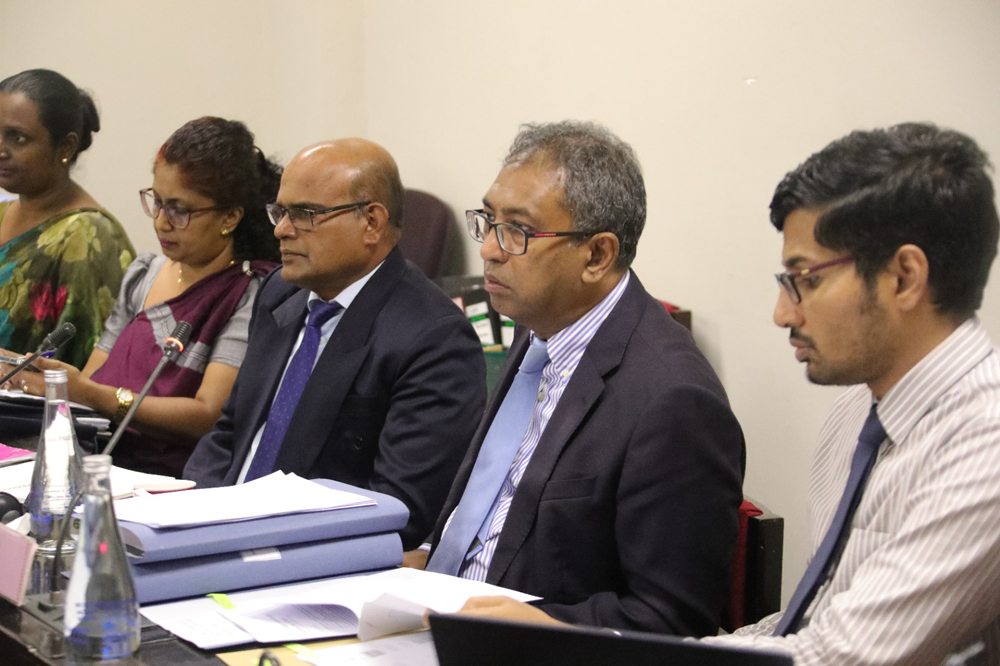
The decision was taken at a meeting of the Committee held in Parliament on 6th July, chaired by Hon. Member of Parliament Dr. Harsha de Silva.
Accordingly, the Committee considered the Resolution published in Extraordinary Gazette No. 2478/03 under the Customs Ordinance (Chapter 235), as well as the Orders published in Extraordinary Gazette Nos. 2478/04 and 2479/38 under the Sri Lanka Export Development Act. Officials representing the Ministry of Finance, Sri Lanka Customs, and the Sri Lanka Export Development Board (EDB) attended the meeting.
In line with the 2026 Budget proposal to implement the National Tariff Policy, the existing customs import duty rates of 0%, 15% and 20% on imported goods have been restructured into a four-band system of 0%, 10%, 20% and 30%, effective 1 April 2026.
Committee discussions emphasized that these amendments are not merely changes to tax rates, but mark the beginning of implementing a National Tariff Policy that will shape Sri Lanka's trade and investment environment over the coming decade. Officials explained that the principal objective of the policy is to establish a scientific and predictable tariff structure that will enable Sri Lanka to integrate more effectively into global supply chains.
Under the policy, a new four-band tariff structure based on the United Nations Broad Economic Categories (BEC Revision 5) classification is proposed, requiring the reclassification of numerous HS tariff codes. The new tariff framework will classify imports under four principal categories—capital goods, intermediate goods, sensitive intermediate goods, and consumer goods—while also balancing the objectives of protecting domestic industries and maintaining stable government revenue.
It was also revealed that, to provide relief to the construction sector, the current effective import tax rate on ceramic tiles, which stands at approximately 85–90%, will be reduced in stages to 20% by 2029. This is expected to lower construction costs and encourage investment in housing and infrastructure.
The Government also proposes introducing new national tariff sub-categories for various sectors in response to requests from domestic industries.
Officials further noted that the Government aims to gradually phase out para-tariffs such as the CESS and the Ports and Airports Levy (PAL) by 2029, moving towards a simpler tariff regime. The Committee also advised officials to consider measures to mitigate any adverse impacts that may arise from tariff liberalization.
It was noted that these tax reforms are expected to support the Export Development Board's objective of doubling Sri Lanka's export earnings from US$18 billion to US$36 billion over the next five years. The policy is also expected to provide a strong foundation for integrating Sri Lanka into global supply chains, particularly in the electronics, rubber products, pharmaceuticals, and information technology sectors.
The Committee also expressed serious concern over delays in updating trade data. The Chair observed that the Department of Trade and Investment Policy's trade database had not been updated since 2021, and instructed the relevant officials to update all trade data and related information required for evidence-based policymaking within one week.
The Gazette notifications are scheduled to be debated in Parliament Wednesday (8 July), following which they are expected to be submitted for Parliamentary approval.
The meeting was attended by Hon. Deputy Minister Chathuranga Abeysinghe, Hon. Deputy Minister Dr. Kaushalya Ariyarathna, and Hon. Members of Parliament Ravi Karunanayake, Harshana Rajakaruna, and Attorney-at-Law Lakmali Hemachandra.
Video Story