

April, 29, 2026
BBC - Oil prices have climbed sharply following reports that the US is preparing for an 'extended' blockade of Iran.
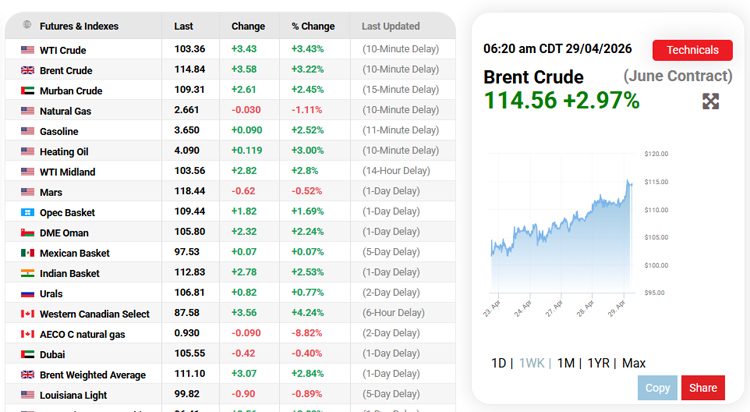
Brent crude rose to around $115 (£85) a barrel on Wednesday, having closed at just over $110 (£81) on Tuesday evening. The price had fallen slightly to $114.37 (£84.68) just before midday BST.
It follows reports from the Wall Street Journal that US President Donald Trump has instructed aides to prepare to extend the ongoing blockade of Iran's ports, in an effort to squeeze the country's economy.
Iran has said it will continue to disrupt traffic travelling through the Strait of Hormuz in response to the US blockade.
The price of oil has seen sharp swings since the start of the war, as the key Strait of Hormuz has been effectively closed for weeks due to the conflict.
Iran has severely restricted shipping through the strait — which usually carries about a fifth of the world's supply of oil and liquid natural gas — in response to US and Israeli strikes that began on 28 February.
Earlier this month, Tehran warned that any vessel that approaches the strait would be targeted.
The US then announced that its forces would intercept or turn back vessels travelling to or from Iran's ports.
Analysis by BBC Verify shows that at least four vessels tracked from Iranian ports appear to have crossed the US blockade line.
Despite the fluctuations of recent weeks, the price of oil remains much higher than the pre-conflict price of a barrel.
The price of Brent crude dropped to $90 a barrel on 17 April, after a ceasefire between Israel and Lebanon was announced. The US said it would pause attacks on Iran on 8 April. It remains much higher than the pre-conflict price of a barrel.
However, the oil benchmark has been rising steadily over the last 12 days, as the US continued its blockade.
On Wednesday, Trump urged Iran to 'get smart soon' and sign a deal, following days of deadlock in efforts to end the conflict.
In a post on Truth Social, Trump said the country 'couldn't get its act together.'
The Wall Street Journal cited US officials as saying the president had instructed aides to prepare for an extended blockade of Iran's ports in a bid to force Tehran's hand.
Officials said Trump had opted to continue squeezing Iran's economy and oil exports with the blockade as his other options - resuming bombing or walking away from the conflict - carried more risk, according to the report.
Iranian officials said on Tuesday the country could withstand the blockade as it was using alternative trade routes.
The World Bank on Tuesday forecast energy prices would surge by 24% in 2026 to their highest level since Russia's full-scale invasion of Ukraine four years ago, if the most acute disruptions caused by the Iran war end in May.
European stocks fell on Wednesday, as investors digested a wave of corporate earnings and awaited the US Federal Reserve's latest interest rate decision.
The FTSE 100 fell 0.76%, while the pan-European Stoxx index was down 0.4% at midday.
France's Cac was down 0.54% and Germany's Dax fell marginally.
Asian stock markets mostly rose Wednesday, continuing their recovery after being particularly hard hit by the initial shock from the war.
"The market is increasingly shifting towards a view that no longer expects a quick and lasting peace, nor an immediate reopening of the Strait of Hormuz," said Arne Lohmann Rasmussen, chief analyst at Global Risk Management.
Video Story