Reuters - The United States has become the world's largest oil exporter, upending a decades-old order long dominated by Saudi Arabia and Russia, a shift that tightens American companies' grip on energy markets as Washington's war with Iran reshapes global energy trade.
America's ascendancy to the top spot marks a stunning reversal for a country that was dependent on Middle Eastern oil for decades and suffered from an oil embargo imposed by some OPEC members in 1973 to retaliate against U.S. support for Israel.
U.S. fortunes began to change after 2010, when oil and gas output from its shale formations soared, first making it the world's top gas and then the world's top oil producer.
With the U.S.-Iran war disrupting Saudi oil exports since February 2026 and Russian oil exports suffering from Ukrainian drone attacks and U.S. sanctions on Moscow for the invasion of Ukraine, the U.S. has become the world's leading oil exporter.
U.S. exports of crude and fuel climbed to about 10.5 million barrels per day in May on the back of high output and the release of strategic reserves, data from ship tracking services Vortexa showed, making the U.S. the top global exporter for the third month in a row. Russian exports stood at 7 million bpd in May, according to Reuters' calculations, while Saudi Arabia's exports stood at 5.9 million bpd, according to Vortexa.
In comparison, Saudi Arabia exported about 8.1 million bpd in 2025, while the United States shipped out 6.6 million bpd, and Russian exports stood at about 5.8 million bpd, according to Vortexa data.
"Washington has a new tool they didn't realize they had before the Iran war — energy exports," said Michelle Brouhard, head of policy at ship tracking firm Kpler.
The new U.S. dominance could weaken the pricing power that the Organization of Petroleum Exporting Countries and its allies have historically held over oil markets. U.S. President Donald Trump has long criticized OPEC for manipulating the markets. The group also suffered a blow in May when one of its biggest members, the United Arab Emirates, left the organization after nearly 60 years.
The biggest oil exporter spot will give Washington a powerful new lever in talks with allies and rivals in addition to its global military supremacy and its dominance of financial markets thanks to the U.S. dollar's role as the world's reserve currency.
"You can see now the leverage the United States has over some of these countries because they are dependent on the U.S. for their oil or gas," Brouhard said, adding that the U.S. was the largest provider of crude to Europe and the second-largest provider of distillates.
EU officials, who initially welcomed the U.S. oil and gas boom as an alternative to Russian and Middle Eastern supply, have grown more skeptical and
warned of risks of becoming too dependent on American companies.
The warning coincided with the EU clashing with the U.S. administration over trade tariffs and green regulations.
Moscow is also finding it hard to hide frustration.
U.S. energy companies were the
main beneficiaries of the closure of the Strait of Hormuz, Igor Sechin, the boss of the Kremlin oil major Rosneft and one of the closest allies of President Vladimir Putin, said this month.
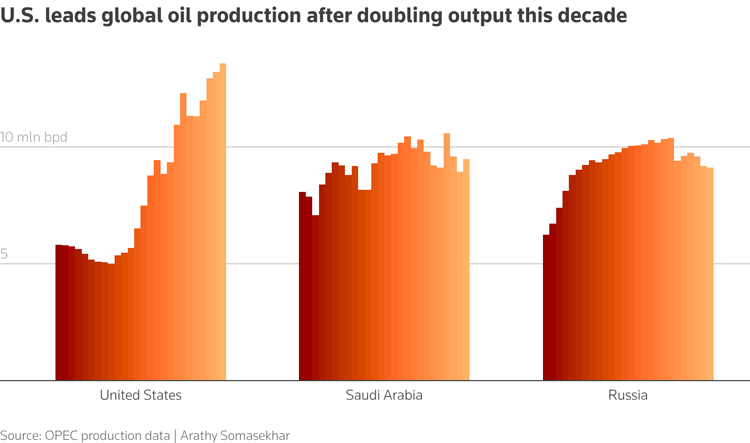
But long before the U.S.-Iran war started, both Saudi Arabia and Russia were trailing far behind U.S. companies on production growth.
Crude and liquids output in the United States has nearly tripled to about 22 million bpd since 2000. Saudi crude and liquids output has largely fluctuated between 10 million and 12 million bpd depending on OPEC quotas between 2000 and 2026.
Russian oil and liquids output soared to 10 million bpd from 6 million bpd between 2000 and 2010, grew by a further 2 million bpd during the 2010s, but has largely stagnated and declined to below 10 million bpd since 2020.
Global oil demand grew to 104 million bpd last year from 87 million in 2010, meaning the lion's share of the global growth of the past 15 years has been mostly met by the U.S. oil boom.
Coloumn chart showing oil ouput growth in U.S., Saudi Arabia and Russia. U.S. currently leads global oil production after doubling output this decade
In 2015, the United States repealed a 40-year export ban it had in place since the Arab oil embargo, opening the gates for its oil boom to the wider world. Fast forward 10 years, it has become the biggest oil exporter, proving skeptics wrong that the growth would be short-lived as fields deplete.
Unlike in Saudi Arabia and Russia, where governments fully or partially set production and export targets, the U.S. boom hinges on private companies' decisions and is primarily driven by profits.
When oil prices rise, U.S. firms will respond by raising production, which will help bring prices down. When prices are weak, U.S. firms will cut output, which will boost prices, said Kenneth Medlock III, a fellow in Energy and Resource Economics at the Baker Institute for Public Policy.
"In many ways, it's kind of a similar role to what OPEC and Saudi Arabia have been doing with spare production capacity, but it's more of a market mechanism than a strategic device," he said.
European countries have leaned heavily on the United States in the years since the Ukraine war began in 2022. The continent took about 47% of U.S. oil exports so far this year, compared with 37% in 2021.
Asian countries, which used to buy the bulk of their crude from the Middle East, are also now increasingly relying on the U.S. for supplies. Asia accounted for about 46% of U.S. oil exports in May, compared with around 37% last year.