

June, 24, 2026
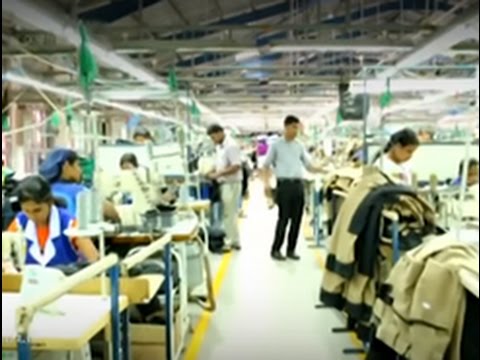
Sri Lanka’s apparel and textile exports grew 7.96% in May 2026 to US$394.14 million, the industry’s best single-month performance so far this year and a sign that demand from key markets is beginning to firm up after a difficult start to the year.
The United States led the gain, with shipments rising 15.36% to US$149.96 million. Exports to markets outside the industry’s traditional three core destinations also grew strongly, up 14.61% to US$70.67 million, while the UK posted modest growth of 0.87%. The EU was the only market to soften, dipping 0.3% to US$121.35 million.
The US rebound lands at a pivotal moment for the sector. Sri Lanka is currently engaging with the US Trade Representative the 301 investigation on the prohibition of importation of goods manufactures with forced labour, that will determine an additional tariff of either 10% or 12.5%. The report published in June places Sri Lanka among the 46 countries that are due to have a 12.5% tariff imposed on them. A number of Sri Lanka’s competitor countries (incl. Bangladesh, Cambodia Pakistan and Indonesia) have been given a lower tariff of 10% on account of their already having taken some action with regard to the import of goods manufactured from forced labour. A public hearing on the proposal is set for 7 July in Washington, and industry bodies have until 22 June to request a hearing slot making the coming weeks a critical window for Sri Lanka to make its case.
This is precisely where the policy conversation and the trade numbers intersect. May’s US strength shows that, even under tariff pressure, Sri Lanka remains a market US buyers are actively sourcing from a reflection of the country’s long-standing reputation for quality, compliance and reliability. The opportunity now is to convert that underlying buyer confidence into a more durable trading position by securing a fairer tariff outcome.
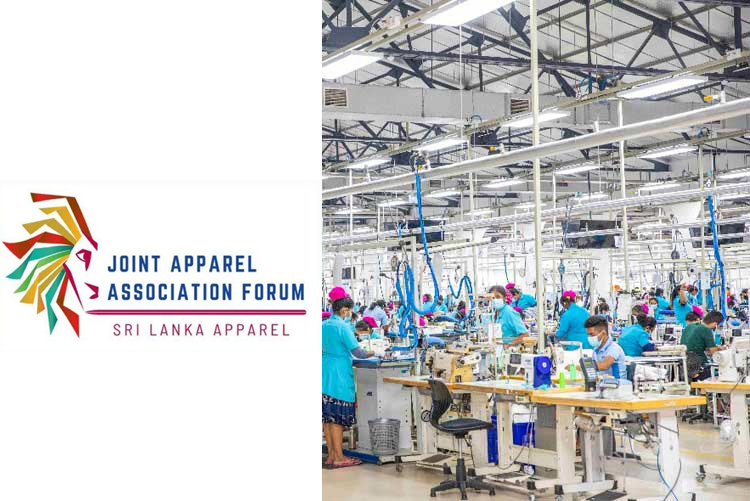
The Joint Apparel Association Forum (JAAF) has consistently lobbied for tariffs to be in line with competitor countries.
A successful outcome for Sri Lanka in the current process would help convert May’s encouraging signal into sustained growth.
The cumulative picture for the year still reflects the headwinds the industry has been navigating. Exports for January–May 2026 stand at US$1,926.85 million, down 4.68% on the same period last year, with the US, EU and UK all in negative territory cumulatively. But May’s performance suggests the industry has room to recover ground in the second half of the year, particularly if the tariff question is resolved favourably and buyer confidence continues to build.
JAAF says, “May’s numbers are genuinely encouraging, and they reflect the trust our buyers continue to place in Sri Lankan manufacturing even amid a challenging trade environment. Our focus now is on securing a fair and competitive tariff outcome in Washington, so that this momentum can translate into long-term growth rather than a short-term gain. We remain confident that with the right policy support, the second half of 2026 can be considerably stronger for the sector.”
With the US hearing process now entering its most consequential phase, the next few months will be a key test of whether Sri Lanka can lock in a more competitive position in its largest market and turn May’s strong showing into the start of a sustained recovery for the sector.
Video Story