

May, 22, 2026
Thirty structured investment projects in Multiple sectors
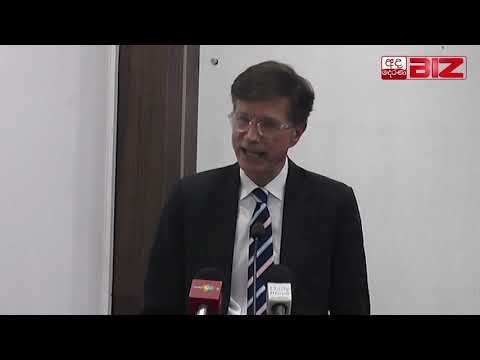
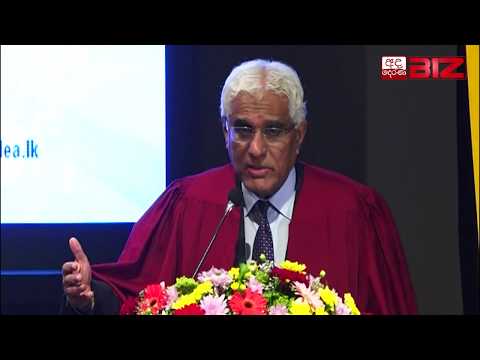
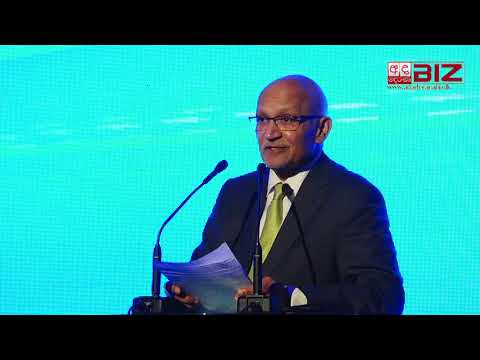
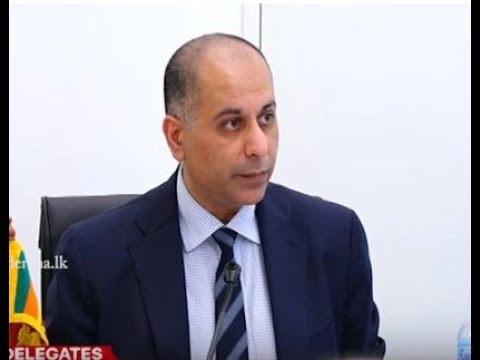
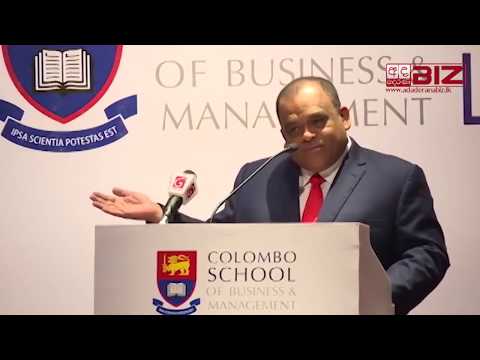
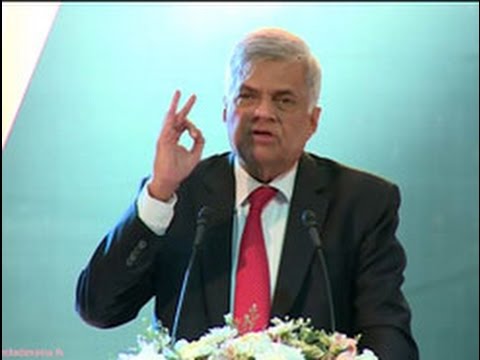
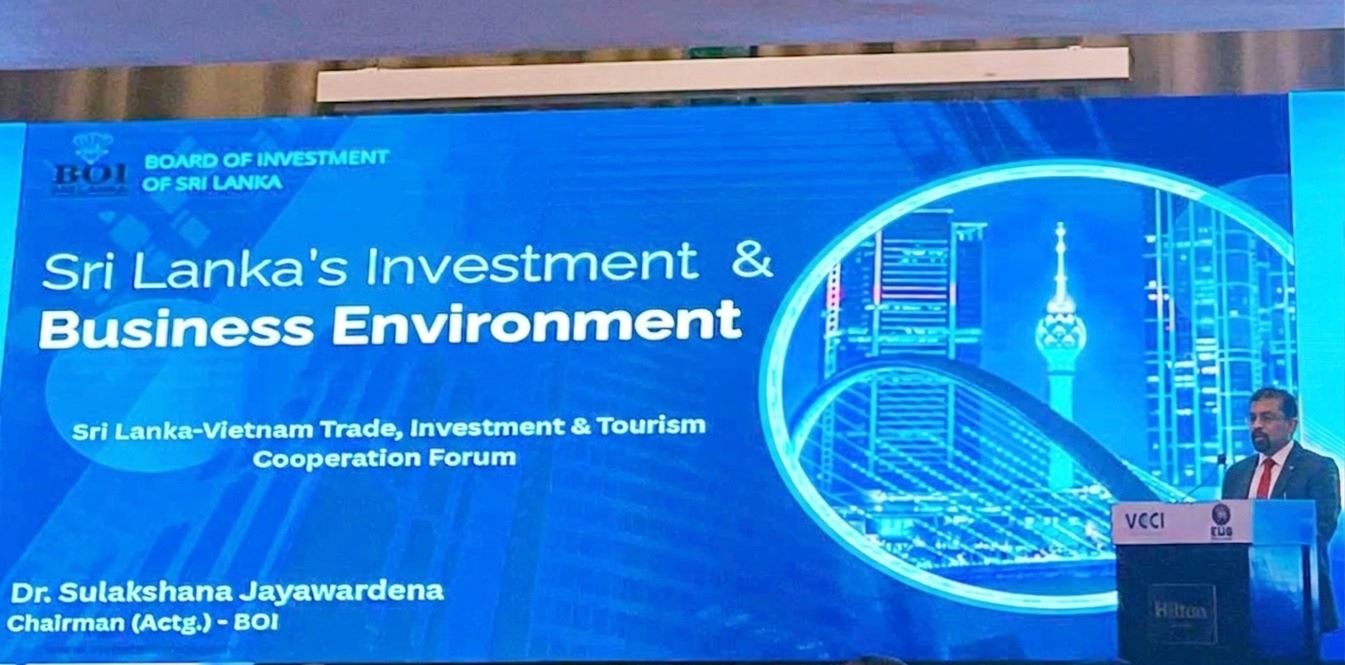
Sri Lanka is open for business. That was the unambiguous message Dr. Sulakshana Jayawardena, Acting Chairman of the Board of Investment (BOI) of Sri Lanka, delivered to an audience of Vietnamese business leaders and officials at the Sri Lanka–Vietnam Trade, Investment & Tourism Cooperation Forum on 8 May 2026. After weathering one of the most severe economic crises in its post-independence history, Dr. Jayawardena told delegates, the island nation has emerged with renewed macroeconomic stability, restored investor confidence, and a clearly articulated vision for growth. His case for why international investors — particularly those from Vietnam and Southeast Asia — should look seriously at Sri Lanka was built on data, policy, and a pipeline of thirty project-ready investment opportunities.
The macroeconomic data, Dr. Jayawardena argued, tell a compelling story of recovery. After a contraction of 2.3% in 2023, Sri Lanka's economy rebounded sharply, posting GDP growth of 5.0% in both 2024 and 2025 — a performance that has surprised even cautious observers — with the Central Bank projecting continued momentum at approximately 4.0% in 2026. Merchandise exports climbed from US$ 11.9 billion in 2023 to US$ 13.6 billion in 2025, with a target of US$ 15.7 billion set for this year. Tourism earnings surged from US$ 2.07 billion to US$ 3.22 billion over the same period, driven by more than 2.3 million international arrivals in 2025.
For investors, Dr. Jayawardena pointed to the FDI trajectory as perhaps the clearest signal of restored confidence. Inflows reached US$ 1.063 billion in 2025 — nearly double the 2024 figure of US$ 614 million — with a target of US$ 1.5 billion set for 2026. "Sri Lanka has arrested its crisis and is firmly on a growth curve," he said.
Dr. Jayawardena positioned Vietnam not merely as a market but as a strategic partner with complementary strengths. The bilateral trade relationship, he noted, is today marked by an imbalance that both sides should see as an opportunity: Sri Lanka exports around US$ 40 million in goods to Vietnam annually — primarily apparel, precious and semi-precious stones, seafood, tea, and footwear — while importing nearly six times that figure, approximately US$ 238 million, in textiles, iron and steel, plastics, and machinery. Rather than a deficit to be managed, he characterised the gap as a platform to build upon.
Vietnam's manufacturing and export processing model, Dr. Jayawardena said, offers valuable lessons for Sri Lanka — particularly in the development of industrial zones. Meanwhile, Sri Lanka's preferential trade access to the EU, the UK, India, and Pakistan creates an immediate export proposition for Vietnamese manufacturers seeking new routes to market. Both countries are also well-positioned, he argued, to benefit from the global trend of diversifying Asian supply chains — a structural shift that has accelerated sharply in recent years — with Vietnam's deep ASEAN integration offering Sri Lanka a bridge to broader Southeast Asian economic engagement.
Central to Dr. Jayawardena's investment case was Sri Lanka's strategic geography. The Colombo Port ranks 28th globally among container ports, sitting astride an East–West shipping lane transited by over 300 vessels daily. The sea route south of Sri Lanka carries an estimated 70% of the world's oil shipments and 50% of its container traffic — making the island, as he put it, a natural logistics hub for global trade. Two major international airports serve the country, handling over 64,000 aircraft movements, 10 million passenger movements, and in excess of 188,800 tonnes of air cargo annually.
Dr. Jayawardena also highlighted Sri Lanka's human capital as a differentiator frequently underestimated by outside investors. Sri Lanka leads South Asia in literacy rates and has cultivated a highly skilled, English-proficient workforce. The country holds the distinction of having the second largest pool of CIMA-qualified professionals in the world — a testament to the depth of its professional services sector. Approximately 44,000 university graduates emerge each year from 18 state universities and 19 higher education institutes, supported by 1,346 tertiary and vocational training institutions, with a further 225,000 students completing technical and vocational programmes annually.
On market access, Dr. Jayawardena was emphatic: few countries of Sri Lanka's size offer comparable reach. Zero-duty access covers more than 6,000 product categories to 27 EU countries under the EU GSP+ scheme and to the UK under the UKDCTS arrangement. Bilateral Free Trade Agreements with India and Pakistan provide duty-free access to the Subcontinent, while FTAs with Singapore and Thailand — pending full operationalisation — add further reach into Southeast Asia. Preferential concessions are also available under APTA and SAFTA.
The investment policy framework, he continued, is designed to match that access with genuine security. Sri Lanka permits 100% foreign ownership across most sectors and guarantees 100% repatriation of profits and capital — protections explicitly enshrined in the Constitution. Strong intellectual property laws aligned with WIPO standards, membership of the World Bank's Multilateral Investment Guarantee Agency, Investment Protection Agreements with 26 countries, and Double Taxation Relief Agreements with 46 countries complete a framework built, as Dr. Jayawardena described it, to give investors confidence from entry to exit.
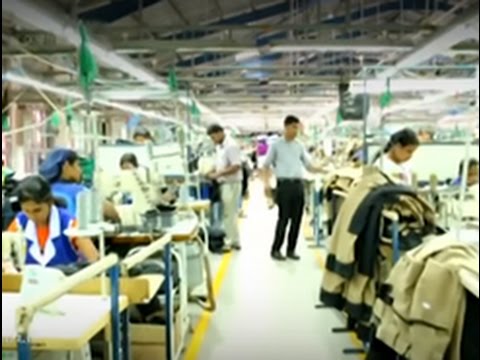
Beyond the macro case, Dr. Jayawardena presented a pipeline of thirty structured, project-ready investment opportunities across five priority sectors. In manufacturing and export processing, established capabilities in apparel, electronics assembly, rubber-based products, and light engineering are complemented by new opportunities including seven dairy processing plants, an Active Pharmaceutical Ingredient facility in a dedicated pharma zone, a textile manufacturing operation in the Eravur Textile Manufacturing Zone, and an EV assembly plant in the Southern Province.
The logistics and port-related services pipeline reflects Sri Lanka's Indian Ocean hub ambitions: a multi-storey logistics hub in Colombo's Bloemendhal area, a logistics centre at Colombo Port, integrated warehousing, a customs verification centre, and both logistics and aircraft MRO facilities at Mattala International Airport. For tourism and hospitality — a sector already generating over US$ 3.2 billion in annual receipts — structured opportunities span a heritage hotel in Kandy, a theme park in Nuwara Eliya, a recreational hub in the Western Province, and an island circle route cruise line. Rounding out the pipeline, infrastructure and mixed development projects include techno parks, a cinema city, mixed development schemes, and residential apartment projects.
Closing his address, Dr. Jayawardena was direct. "Sri Lanka has turned the page on its economic crisis," he told the Forum. "Macroeconomic stability has been restored. A proactive and investor-friendly policy environment is in place. And we now have a pipeline of structured, ready-to-engage opportunities across high-growth sectors." For Vietnamese businesses looking to expand into South Asia, leverage Sri Lanka's gateway access to global markets, and position within restructuring Asian supply chains, he said, the timing has rarely been more favorable. The Board of Investment of Sri Lanka, he concluded, stands ready to engage.
Video Story