


August, 17, 2020
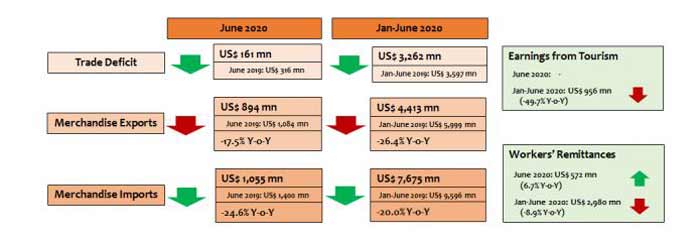
According to the latest external trade data released by the Central Bank, country’s trade deficit narrowed in June 2020 (year-on-year), with a more than expected rebound in merchandise exports and notable reduction in merchandise imports on account of restrictions on non-essential imports.
The deficit in the trade account narrowed in June 2020 to US dollars 161 million, from US dollars 316 million in June 2019, recording the lowest monthly deficit since August 2009.
Also, on a cumulative basis, the trade deficit narrowed by US dollars 335 million to US dollars 3,262 million during the first six months of 2020 from US dollars 3,597 million in the corresponding period of 2019.
Meanwhile, terms of trade, i.e., the ratio of the price of exports to the price of imports, declined by 7.3 per cent (year-on-year) in June 2020 with prices of exports declining at a faster pace than those of imports.
Exports
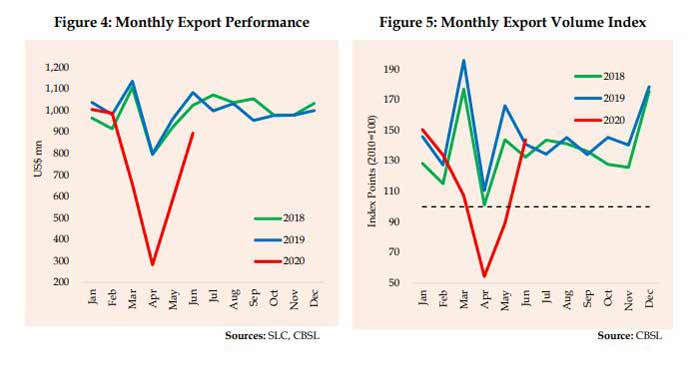
Earnings from merchandise exports rebounded sharply, recording US dollars 894 million in June 2020 compared to US dollars 587 million recorded in May 2020. The gradual resumption of economic activities of the country as well as the recovery of both domestic and global supply and demand chains to some extent contributed to this improvement. The earnings from textiles and garments exports led the increase from May 2020 to June 2020, followed by rubber products, food beverages and tobacco, seafood and spices.
However, compared to June 2019, earnings from merchandise exports declined significantly by 17.5 per cent in June 2020. The year-on-year decline in earnings from exports was led by industrial exports. Earnings from textiles and garments contributed the most to the decline in June 2020, on a year-on-year basis, despite the increase in earnings from personal protective equipment (PPE) such as face masks and protective suits, categorised under other made up articles. Earnings from most subcategories of industrial exports including transport equipment, petroleum products, gems, diamonds and jewellery and animal fodder declined, year-on-year, during the month. Despite the increase of surgical and other gloves exports, earnings from rubber products declined, mainly driven by lower exports of tyres. However, earnings from food, beverages and tobacco (led by liquid coconut milk, coconut cream and manufactured tobacco), plastics and articles thereof (led by plastic clothing articles) and chemical products (led by activated carbon) exports increased in June 2020 compared to June 2019.
Earnings from agricultural exports grew considerably by 12.0 per cent on a year-onyear basis in June 2020, for the first time since May 2019. This increase was led by all subcategories of agriculture exports except for unmanufactured tobacco. Earnings from tea recorded a growth after 10 months in June 2020 driven by higher average export prices of tea although the volume exported recorded a minor decline. Higher earnings were recorded in minor agricultural products led by higher exports of arecanuts, fruits and betel leaves. Earnings from spices increased with higher export volumes of cinnamon and pepper, while earnings from coconut increased as a result of higher average export prices of kernel products and higher export volumes of non kernel products.
Earnings from mineral exports recorded a decline in June 2020, year-on-year, led by lower earnings from ores, slag and ash exports.
The export volume index improved by 2.5 per cent, on a year-on-year basis while the unit value index deteriorated by 19.5 per cent, on a year-on-year in June 2020, indicating that the decline in exports was on average driven by lower export prices compared to June 2019. However, on a month-on-month basis, the improvement of the export volume index was substantially high at 61.7 per cent while the deterioration of the unit value index was relatively low at 5.7 per cent, in June 2020 compared to May 2020.
Imports
The declining trend observed in expenditure on merchandise imports from December 2019 to May 2020, reversed in June 2020, although a decline of 24.6 per cent was recorded on a year-on-year basis. In June 2020, expenditure on merchandise imports stood at US dollars 1,055 million. Expenditure on all major import sectors declined on a year-on-year basis in June 2020, with intermediate and investment goods imports declining the most. This broadbased decline is attributable to the measures taken by the government and the Central Bank since March 2020 to restrict the importation of selected goods to mitigate the adverse effects created by the COVID-19 pandemic and also to the steep decline in expenditure on fuel imports.
Expenditure on intermediate goods contributed the most to the decline in import expenditure. Import of fuel in June 2020 declined significantly compared to June 2019 as a result of the decline in expenditure on refined and crude oil. This decline in expenditure stemmed from both the reduction in volumes imported and the lower prices of fuel in the international market. The average import price of crude oil declined to US dollars 38.35 per barrel in June 2020, compared to US dollars 67.29 a year ago. Expenditure on imports of textile and textile articles declined significantly in June 2020 led by lower imports of fabric and yarn. However, import expenditure on fertiliser (mainly urea), mineral products (mainly cement clinker), unmanufactured tobacco and agricultural inputs (mainly animal fodder) increased during the month compared to June 2019.
Expenditure on investment goods declined notably with the decline of all sub categories of investment goods in June 2020. Accordingly, expenditure on machinery and equipment (mainly medical and laboratory equipment), building material (mainly articles of iron and steel) and transport equipment (mainly commercial vehicles such as tankers and bowsers) declined in June 2020, compared with June 2019. However, expenditure on machinery and equipment parts and cement increased during the period under review.
Although expenditure on food and beverages increased, expenditure on consumer goods declined, due to the decline in expenditure on non-food consumer goods imports. Expenditure on motor vehicle imports declined considerably by 80.9 per cent while import of home appliances declined led by refrigerators and televisions during the month mainly due to the import restriction measures taken by the government and the Central Bank since March 2020. However, expenditure on medical and pharmaceuticals and telecommunication devices (mainly mobile phones) imports increased in June 2020. Meanwhile, import expenditure on food and beverages increased, led by import of seafood (mainly dry fish), dairy products (mainly milk powder), vegetables (mainly lentils), fats and oils (mainly coconut oil) and spices (mainly chillies and coriander seeds).
Both the import volume index and the unit value index declined by 13.2 per cent and 13.1 per cent, respectively, in June 2020, indicating that the decrease in imports was driven both by lower volumes and lower prices when compared to June 2019.

Video Story