

May, 18, 2026
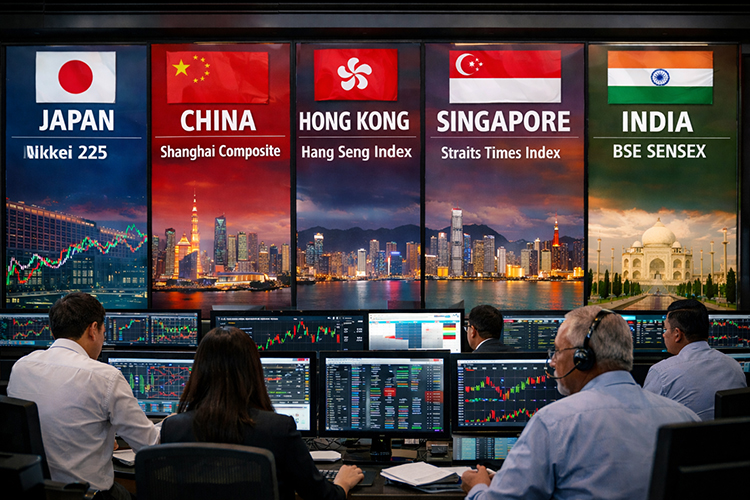
Reuters - Asian share markets were on the skids on Monday as fresh drone attacks in the Gulf shoved oil prices and bond yields higher, while the AI boom is set to be tested by earnings from Nvidia this week.
A drone strike caused a fire at a nuclear power plant in the United Arab Emirates, while Saudi Arabia reported intercepting three drones, as U.S. President Donald Trump warned that Iran must act "fast" to reach a deal.
Meanwhile, the vital Strait of Hormuz remains closed to all but a trickle of shipping as Tehran tries to formalise its control of the waterway that during normal times carries 20% of the world's oil trade.
"The closure is draining global oil inventories fast," warned analysts at Capital Economics. "Inventories could reach critical levels by end-June, setting the stage for Brent at $130-140pb, if not higher."
"If the strait is closed through year-end and oil stays around $150pb into 2027, that would push inflation to near 10% in the UK and euro zone, send rates back to their recent peaks and lead to global recession."
Brent was trading up 1.9% at $111.34 a barrel, while U.S. crude climbed 2.3% to $107.84 a barrel.
G7 finance ministers are scheduled to gather in Paris on Monday to discuss the Strait of Hormuz and critical raw material supplies, even as geopolitical differences threaten to test the group's cohesion.
Global bond markets were hammered on Friday on concerns that energy costs would stay high and thus continue to drive inflation.
Yields on U.S. 10-year notes hit a 15-month top of 4.631%, having already surged 23 basis points last week. Yields on 30-year bonds reached 5.159% after jumping 18 basis points on the week.
Japanese yields hit peaks not seen since 1996 as the government proposed to issue fresh debt to fund a planned extra budget to cushion the economic blow from the U.S.-Israeli war on Iran.
Investors in turn feared central banks globally would have to tighten to head off an inflationary spiral and a hike from the Federal Reserve is now seen as a 50-50 chance this year.
Minutes of the Fed's last meeting are out on Wednesday and should show how much pressure there was on the committee for a shift to a neutral stance and away from an easing bias.
Japan's Nikkei, opens new tab eased 1.1%, having fallen 2% last week from record highs. South Korean stocks, opens new tab fell 0.1%, as the red-hot market cooled just a little after demand for semiconductors drove it to all-time peaks.
MSCI's broadest index of Asia-Pacific shares outside Japan, opens new tab lost 0.9%.
Chinese blue chips held steady, having hit their highest level in more than four years last week.
Economic data disappointed as April retail sales edged up 0.2% when analysts had looked for growth of 2.0%, while industrial output rose a sluggish 4.1%.
AI, RETAIL EARNINGS TO TEST THE BULL RUN
S&P 500 futures fell 0.6% and Nasdaq futures lost 0.8%. For Europe, EUROSTOXX 50 futures and DAX futures both fell 1.0%, while FTSE futures were flat.
While Wall Street has been supported by upbeat earnings, analysts at Citi noted that half of the boost to earnings came from one-time items like tariff add-backs and asset mark-ups. Both the gains in profits and the overall indexes were also tightly based.
"We identify 20 stocks that contributed the majority of index earnings upside," analyst Scott Chronert wrote in a note. "Forward guidance increases also show a similar narrow focus."
"Broadening is a necessary condition for meaningful index upside from here," he added. "This will require a better line of sight to the Iran conflict wind-down."
Rising yields also push up borrowing costs for the U.S. government and home buyers, a negative for the budget deficit and housing markets. They also mean a higher discount for future company earnings, challenging stock valuations.
The all-important AI trade will be tested by earnings from Nvidia, opens new tab that are due on Wednesday, where expectations are sky-high for the world's most valuable company.
Nvidia shares are up 36% since a March low, while the Philadelphia SE semiconductor index, opens new tab has surged more than 60%, amid voracious demand for chips as tech companies spend massively to build AI-related infrastructure.
Also due this week are results from a host of retailers led by Walmart, opens new tab, which will provide an insight into how consumers are faring with high energy prices.
In forex markets, risk aversion has tended to benefit the greenback as the world's most liquid currency. The U.S. is also a net energy exporter, giving it a relative advantage over Europe and much of Asia.
The euro sat at $1.1616 after losing 1.4% last week. The pound wallowed at $1.3311 , having dived 2.3% last week as political instability added to already intense pressure on the gilt market.
The dollar held firm against the yen at 158.91 , with only the threat of Japanese intervention preventing another speculative assault on the 160.00 chart barrier.
In commodity markets, gold dipped 0.2% to $4,527 an ounce , having drawn little support so far as a safe haven or as a hedge against inflation risks.
Video Story