

June, 11, 2026
By Jithendra Antonio
For decades, Sri Lanka has debated ports, airports, expressways, free trade agreements, and foreign investments as pathways to economic transformation. Yet one proposal has consistently resurfaced across governments, administrations, and geopolitical cycles as perhaps the most consequential infrastructure project ever contemplated for the island nation: a permanent land connection between India and Sri Lanka.
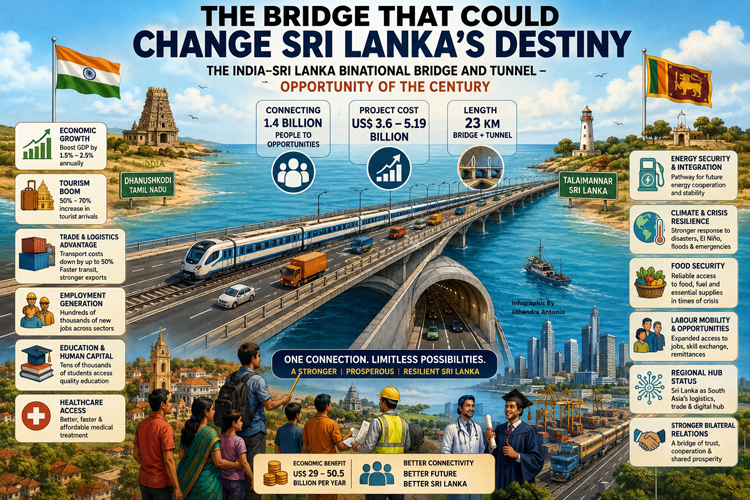
The proposed India–Sri Lanka Binational Bridge and Tunnel, stretching approximately 23 kilometres between Dhanushkodi in Tamil Nadu and Talaimannar in Sri Lanka, is often viewed through a narrow political lens. Critics focus on sovereignty concerns, migration fears, and environmental challenges. However, when evaluated through the broader framework of economics, trade, tourism, logistics, human capital, and national resilience, the project represents something much larger than a bridge.
It represents a strategic opportunity to fundamentally redefine Sri Lanka's economic future.
The project, estimated to cost between US$3.6 billion and US$5.19 billion, has been discussed in various forms for over a century. The concept dates back to 1860 and gained renewed momentum in the 2000s before feasibility discussions resumed between India and Sri Lanka in recent years. While Sri Lanka has currently paused advancement due to technical, environmental, and sovereignty considerations, the long-term economic logic behind the project remains compelling.
At its core, the bridge would connect Sri Lanka directly to the world's most populous nation and one of the fastest-growing major economies. India today represents a market of more than 1.4 billion people. For Sri Lanka, which has a population of approximately 22 million, the scale difference is transformational.
Tourism alone demonstrates the magnitude of the opportunity.
India consistently ranks among Sri Lanka's largest source markets for visitors. A permanent road and rail connection could significantly reduce travel costs while shortening journey times. Studies associated with the project have projected tourism increases of between 50 and 70 percent. This would not merely benefit hotels and airlines. The gains would flow across restaurants, transport operators, retailers, entertainment providers, and small businesses throughout the country.
Regions such as Mannar, Talaimannar, Jaffna, Anuradhapura, Trincomalee, and the Eastern Province could emerge as major tourism and logistics corridors, attracting both domestic and foreign investment. Religious tourism alone could become a powerful economic engine through integrated Ramayana, Hindu, Buddhist, and cultural heritage circuits spanning both nations.
However, tourism is only the beginning.
Perhaps the most significant benefit lies in logistics and trade.
Sri Lanka's economic vulnerability has repeatedly been exposed during periods of crisis. The economic collapse of 2022 demonstrated the dangers of supply chain disruptions, fuel shortages, and foreign exchange constraints. A permanent land connection would create an alternative logistics corridor capable of supporting the movement of food, fuel, medicine, industrial inputs, and essential goods during emergencies.
Project assessments suggest transport costs could be reduced by as much as 50 percent for certain categories of trade. Transit times that currently require days through maritime routes could potentially be reduced to hours. Lower logistics costs would improve competitiveness for exporters while reducing costs for consumers and businesses.
The bridge could also accelerate labour mobility and human capital development.
India possesses one of the world's largest higher education ecosystems, advanced healthcare infrastructure, and rapidly growing technology sectors. Enhanced connectivity would provide Sri Lankan students, professionals, entrepreneurs, and workers with unprecedented access to educational opportunities, specialized medical services, and employment markets.
Some projections associated with the broader connectivity vision suggest that hundreds of thousands of Sri Lankans could eventually benefit from expanded labour mobility while tens of thousands of students gain access to regional educational institutions. Rather than viewing this as a brain drain, policymakers should recognize the potential for knowledge transfer, remittance growth, and entrepreneurial development.
The bridge also carries important implications for energy security and climate resilience.
As climate change intensifies, nations will increasingly depend on regional cooperation to manage disruptions caused by extreme weather events, food insecurity, and energy shortages. A physical connection between India and Sri Lanka could support future energy integration, emergency response mechanisms, and more resilient supply chains.
Most importantly, the bridge would alter Sri Lanka's strategic position within South Asia.
For decades, Sri Lanka has attempted to position itself as a regional hub. Yet true hub status requires connectivity. Ports and airports alone are no longer sufficient in an increasingly integrated world. Economic corridors, logistics networks, digital infrastructure, and physical connections increasingly determine competitiveness.
Naturally, concerns surrounding sovereignty, border management, environmental protection, and demographic impacts cannot be dismissed. These issues require rigorous planning, bilateral agreements, advanced border controls, environmental safeguards, and transparent public consultation.
But history demonstrates that transformative infrastructure projects often face resistance before becoming engines of growth.
The real question is not whether challenges exist.
The question is whether Sri Lanka can afford to ignore a strategic opportunity that could reshape its economic trajectory for generations.
A bridge will not solve every problem facing Sri Lanka. No single project can.
However, by connecting the island directly to one of the world's largest markets, reducing trade costs, boosting tourism, strengthening resilience, and expanding opportunities for future generations, the India–Sri Lanka Bridge may ultimately prove to be one of the most significant investments ever considered in the nation's modern history.
The debate, therefore, is not about concrete and steel.
It is about whether Sri Lanka chooses to remain an isolated island economy or evolve into a connected regional gateway at the centre of South Asia's next phase of growth.

Jithendra Antonio
(The writer is a Consultant specialised in Data Analytics with a Special Focus on Sri Lanka’s Future Direction, and in the fields of Sustainable Energy, ESG, Investments and telecommunications. He can be reached at jithendra.antonio@gmail.com.)
Video Story