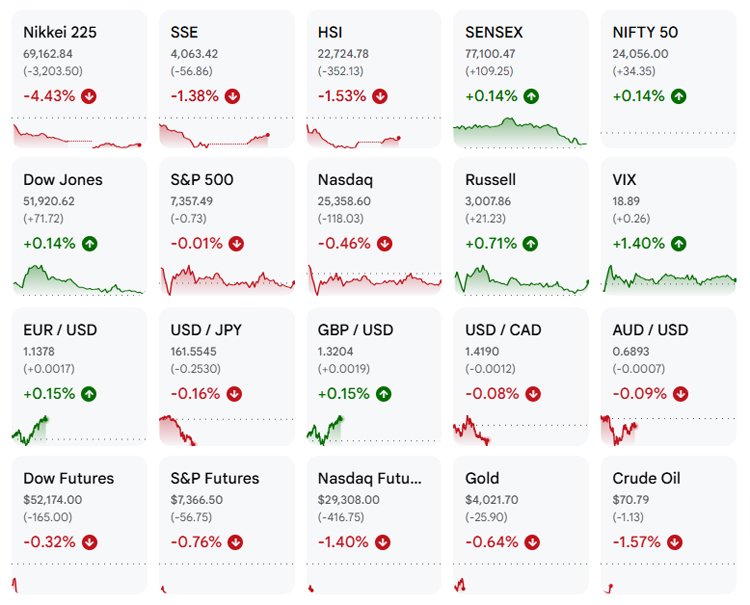
Reuters - Asian shares pulled back on Friday after a stellar quarter, as Apple's hefty price hikes revealed the downside of booming chip demand, while the threat of Japanese intervention kept the yen from hitting 40-year lows.
Oil prices fell toward their lowest in fourth months, with Brent crude futures down 1.9% to $73.9 a barrel, as
Saudi Aramco resumed oil loading at its Ras Tanura terminal after a halt of almost four months. More stranded oil tankers have crossed the Strait of Hormuz with the help of military escorts, although a
cargo ship was hit by a projectile.
Nasdaq futures tumbled 1.7% in Asia, as investor sentiment soured after a
media report that OpenAI is considering holding off on its public debut until next year. European bourses are bracing for a much lower open, with pan-region stock futures sliding 1%.
Shares of Apple
(AAPL.O), slid 6.1% overnight after the tech giant announced
price increases for iPads and MacBooks to counter the surging cost of memory and storage chips. That wiped about $250 billion off of its market value. Microsoft
(MSFT.O), is
raising prices for its Xbox gaming consoles by up to $150 worldwide.
The price increases tempered investor enthusiasm about a blowout earnings report from chipmaker Micron
(MU.O), this week, whose shares surged almost 16% overnight to a record high.
"Apple's price increases were a reflection of how the big tech may at some point start to feel the pain of these higher component costs, and that can become a broader ecosystem headwind," said Charu Chanana, chief investment strategist at Saxo.
"That is why markets are becoming more cautious. Higher input costs, heavier capex needs and rising funding demands are making investors more selective about AI exposure."
Analysts also say that month-end and quarter-end rebalancing flows might have contributed to the weakness and choppy prices in big tech companies, which have outperformed for much of the second quarter.
On Friday, MSCI's broadest index of Asia-Pacific shares outside Japan
(.MIAPJ0000PUS), fell 3.8%, bringing its weekly loss to 5.4%, as investors took profits from a record run. While it was down 3.7% for the month, the index was up a whopping 21% for the quarter.
Japan's Nikkei
(.N225), slumped 5% and was headed for a weekly drop of 3.6%. It has climbed 3.5% for the month and surged 34% for the quarter.
South Korea's KOSPI
(.KS11), tumbled 8.2%, triggering a circuit breaker that halted trading for 20 minutes. It was down 9.4% for the week, but still managed a monstrous 62% gain for the quarter.
Chinese blue-chips
(.CSI300), fell 2.9% and Hong Kong's Hang Seng index
(.HSI), lost 2.4%.
YEN WEAK
In the currency markets, the yen teetered near its weakest level against the dollar in 40 years at 161.73, well beyond the 160 level that many see as a line in the sand for Japanese authorities.
It found little relief even as a U.S.
inflationreading met forecasts and traders trimmed bets for a rate hike from the Federal Reserve in September.
Separate data also showed the
U.S. economygrew faster than previously estimated in the first quarter thanks to a downward revision to imports, but consumer spending almost stalled, casting doubt on growth momentum in the second quarter.
The dollar index , which measures the greenback's strength against a basket of six major peers, held at 101.46, not far from its strongest level since May 2025. It has risen 2.6% this month.
Treasury yields were steady on Friday after slipping a little overnight. 2-year yields held at 4.1250%, having eased 2 basis points on Thursday, while ten-year yields were little changed at 4.4020%, having hit a nearly two-month low of 4.3627% in the previous session.
Precious metals have had a rough month, with spot gold down 12% to $3,992 an ounce and spot silver sliding 25% to $56.3 an ounce.